MICROCOLLEGE:  The Thoreau College Podcast

MICROCOLLEGE: The Thoreau College Podcast

by Thoreau College
Douglas Haynes - Teaching Toward Slow Hope
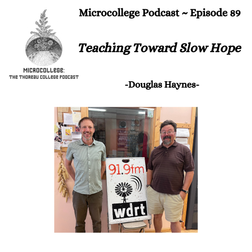
For this episode we welcomed Professor Douglas Haynes into the studio at WDRT in Viroqua to discuss his beautiful new book Teaching Toward Slow Hope: Place-Based Learning in College and Beyond, published this spring by Johns Hopkins University Press. Douglas teaches English at the University of Wisconsin-Oshkosh and also hosts the Monday sessions of "A Public Affair" on Madison's community radio station, WORT-FM. Teaching Toward Slow Hope traces how students and educators across the Upper Midwest are remaking college into a place for connection, meaning, and collective resilience. In the book, Douglas talks about his own teaching experiences at a regional public university and also shares four inspiring examples of place-based education at different colleges and universities in Wisconsin and Michigan, three of them public institutions. These stories and Douglas’ reflections about the role of higher education in the lives of young people today make this book both moving and highly practical for anyone working on the revitalization of higher education, whether they are inside an existing organization or starting something new. Douglas Haynes is a nonfiction writer, poet, and teacher. In addition to Teaching Towards Slow Hope, his 2017 nonfiction book Every Day We Live Is the Future: Surviving in a City of Disasters is a cautionary tale of urban inequality and the climate crisis that recounts two Nicaraguan families’ quests to reinvent their lives in Managua, one of the world’s most disaster-prone cities. Douglas’s essays and journalism have appeared in Orion, Longreads, Michigan Quarterly Review, Virginia Quarterly Review, The Progressive, Civil Eats, Boston Review, North American Review and dozens of other publications. Douglas grew up in Iowa and Illinois and studied at the University of Wisconsin-Madison and Southern Illinois University Carbondale. He went on to study literature and languages in Germany, Ireland, and Guatemala while working as a dishwasher, farmhand, freelance writer, and English teacher. He returned to WI to teach English at the University of Wisconsin-Oshkosh, as well as creative writing and environmental humanities. Teaching Toward Slow Hope - https://www.press.jhu.edu/books/title/53868/teaching-toward-slow-hope "A Public Affair" on WORT-FM - https://www.wortfm.org/tag/douglas-haynes/ Douglas' Personal Website - https://www.douglas-haynes.com/ Jacob Hundt & Grace Greenwald about microcolleges on WORT - https://rss.com/podcasts/thoreaucollege/2599918/ Driftless Field School on WORT - https://www.wortfm.org/teaching-eco-literacy-in-the-driftless-bioregion/ Northland Collaborative - https://northlandcollaborative.org/
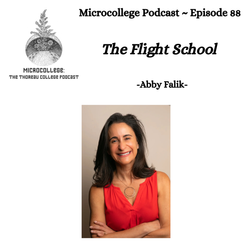
Abby Falik - The Flight School
For this episode of the podcast it was my great honor to speak with Abby Falik, one of the most articulate and passionate proponents of non-traditional developmental pathways for young adults in our time. Abby is a founder and futurist re-imagining how we animate, liberate and co-create. For two decades she has been a leading advocate and architect of a re-invented "gap year." In 2008 she founded Global Citizen Year (now known as Tilting Futures) and in 2022 she joined the Emerson Collective as an Entrepreneur in Residence to design a blueprint for taking the model to scale. A globally-respected entrepreneur and thought leader, she thrives at the interface where inner growth drives societal change. Her work has been featured in The New York Times, NPR and PBS, and she serves as a Fellow at Stanford and Advisor at Harvard Business School. In this fascinating conversation, Abby problematizes the concept not only of a "gap year," but also the very notion of "education." Instead of a school in any conventional sense, the Flight School School offers a globally networked community mentors and young people engaged in a yearlong Fellowship which "reimagines the gap year as a Launch Year—a rebellious rite of passage," setting the stage for adulthood in a rapidly transforming world. In the words of the Flight School website, "Through inner work, wise accompaniment, and immersive travel, Fellows are seen, stretched, and supported in asking: Who am I beyond my achievements? What breaks my heart? What lights me up? How do we build what comes next? Our campus is in the cloud. Our community spans continents. Our curriculum is rooted in relationship, ritual, retreat, and reflection. The Fellowship is our lab – and just the beginning. As a convener and catalyst, we’re taking what we learn and offering it freely—to anyone ready to fly." The Flight School - https://theflightschool.org/ Abby's Substack - "Taking Flight" - https://abbyfalik.substack.com/ Tilting Futures (Formerly known as Global Citizen Year) - https://tiltingfutures.org/ Thoreau College - https://thoreaucollege.org/
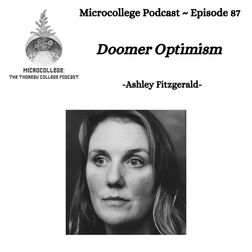
Doomer Optimism - Ashley Fitzgerald
In this special episode of the Microcollege Podcast, Ashley Fitzgerald and I interview each other for our respective platforms. Ashley is an environmental sociologist from Chicago who is co-founder of Doomer Optimism, which is a podcast, a Substack, and a growing eclectic community of people interested in localism, regenerative agriculture, cultivating meaning and community in the midst of technocracy, and generally seeking ways to imagine and build a hopeful future in spite of all the gathering doom and gloom. Ashley is also an educator in the microcollege vein - after a diverse education and young adulthood, Ashley and her husband Patrick relocated to Uruguay where they started the Rizoma Field School, which introduced American university students to rural life and the practice of sustainable agriculture in that country. She is now back in her hometown of Chicago, where she is raising her three children and continuing the work of the Rizoma Field School with high school students at the Chicago High School for Agricultural Sciences. Thank you, Ashley for a lovely conversation and for sharing it on our podcast! Rizoma Field School - https://rizomafieldschool.com/ Doomer Optimism Substack - https://substack.com/@doomeroptimism Doomer Optimism Podcast - https://doomeroptimism.substack.com/s/doomer-optimism-podcast Thoreau College - https://thoreaucollege.org/
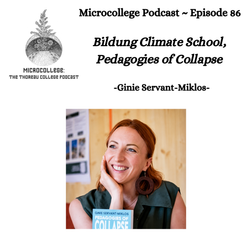
Pedagogies of Collapse - Ginie Servant-Miklos
On this episode we welcome back Ginie Servant-Miklos, founder and director of the Bildung Climate School in Rotterdam, the Netherlands, to check in on how this initiative has evolved and also about her recent book, Pedagogies of Collapse: A Hopeful Education for the End of the World as We Know it. The Bildung Climate School is in its third year and set to receive formal accreditation within Erasmus University Rotterdam, one of the great research universities of Europe. Deeply informed by the vision of "Bildung," the model of human development expressed in the Danish folk high schools, BCS seeks to empowers young people drawn from all sectors of post-secondary education in the Netherlands to "face sustainability challenges with resilience, creativity, and care" in the context of "an interdisciplinary learning community, combining science, hands-on skills, and personal development to prepare the next generation for a just and sustainable world." Ginie is an experienced experimental educator and a scholar with a broad range of expertise, as well as a passionate practitioner and promoter of martial arts. She pulls no punches in her book and in our conversation about the dire situation we are in as a species and about how challenging it is to be a young person coming of age today. But her message, and the mission of the Bildung Climate School, is ultimately about hope and an embrace of the most profound facets of what it means to be human. Her work and writing is deeply marked by her own life experiences and the ideas of her intellectual heroes, including Simone de Beauvoir, Paulo Freire, Viktor Frankl, and Hannah Arendt, whose work we discuss in this conversation. Ginie Servant-Miklos is an engaged environmental educator with fifteen years of experience in education practice, research, and advocacy. She currently holds an Associate Professorship with an Education Profile at the Erasmus School of Social and Behavioural Sciences in Rotterdam, The Netherlands. Her research and education work focuses on developing innovative pedagogies for societal impact. She developed the Experimental Pedagogics educational design framework, is the Director of the Bildung Climate School and the author of "Pedagogies of Collapse: A Hopeful Education for the End of the World as We Know It". She is a Leadership Fellow of the Comenius Network for educational innovators in the Netherlands. She is the founder and chair of the board of the FairFight Foundation, an organisation that provides girls and women from Zambia, Zimbabwe, and India with the mental and physical benefits of martial arts practice, as well as educational support. Ginie is a vocal activist for sustainability and gender equality, advocating for change through public engagements like TEDx talks, debates, podcasts, and other digital media outlets. Ginie obtained a Bachelor of Arts in Politics, Philosophy and Economics from the University of Kent, an LLM in International Law from Kent Law School, an MA in International Relations from Sciences Po Lille, a PhD in Education Philosophy and Psychology from Erasmus University Rotterdam, and a post-doctoral research grant in Sustainability Education from Aalborg University in Denmark. She was also a visiting professor in Experimental Pedagogics at Tyumen University in Russia. Bildung Climate School - https://www.bildungclimateschool.com/ Pedagogies of Collapse - https://www.bloomsbury.com/uk/pedagogies-of-collapse-9781350400498/ https://thoreaucollege.org/
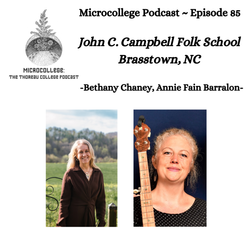
John C. Campbell Folk School - Bethany Chaney and Annie Fain Barralon
In this episode we learn about the John C. Campbell Folk School, located in Brasstown, North Carolina. Founded just over 100 years ago in 1925, the John C. Campbell Folk School was inspired by the Danish Grundtvigian folk high school tradition and established to serve the culturally distinctive, but economically depressed mountainous region of southern Appalachia. Today, it is one of the oldest and largest folk schools in North America and the guiding inspiration for dozens of younger folk schools around the country, including the Driftless Folk School here in Viroqua, Wisconsin. In this conversation I speak with JCCFS instructor and Programming Development Manager Annie Fain Barralon and Executive Director Bethany Chaney about this inspiring history and about what it is like to participate in a multi-day course in folk arts, craft, music, or dance on their beautiful campus in far western North Carolina. We talk about who attends and teaches these courses, as well as about opportunities for young people to spend longer periods at the Folk School such as their Work Study and Student Host programs (see links below). Finally, Annie Fain talks about what it is like to work as a creative artist in the context of a living folk arts tradition, walking the fine line between original innovation, cultural exchange, and loyalty to heritage. Annie Fain Barralon is a native of the crafts and music/dance community of Brasstown, North Carolina and the John C. Campbell Folk School's Programming Development Manager. She teaches a variety of classes at the school including book arts, clawhammer banjo, and several styles of dance–Appalachian clogging/flatfooting, English waltz clog, Northwest Morris, and Bal Folk (learned when she married into a French family). Annie Fain plays banjo and banjo uke for the all-woman string band, Blue Eyed Girl, and has danced with both Loafers Glory Clog Morris and the Green Grass Cloggers. She sells her handmade books, greeting cards, and original watercolors regionally and is a member of the Southern Highland Craft Guild. Bethany Chaney is Executive Director of the John C. Campbell Folk School. Prior to joining the Folk School, Bethany served more than 25 years in a variety of non-profit and public service roles, specializing in resource development, strategic planning, and community and economic development programming. She is an award-winning writer, a former NC Arts Council Fellow, and an avid maker of pine needle baskets, a craft she first nurtured as a Folk School student. In 2025 she was named by Country Living Magazine as a Top 100 Design Influencer as an arts advocate. John C. Campbell Folk School - https://www.folkschool.org/ JCCFS Work Study & Student Host Programs - https://www.folkschool.org/programs/student-host-and-work-study/ Find a Folk School near you! Folk School Alliance - https://www.folkschoolalliance.org/ Driftless Folk School - http://www.driftlessfolkschool.org/ Thoreau College - http://thoreaucollege.org/
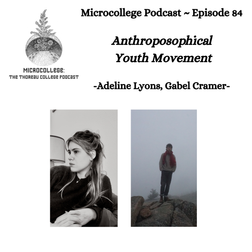
Anthroposophical Youth Movement - Adeline Lyons and Gabel Cramer
On this episode of the podcast we speak with Thoreau College alumna Adeline Lyons and her collaborator Gabel Cramer about the diverse activities of the Youth Section of the Anthroposophical Society in North America, including the upcoming Youth Conference to be held August 3-7, 2026 in Fair Oaks California with theme "Courage: From Initiative to Idea to Initiative." We also discuss other conferences and gatherings organized by the Youth Section and Futuring Now, their journal of essays, poetry, and artwork published in hard copy thrice yearly (please subscribe!). We also discuss Gabel and Adeline's life and work at Free Columbia (Philmont, NY) and the Threefold Youth CoLab (Chestnut Ridge, NY), two anthroposophical artistic and life sharing organizations in New York State that have appeared previously on the podcast. Join us for a refreshing conversation with two visionary young people taking the lead on curating spaces for deep conversation and creative work around questions of vocation, meaning, spirituality, and the deep work we are called to do in our time. Adeline Lyons lives and works in the Threefold Community outside of New York City. She is involved as community organizer and event planner, a coworker of the North American Youth Section, editor, writer, and stage artist. She received a degree in Creative Writing from UW-Madison, and is also an alumna of Thoreau College! She keeps a Substack: @writingaworld Gabel Cramer is the director of development at Free Columbia, a community arts initiative that weaves together creativity, artistic practice, accessibility, and education. Along with this, he is an organizing member of the North American Youth Section, helping to run the finances, put on conferences, and collaborate with other passionate young people. He is sometimes a musician, sometimes a potter and sculptor, and often busy cooking, growing plants, and undertaking fun projects. After getting a master’s degree in community development and planning, he has found great meaning in his work in the intersection of community, art, youth, education, and spirit, though often wondering how to bring it all into balance in his own life. For North American Youth Section: nayouthsection.org For Futuring Now: https://www.nayouthsection.org/initiatives-1/futuring-now For Courage conference: nayouthsection.org/courage To support the Courage conference: nayouthsection.org/donate Threefold Youth CoLab: threefold.org/youth Free Columbia Residency Program: https://www.freecolumbia.org/residency-program
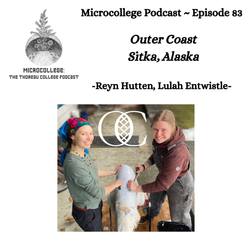
Reyn Hutten, Lulah Entwistle - Outer Coast, Sitka, Alaska
On this episode of the Microcollege Podcast we return for an update from one of the most inspiring success stories of the emerging microcollege movement. Rooted in the beautiful island community of Sitka, Alaska among the fjords and temperate rainforest of the southeastern panhandle of Alaska, Outer Coast is inspired by Deep Springs College and nourished by the unique cultural heritage of the Tlingit people of that region. Since 2015, Outer Coast has been developing as a peer and fellow traveler of Thoreau College, and now has launched a full 2-year undergraduate program granting academic credits through the University of Alaska Southeast suitable for an Associates Degree or transfer to a 4 year school. Join me as I speak with Outreach Lead Reyn Hutten and pioneer 2nd Year student Lulah Entwistle about entering higher education after growing up in a rural place, about the role of service learning in the context of tight knit local community, about the value of robust student self-governance, and about the impact of incorporating indigenous languages, storytelling, and culture into a full microcollege curriculum. Reyn Hutten is the Outreach Lead and periodic Summer Seminar Program Director at Outer Coast and has been in Sitka at Outer Coast for nearly 3 years. Hailing from the small island community of Wrangell, AK, Reyn is a long-time believer in (and beneficiary of) holistic, community-based, in-situ learning in southeast Alaska. She has focused on community building and education from many angles, including through her B.A. in ecology with a focus on the Arctic at Dartmouth College, as a field program coordinator, and as a ski and sea kayak coach. Reyn finds vibrance in many of life’s little moments but especially when moving her body outside, cooking, tinkering and connecting with people. Lulah Entwistle grew up homeschooled on a biodynamic farm in Middle Tennessee, where her family grew food to sustain themselves and ran a small CSA. When she is home, Lulah likes to ride her horses, play with the goats, and help on the farm. She is currently studying at Outer Coast and is in the process of finding a place to go next. For the past two years she has been walking around Sitka, listening to music and watching the mountains.
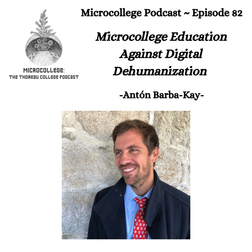
Antón Barba-Kay - Microcollege Education Against Digital Dehumanization
In this episode of the podcast, I spoke with Antón Barba-Kay, a philosopher and scholar whose life includes time as a student at St. John's College and as a professor at Deep Springs College. As a scholar, Antón has focused on exploring how the internet and digital technology in general have come to shape our inner lives and our experiences of reality. Rooted in classical and German philosophy, Dr. Barba-Kay engages with questions of aesthetics and interior formation as he articulates a view of digital technology as a "natural technology" - i.e. "a technology so intuitive as to conceal the extent to which it transforms our attention" and our sense of self. This has obvious implications for the design and practice of education, which Dr. Barba-Kay is uniquely placed to explore. Antón Barba-Kay is a fellow at the Carr-Ryan Center at the Harvard Kennedy School, a senior fellow at the Institute for Practical Ethics at UC San Diego, and a distinguished fellow at the Center on Privacy & Technology at Georgetown Law. He received a B.A. from St. John’s College, a B.A. in classics from Cambridge University, and a PhD from the Committee on Social Thought at the University of Chicago; he has been (tenured) Associate Professor of Philosophy at Catholic University and taught at Deep Springs from 2020-24 (two of those years as Robert B. Aird Chair of Humanities). In addition to his scholarly publications in nineteenth-century German philosophy, his essays about culture and technology have appeared in The New Republic, The Atlantic, The New Atlantis, Dissent , The Hedgehog Review, and The Point, among other magazines. A Web of Our Own Making: The Nature of Digital Formation –his book about what the internet is and what a difference it makes–was published in 2023 by Cambridge University Press. A Web of Our Own Making: The Nature of Digital Formation - https://www.cambridge.org/core/books/web-of-our-own-making/92F7F830EBEC409F05A526E64DDD1D9D Deep Springs College: https://www.deepsprings.edu/ St. John's College: https://www.sjc.edu/
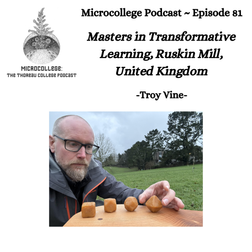
Troy Vine - Masters in Transformative Learning, Ruskin Mill Centre, United Kingdom
On this episode we chat with Dr. Troy Vine with the Ruskin Mill Centre for Practice in the United Kingdom about a new Master of Arts program in Transformative Learning that will be launching this fall, offering a unique opportunity to explore the contemplative model of science pioneered by Johann Wolfgang von Goethe and practiced by Henry David Thoreau, Rudolf Steiner, and other out-of-the-box thinkers. Not only is this a different, more holistic way of doing science - it is also a pathway to inner transformation. After gaining a doctorate in particle physics from University College London, Dr. Troy Vine became interested in Goethe’s theory of colour. Studying with leading authorities on the topic, he has published extensively on Goethe’s colour science, both as writer and as editor. With artist Nora Löbe and physicist Matthias Rang he wrote the book Seeing Colour: A Journey Through Goethe’s World of Colour, published by Floris Books in 2022. Troy is in the final stages of a second doctorate, this time in philosophy, at the Humboldt University of Berlin, with a thesis focusing on the history and philosophy of Goethe’s colour science. Troy has taught Goethean colour science and the history and philosophy of holistic science more generally for over two decades, including at Schumacher College, where he was programme lead for MSc Holistic Science. Troy has recently drawn on this experience to design a MA programme in Transformative Learning for the Ruskin Mill Centre of Practice, that will begin this coming autumn. MA in Transformative Learning - https://rmcp.org.uk/ma-in-transformative-learning/ Seeing Colour: A Journey Through Goethe's World of Colour: https://www.florisbooks.co.uk/blog/2024/02/19/seeing-colour-a-journey-through-goethes-world-of-colour/ Thoreau College: https://thoreaucollege.org/
A Public Affair w/ Douglas Haynes on 89.9 WORT FM -- The State of the Microcollege Movement
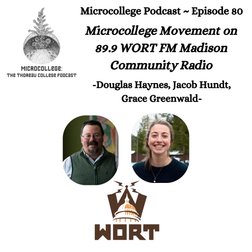
This is the 80th episode of the Microcollege podcast! To celebrate this milestone, we would like to do something a little different. For this episode we will be sharing an interview that took place live on WORT 89.9 FM, Madison, Wisconsin’s community radio station. On February 2, Douglas Haynes, host of the WORT show “A Public Affair," interviewed me and Grace Greenwald of the Springboard Foundation about the state of the microcollege movement, including the origins and development of Thoreau College. Douglas was a great interviewer and this conversation serves as a reintroduction for myself and Thoreau College, as well as a status update on how things have changed in the past 3 and a half years, since the Microcollege podcast started on Henry David Thoreau’s birthday in July 2022. This podcast has proven to be an fun and amazingly effective way to explore, articulate, and promote this emergent model of education and the people and organizations who are making it happen. I have made connections with people and ideas that have informed my practice as an educator and organizational leader. The podcast has helped Thoreau College connect with new students, instructors, funders, and collaborators and has contributed to the formation of networks and gatherings of allied organizations, scholars, and educators, such as the International Folkmode for Educators in Denmark in 2025 and the now annual summits of the Nunnian Consortium, most recently here in Wisconsin in January 2026. Most exciting of all, I have increasingly begun to hear from ambitious educators and dreamers who tell me that the stories and examples shared on the Microcollege podcast are helping to inspire and inform their own plans to establish new holistic, humanly scaled educational programs on the microcollege model at locations around the world. This is so exciting and it makes this work seem ever more important and timely. In the past three and half years the sense of crisis in higher education and beyond has accelerated and deepened. Many legacy liberal arts colleges and smaller public campuses have closed, merged, or dramatically restructured during this time and the rapid emergence of Artificial Intelligence and other powerful digital technologies have cast many aspects of education, culture, and life in general into disarray. I feel so grateful to have this outlet as a platform for thinking about these complex times alongside creative and inspiring people who are crafting ambitious and original responses. Thank you to everyone who has been listening to these conversations - and also thank you to Liam McGilligan, the faithful producer of this show. To mark this 80th episode, please take a moment to leave a comment on the platform you use to listen to the show or send an email to me at admin@thoreaucollege.org to say what you appreciate about the show and/or what you would like to hear more about. That would be so exciting and inspiring for us! WORT FM: https://www.wortfm.org/ Springboard Foundation: https://www.springboardlife.org/ Thoreau College: https://www.thoreaucollege.org/
1 of 9