Progress in Practice – A Sustainability Podcast

Progress in Practice – A Sustainability Podcast

by Go Well Consulting
Season 1
Nature Baby: One Garment. Eight Children. Nature Baby's Circular Fashion Revolution
What does a circular economy actually look like in practice for a children's clothing brand? Not in theory. Not in a strategy document. But in the messy, energising, sometimes frustrating reality of running a retail brand — managing teams, navigating logistics, and trying to change the way your customers think and behave? That's the question at the heart of this episode, and Jacob Faull answers it with remarkable honesty. Jacob is the co-founder of Nature Baby, a New Zealand-born children's clothing label he started with his wife Georgia about 25 years ago — born out of frustration at not being able to find organic, natural clothing for their first child. Today, Nature Baby operates stores in Auckland, Wellington, and Sydney, works with over 80 stockists across Australia and the United States, and manufactures its garments using certified organic cotton from India and ZQ-certified merino from Australasia. It's a brand built slowly, deliberately, and with genuine care — and it shows. The initiative at the centre of this conversation is Worn Again — Nature Baby's circular takeback program. Customers return their pre-loved Nature Baby garments in exchange for store credit. Those items are assessed, cleaned, and sent back out into the world: resold, donated, repaired, or recycled, depending on their condition. Simple in concept. Genuinely hard in practice. Jacob walks us through all of it — the lightbulb moment that came from hearing a single garment had been worn by eight different children, the surprising fibre science behind why Nature Baby products last so much longer than typical children's clothing, and the very human challenge of asking customers to change habits they've had their whole lives. He's refreshingly candid about the numbers. Their current return rate sits at around 1.5% — lower than the 8% benchmark they were aiming for, and a long way from the 12% Jacob had hoped for. But 90% of what does come back goes straight to resale. And each month, slowly, the numbers grow. In this episode, Nick and Jacob cover: Why Nature Baby's organic fibres make their garments uniquely suited to multiple lives The full circular hierarchy: resale first, then donation, repair, and recycling as a last resort What it actually took to get the whole team — product, merchandise, retail, marketing, digital — aligned and energised around a program that adds real workload Why inspiring customers to participate is just as hard as solving the logistics What Worn Again content does to their social media engagement — and the interesting gap between what people like and what they buy The plan to launch online returns and scale the program beyond the in-store experience Jacob's long-term vision: a fully pre-loved, standalone Nature Baby community store What makes this conversation genuinely worth your time isn't just the initiative itself — it's the way Jacob talks about it. For anyone thinking about what circular economy could actually mean for their own business — or anyone who just wants to hear from someone doing something that matters and doing it with integrity — this one's for you. To find out more about Nature Baby and the Worn Again program, visit https://www.naturebaby.co.nz/pages/worn-again. To learn more about Go Well Consulting and how we work with businesses on sustainability strategy and reporting, visit https://gowellconsulting.co.nz/.
NZ's Flooring Waste Was Going to Landfill. Jacobsen Spent 6 Years Fixing That
Every year, thousands of square metres of flooring are ripped up from offices, hospitals, schools and commercial buildings across New Zealand — and the vast majority of it ends up in landfill. It's a quiet but significant waste problem that most people in the construction and fitout industry simply accept as the cost of doing business. Jacobsen didn't accept it. In this episode of Progress in Practice, host Nick Morrison speaks with Cynthia Tang, General Manager of Marketing, Technology and Impact at Jacobsen, about Re.form — the company's product stewardship and takeback program that has been running since 2020. Re.form collects discarded vinyl, carpet tile and rubber flooring from Jacobsen customers and sends it back through the supply chain to manufacturing and recycling partners in Europe, where it is processed back into new flooring products. It is a genuine closed loop recycling solution — and one of the most ambitious sustainability initiatives being run by a New Zealand flooring business today. But the story of Re.form is not just about what the program does. It's about what it took to build it. Over six years, Cynthia and the Jacobsen team have navigated a remarkable set of obstacles: convincing architects, specifiers and flooring contractors to change their on-site habits; discovering that PVC vinyl is classified as hazardous waste under export regulations, making it illegal to ship overseas in its flooring form; spending nine months searching for a granulating partner who could process the PVC into raw material pellets before export; applying for Auckland City Council waste minimisation funding to purchase their own granulator; and then, just as that funding was approved, being approached by an unexpected granulating partner who changed the plan entirely. The entire business rallied around a program that, by Cynthia's own admission, was never designed to be a money-making or customer acquisition tool — just the responsible thing to do. Key topics covered in this episode: What Re.form is and how the closed loop flooring recycling system works The supply chain partners behind the program — Tarkett and Shaw Contract — and their global recycling infrastructure The role of architects, specifiers and flooring contractors in making product stewardship programs succeed How the Green Star framework and shifting client expectations are driving greater demand for end-of-life flooring solutions The hazardous waste export regulation challenge that nearly stopped the program in its tracks The nine-month search for a PVC granulating partner — and the unexpected resolution The real-world logistics of running a takeback program: sorting days, bag management, freight efficiency and quality control How Jacobsen prioritises reuse before recycling, including partnerships with Habitat for Humanity and projects like the Auckland Airport temporary terminal The science and challenge of closed loop recycling — including a visit to Tarkett's R&D facility in Sweden Advice for other New Zealand and Australian businesses looking to launch their own takeback or product stewardship programs Re.form is proof that sustainability leadership in business is rarely a straight line. It takes resilience, creativity, whole-of-business commitment. To find out more about Jacobsen and the Re.form program, check it out here. To learn more about Go Well Consulting and how we work with businesses on sustainability strategy and reporting, visit our website.
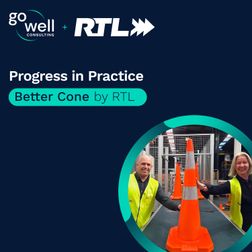
NZ's Road Cones Were All Going to Landfill — Until RTL Did Something About It
Road cones. New Zealanders love to hate them. But until recently, when they wore out, they went straight to landfill. RTL decided to change that — and built the country's first fully closed-loop cone recycling programme to prove it. Road cones are one of New Zealand's most visible — and most complained about — pieces of infrastructure. Media coverage, talkback radio, and even politicians regularly weigh in on the sheer number of them lining our roads. But love them or loathe them, they serve a vital purpose: protecting road workers and the public during maintenance and infrastructure projects. The real problem isn't the cones themselves. It's what happens to them when they're damaged, worn out, or forgotten. Until recently, the answer for most cones was simple and wasteful — landfill. RTL decided to change that. Better Cone is New Zealand's first dedicated road cone recycling programme — a fully closed-loop system that takes cones from any manufacturer, shreds them into chip, and remanufactures that material into the base of brand new cones. Nothing goes to landfill. The programme is nationwide, price-competitive, and already gaining serious traction: since launching in July 2024, Better Cone has diverted over 1,500 cones from landfill — with 620 returned in February 2025 alone. That's seven tonnes of polyethylene kept out of the environment and back in circulation. In this episode, host Nick Morrison sits down with Joanne McMahon, General Manager of RTL, to hear the full story behind Better Cone — from first idea to market. It's a candid conversation covering: How the programme works, and the stakeholders who made it possible The two-and-a-half year journey from concept to launch, including six months of manufacturing trials The emotional and commercial realities of pushing forward through New Zealand's economic downturn How RTL cracked the pricing challenge — and why the two-for-one return model has been key The unexpected morale boost the initiative has given the RTL team What Joanne would do differently, and what the future of Better Cone looks like This is a story about sustainability, yes — but it's also a story about leadership, resilience, and what happens when a team refuses to follow the easy path. Progress in Practice is a Go Well Consulting series profiling the real-world initiatives being brought to market by the businesses we work with — the good ideas, the hard work, and the honest lessons learned along the way. To find out more about Better Cone, visit RTL's website via the link below. Better Cone To learn more about Go Well Consulting and the themes we explore in this series, visit our website linked below. Go Well Consulting
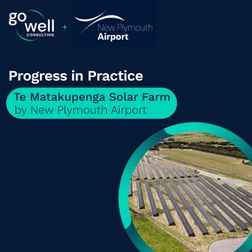
Small Airport, Big Solar Farm – New Plymouth's Renewable Energy Story
A small regional airport. A 15-hectare solar farm. 96% of the electricity going straight to the national grid. This is what commercial ambition meets community purpose looks like. What does it take for a regional airport to become a significant contributor to New Zealand's renewable energy grid? New Plymouth Airport CEO David Scott has a practical answer: vision, commercial discipline, and a willingness to take the harder road. Over the past two and a half years, the airport has developed Te Matakupenga — a 12 megawatt solar farm generating approximately 14,700 megawatt hours annually. The airport uses just 4% — the rest goes to the grid, with a portion sold at a discounted rate to the local council via Ecotricity. This is more than an energy project. It's a story about what's possible when an organisation decides to own the entire process. In this episode, host Nick Morrison talks with David Scott about: How the project evolved from a post-COVID income diversification strategy into something much more meaningful The structure of the airport's private power network and how tenants, hangars, and rental car operators all benefit The Battery Energy Storage System (BESS) coming online in the next few weeks — and what it means for energy resilience Why the farm was built at a scale far beyond the airport's own needs, and the commercial logic behind selling to the grid The partnership with Ecotricity and how the local council is now buying discounted renewable power generated at the airport EV charging infrastructure already powered by the solar farm — and how the airport has future-proofed for electric rental car fleets The role of Puketapu Hapū as mana whenua, and how they helped shape the vision and name of the project The emissions story — 1,500 tonnes of CO2 equivalent avoided annually, with a carbon payback period of just three and a half to four years Why fixed panels were chosen over rotating ones, and how sheep grazing between the panels solves a land management challenge The financial payback timeline of seven to ten years — and what future battery storage investments could mean for the bottom line What it would look like for electric aircraft to one day charge from the farm — and why that's closer than you might think What makes this conversation particularly compelling is David's refreshing honesty. This project started as a commercial decision, and it remains one. But along the way, it became something the whole community can be proud of — a model for how regional infrastructure can lead the way on New Zealand's energy transition. New Plymouth Airport may not be a large organisation, but Te Matakupenga is a large statement about what's possible when you decide to take the harder road. Progress in Practice is a Go Well Consulting series profiling the real-world sustainability initiatives being brought to market by the businesses we work with — the good ideas, the hard work, and the honest lessons learned along the way. To watch this podcast episode and for others, check us out on YouTube here. Click here to find out more about the New Plymouth Airport solar project. To learn more about Go Well Consulting, visit our website here.
Turning Old Clothes Into Biochar – A Circular Fashion Breakthrough
What happens to a garment when it truly reaches the end of its life? For most fashion brands, the answer is landfill. For Wellington-based label Kowtow, the answer is something far more ambitious: transform it into biochar, and put it back into the earth. In this episode of Progress in Practice, Go Well Consulting's Nick Morrison sits down with Emma Wallace, Managing Director of Kowtow, to explore one of the most genuinely innovative end-of-life solutions we've seen in the New Zealand and Australian fashion industry. Kowtow — a label built from the ground up on fair trade organic cotton and ethical manufacturing — has completed the first trial of their biochar initiative as part of what they now call the Regenerate Programme. By heating returned garments in a retort kiln through a process called pyrolysis, they are transforming 100% organic cotton clothing into a carbon-rich biochar that, when activated with seaweed tea and mixed into soil, sequesters carbon, supports water retention, and provides a home for beneficial soil microorganisms. This isn't a PR stunt or a future aspiration. The trial has been run, the biochar has been tested, the tomatoes in the Kowtow workroom grew measurably taller. This is real. Emma walks Nick through the full picture — from the founding philosophy that has guided Kowtow for two decades, to the grassroots partnerships with a Hokianga farmer and a local biochar distributor that made the trial possible. Together, they unpack why this initiative matters well beyond the fashion industry, and what it means for any business grappling with the genuine hard work of circular economy implementation. Key topics covered in this episode: What biochar is, how it's made through pyrolysis, and why it's a powerful soil amendment How Kowtow's Regenerate Programme collects, decommissions, and prepares end-of-life garments for biochar conversion The science behind carbon sequestration — and why biochar outperforms composting for locking carbon into the soil Kowtow's 20-year journey through circular economy principles: from organic cotton selection, to plastic-free garment redesign, to repair and resale, and now biochar The grassroots partnerships — including a Hokianga farmer and The Good Carbon Farm — that made the trial possible The commercial realities of sustainable fashion and what product stewardship really costs a small business The potential for the initiative to scale and attract industry partners Why small cultural shifts — like switching from pens to pencils — matter in building an organisation that can solve hard problems Whether you're a sustainability professional, a business leader exploring circular economy models, or simply someone who cares about where your clothes end up, this episode is a masterclass in what it looks like to keep pushing when you could have stopped. To watch this episode on Youtube check it out here. To learn more about Kowtow and the Regenerate Programme, visit their website. And to find out how Go Well Consulting can help your organisation navigate its own sustainability journey, visit the Go Well Consulting website here.