Integrate This! Ed Tech Podcast

Integrate This! Ed Tech Podcast

by David Berner and Jeremy Mikla
Season 1

After Math: What Matters When the Numbers Don’t | Ted Dintersmith

What happens when the numbers we use to define success in school don’t actually measure what matters most? Jeremy Mikla and David Berner are joined by education advocate, author, filmmaker, and former venture capitalist Ted Dintersmith for a provocative conversation about what schools prioritize—and what students actually need for life beyond the classroom. Drawing from his book Aftermath, Ted challenges the continued emphasis on math procedures that technology can perform instantly and argues for greater attention to ideas students will actually use: probability, statistics, estimation, algorithms, data, and decision-making. The conversation expands from math into the larger purpose of school. Ted reflects on visiting 200 schools across all 50 states and the “bright spots” he found where teachers are trusted, students have agency, and learning is connected to genuine purpose. He discusses career-based learning, his documentary Multiple Choice, alternatives to the college-for-all pathway, the pressure created by elite college admissions, and why he questions the influence of standardized test scores on education. Along the way, Ted offers a simple but powerful reminder: when students are engaged, they learn. Resources mentioned in this episode: Ted Dintersmith — https://www.teddintersmith.com/ Aftermath — https://www.aftermaththebook.com/ Multiple Choice — https://www.multiplechoicefilm.com/ What School Could Be — https://www.teddintersmith.com/what-school-could-be Most Likely to Succeed — https://www.whatschoolcouldbe.org/most-likely-to-succeed

Dr. Nadine Ebri: Long-Division Rap, Building an App, and Starting a Ripple Effect

Dr. Nadine Ebri, CEO of Ebri Education and a 2026 Presidential Leadership Scholar, joins the podcast to share how working with her daughter after an autism diagnosis led her to build an app called Free Indeed, designed to track development and give other parents tools to support their kids at home. Nadine also talks through her Presidential Leadership Scholars project, The Ripple Effect, which trains college students to bring AI literacy to older adults in their communities so no one gets left behind, and her journey from reluctant teacher to Duval County Teacher of the Year finalist, including the long division rap video with her students that went on to rack up over 20 million views. She also shares how she built and led a district-wide Minecraft Education lab focused on cybersecurity and AI. https://ebrieducation.org/ 0:00 – Intro & welcome 1:05 – Nadine's journey: from reluctant teacher to "how do you want to learn?" 6:23 – The leap from classroom to Minecraft Education and beyond 23:35 – How the Duval County Minecraft Lab got started 25:16 – Biggest takeaways from Minecraft Education 28:05 – Building "Free Indeed" with her daughter 32:42 – Becoming a Presidential Leadership Scholar 34:01 – The Ripple Effect: fighting AI scams and building literacy in older adults 45:39 – Lightning round 50:10 – This or that 51:06 – Where to find Nadine & closing thoughts

Conversation from the Educators AI Summit | Jon Laven of Snorkl

Jeremy catches up with past Integrate This! guest Jon Laven from Snorkl at the Educators AI Summit at Saint Mary’s University of Minnesota. In this quick conversation, Jon shares what’s new with Snorkl and how the platform is helping students explain their thinking and receive immediate AI-powered feedback without allowing AI to do the thinking for them. They also discuss cognitive offloading, student voice, purposeful screen time, new Snorkl features including Activity Sets and an upcoming PhET integration, and why asking students to verbally explain their learning can provide educators with a much richer picture of understanding. Jon also shares the Snorkl activity he recommends educators try first and why a classroom full of students talking about their thinking can be a pretty powerful thing. Learn more at snorkl.app.
Season 1

Straight Outta Compton: Student Ingenuity, Collaboration & Opportunity with Jose Gonzalez

Jose Gonzalez, a 21st Century Learning Specialist at Compton Unified School District, joins the podcast to share years of hands-on, project-based learning with his students, from building aquaponics systems on trucks and ships to designing a scaled-down interstellar mission in collaboration with a school in Brazil. He talks through how normalizing failure, giving students real problems to solve, and stepping back as "sage on the stage" builds confidence, communication skills, and genuine expertise in his students, many of whom have gone on to present their work on national TV and international stages. Jose also shares stories from taking students to Hawaii and Denver, working through shipping disasters and last-minute repairs, and previews his next big idea: launching student-built can satellites. Stick around for the lightning round, including his class's team song. Connect with Jose: Jose Gonzalez | LinkedIn Explore the Davis MS Projects Here: https://docs.google.com/document/d/1alhJOSTPOIC-ol0cdJpSNjtxfFcfHx9XiHoQJPjgeKk/edit?tab=t.0 0:00 – Intro & welcome 1:01 – Jose's path from Cuba to teaching in Compton 3:55 – What drives him to teach in Compton 5:33 – Why project-based learning works 10:02 – The Infy Makers Award and what it made possible 18:31 – Taking students to Hawaii 25:34 – The ISTE presentation and the Brazil spacecraft project 38:27 – Advice for teachers wanting to try this 43:57 – What's next: student-built can satellites 47:00 – Lightning round & this-or-that

Better Learning, Not Just Better AI | Dan Fitzpatrick

AI is changing quickly—but better technology doesn’t automatically mean better learning. In this episode of Integrate This! EdTech, Jeremy Mikla and David Berner sit down with Dan Fitzpatrick, The AI Educator, fresh off the 2026 Back to School AI Summit, to talk about where AI in education is headed and what educators should be paying attention to right now. The conversation moves beyond the basics of “What is AI?” and into the much harder question: How do we think with machines without losing our ability to think without them? Dan shares his perspective on the growing research around AI and student learning, why AI literacy matters, and how the way students use AI may be far more important than simply whether they use it. The conversation also explores the role of student voice, the importance of giving teachers practical strategies they can use immediately, and why schools need to balance the risks of AI with the opportunities it can create. Dan also takes us behind the scenes of the Back to School AI Summit, discusses the rapid evolution of AI agents, and shares the thinking behind The Educator’s AI Guide 2027—a practical, educator-driven field guide designed to help teachers turn ideas into action. Plus, stay for the lightning round to hear about Dan’s personal team of AI agents, his favorite places in the United States, the word he hopes defines his work in education, and the very personal reason AC/DC is his keynote walk-up music. In this conversation: • Moving from AI awareness to meaningful classroom practice • Using AI without outsourcing student thinking • What emerging research tells us about AI and learning • AI literacy for teachers and students • Student voice in AI policies and decisions • Why practical, teacher-led professional learning matters • Balancing AI safety with opportunity • The accelerating pace of technological change • AI agents and what may be coming next • The Educator’s AI Guide 2027 • Amplifying the voices of classroom educators RESOURCES 🔗 The AI Educator: https://theaieducator.io/ 🔗 The Educator’s AI Guide 2027: https://aieducator.tools/2027-educators-guide 🔗 Back to School AI Summit: https://summit.aieducator.tools/

Girls Who Game, A.I., & Empathy: Rethinking EdTech with Dr. Nekia Becerra
Dr. Nekia Becerra — Education Strategist at Dell Technologies and former classroom teacher, campus administrator, and district leader — joins David Berner and Jeremy Mikla on the Integrate This! EdTech Podcast to talk about what actually matters as AI transforms K-12 education: empathy, design thinking, and preparing students for jobs that don't exist yet. Nekia shares her journey from fourth-grade math teacher to Dell's Global Skilling Program, breaks down the Girls Who Game initiative (built with Microsoft, Intel, and Dell using Minecraft for Education), and explains why "failing fast" and productive struggle are essential skills for both students and teachers navigating AI in the classroom. 🎙 Integrate This! EdTech Podcast is hosted by David Berner and Jeremy Mikla, exploring AI, edtech tools, and instructional strategy for K-12 educators and district leaders. Connect with Dr. Nekia Becerra LinkedIn: https://urldefense.com/v3/__https:/www.linkedin.com/in/nekia-t-becerra/__;!!LpKI!jFAhw8KyLaz57cZyvj9nF7MLsPoitMa69BYszxUl9HUDpgTTRbs3PZFQ-RWkUxnZ1yzUAaGgpRg$ Girls Who Game: https://www.dell.com/en-us/lp/dt/girls-who-game Tech Career Circuit: https://techcareercircuit.discoveryeducation.com/ "The best career path isn't always a straight line" (TED Talk) [ted.com]: https://www.ted.com/talks/sarah_ellis_and_helen_tupper_the_best_career_path_isn_t_always_a_straight_line

Human First, Tech with Purpose: Voice, Collaboration, and Better EdTech | Zareen Levien
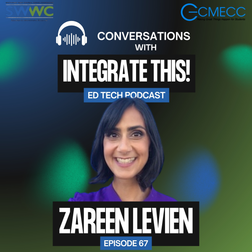
What happens when we put the human side of learning first and use technology with purpose? In this episode of Integrate This!, Jeremy and David are joined by Zareen Levien, Principal Educator at Padlet, for a conversation about student voice, collaboration, AI, and what better EdTech should actually look like. Zareen shares her journey from the tech world at Yahoo to the classroom, instructional coaching, district leadership, and eventually Padlet. Along the way, the conversation explores why technology should augment—not replace—the relationships and interactions that make learning meaningful. They discuss avoiding EdTech tool fatigue, creating safe and welcoming digital learning spaces, giving every student meaningful ways to participate, and challenging the “myth of the independent learner.” Zareen also shares her perspective on AI in education, including why students need adults talking with them about AI rather than simply restricting access to it. The conversation wraps up with practical Padlet ideas for classroom community, peer feedback, younger learners, multimedia creation, and more—plus the Integrate This! lightning round. Resources: Padlet: https://padlet.com Padlet Learning Resources: https://padlet.tv Zareen on LinkedIn: https://www.linkedin.com/in/zareen-poonen-levien-m-ed-786817/

IntegratED's 7 Pathways to Student Engagement: Megan Diede & Kara Rigsby
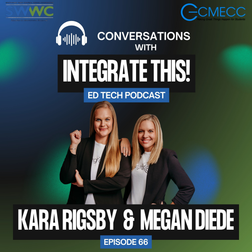
Megan Diede and Kara Rigsby, co-founders of Integrated Edu, join the podcast for a deep dive into their framework for student engagement. They share how a casual "let's start running together" turned into a business partnership, and break down their core philosophy that engagement is an outcome, not a strategy, built through purposeful design, consistency, and connection (their "3 C's"). Megan and Kara walk through the seven pathways to learning (from movement to visual arts to storytelling), why they push back on traditional small-group centers and worksheet-heavy instruction, and how teachers can start with small, 1% shifts instead of overhauling everything at once. They also talk about their book, Elevated Educator, their podcast, and where their "Integrated" name really comes from. Checkout their work: integratedk12.com Get the book: https://a.co/d/0bZMy2kP

Jeremiah Frink (Dell) on Data Dunkers, AI, and Teaching Kids to Think Critically
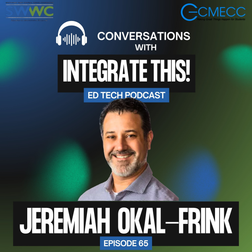
Jeremiah Frink spent 20 years in public education, from elementary teacher to district administrator, before moving to Dell as an education strategist. He joins the podcast to talk about Data Dunkers, Dell's program that teaches data and AI literacy through basketball stats from the WNBA and NBA, and the ISTE + ASCD Innovator Challenge, where student teams use AI to tackle real problems in their communities. Jeremiah breaks down why data literacy keeps getting treated as a one-off unit instead of something woven through every subject, what "classroom-ready AI" actually looks like beyond just prompting, and how brainstorming and design thinking can be taught as real, learnable skills. He also shares candid conversations with his own five kids about AI, screen time, and what it means to stay a lifelong learner. Stick around for the lightning round, including his walk-up song and this-or-that round. Connect with Jeremiah Frink, Dell Technologies K-12 Education Strategist, on LinkedIn: https://www.linkedin.com/in/jeremiahfrink/ Dell Data Dunkers: A hands-on educational program that combines basketball, coding, and data analytics to help students build foundational AI and data literacy skills. http://datadunkers.ca/ Girls Who Game: An extracurricular initiative designed to empower young women and underserved students to build critical STEM, leadership, and collaboration skills through esports and Minecraft Education design challenges. http://dell.com/en-us/lp/dt/girls-who-game Dell Student TechCrew: A student-led IT help desk program that promotes career readiness by empowering students to earn industry-recognized technology certifications while supporting their district's daily tech needs. http://dell.com/en-us/lp/dt/student-techcrew

Less Noise, More Coherence: Keeping Teachers at the Center of EdTech | Dr. Gene Kerns

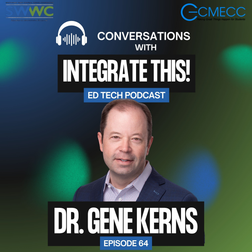
How can schools take advantage of powerful technology without adding more noise to an already crowded instructional landscape? In this episode of Integrate This!, Jeremy and David sit down with Dr. Gene Kerns, Chief Academic Officer at Renaissance, to explore what effective educational technology should really accomplish. Gene shares his journey from the classroom to more than 20 years with Renaissance and explains a principle that continues to shape his thinking about EdTech: technology should support teachers, not supplant them. The conversation dives into instructional coherence—making sure assessments, curriculum, intervention, instructional resources, and technology actually work together rather than becoming disconnected pieces teachers have to assemble themselves. Gene also discusses personalized learning, using assessment data to determine “what’s next,” the growing role of AI behind the scenes, and why teachers must remain the ones making the final instructional decisions. They also tackle the ongoing debate around student screen time and why the conversation should focus not simply on the amount of technology students use, but on the quality and purpose of that use. And, of course, Gene faces the Integrate This! lightning round, where things wander from school leadership to television, becoming an ordained minister, 80s music, and whether he’d rather head to the mountains or the beach. In this episode: • Keeping teachers at the center of educational technology • “Supporting, not supplanting” teachers • Personalized learning vs. learning that is more personalized • Instructional coherence across curriculum, assessment, and intervention • Turning assessment data into meaningful next steps • Connecting supplemental resources to what teachers are actually teaching • AI as a “24/7 digital teaching assistant” • Quality vs. quantity when thinking about student screen time • The future of Renaissance Intelligence Resources & Links 🔗 Renaissance: https://www.renaissance.com/ 🔗 Renaissance Intelligence: https://www.renaissance.com/renaissance-intelligence/ 🔗 Renaissance Webinars: https://www.renaissance.com/resources/webinars/ 🔗 Renaissance Blog: https://www.renaissance.com/resources/blog/ 🔗 Dr. Gene Kerns on LinkedIn: https://www.linkedin.com/in/gene-kerns-8bbb8014/ 🎧 Integrate This! is a podcast exploring educational technology, effective instruction, and the ideas shaping teaching and learning.
1 of 10