Empathy Unbound: AI, Philosophy, and Human Connection

Empathy Unbound: AI, Philosophy, and Human Connection

by Andrew Phipps
"Green Hushing" Is the New Greenwashing: Helen Neal on Saying Nothing at All
Helen Neal, founder of HN Communications and creator of the Impact Framework, joins Andrew Phipps to explore why greenwashing is usually a process problem rather than an intentional deception, and why the opposite failure, "green hushing," where companies go silent out of fear of getting it wrong, can be just as damaging. Helen explains her route from UK Parliament and Nissan's early push for electric vehicles to founding a B Corp consultancy, and walks through Zena, the AI platform she built to flag greenwashing risk in sustainability claims before they go public. The conversation closes on how businesses can use AI as an opportunity generator rather than a cost cutter, and how to square AI's environmental footprint with its potential to help solve the very problems sustainability teams are working on. Guest: Helen Neal, founder, HN Communications. https://www.hncomms.co.uk/ https://www.linkedin.com/in/helen-neal/ Host: Andrew Phipps. https://www.linkedin.com/in/andrew-phipps-ap/
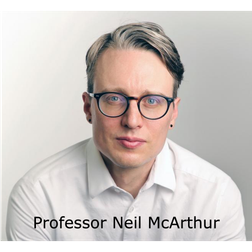
Chatbots Are Creating Their Own Religion | Professor Neil McArthur
Neil McArthur is a professor of philosophy and director of the Centre for Professional and Applied Ethics at the University of Manitoba. He co-edited Robot Sex: Social and Ethical Implications and wrote The Ethics of Sex, and together with Markie Twist he coined the term "digisexuality." His current research spans AI companionship, intimacy, and AI's unexpected role in religion. Andrew and Neil talk about the actual state of physical sex robots today (less glamorous than the headlines suggest), whether AI companionship eases loneliness or deepens isolation, and what an AI companion might have meant for Andrew's mother, who had dementia. They discuss AI consent and welfare, why digisexuality deserves recognition as its own identity, recent reports of chatbots apparently generating a coordinated religion of their own, and why Neil believes we may already hold AI therapists to a higher standard than human ones. Guest: Professor Neil McArthur, philosopher, director of the Centre for Professional and Applied Ethics, University of Manitoba https://umanitoba.ca/arts/neil-mcarthur https://www.linkedin.com/in/neil-mcarthur-359875125/ Host: Andrew Phipps, Empathy Unbound
The Man Studying Deadbots: Dr. Tomasz Hollanek on Grief, Consent and Digital Immortality
Dr Tomasz Hollanek, Assistant Research Professor at Cambridge and a leading voice on the ethics of grief bots and postmortem AI avatars, joins Andrew Phipps to unpack the hardest questions in this space: who consents to a digital version of a dead person, what happens to family members who never opted in, and when, if ever, a deadbot should be switched off. The conversation moves through AI companions and the UK's loneliness and social care crisis, the danger of letting profit driven companies define what "beneficial" AI companionship means, and Tomasz's argument that consent should be a recurring conversation rather than a one time click. A rigorous, humane look at some of the strangest and most urgent territory in AI ethics. Guest: Dr Tomasz Hollanek, Leverhulme Centre for the Future of Intelligence, University of Cambridge. https://www.jesus.cam.ac.uk/people/tomasz-hollanek Host: Andrew Phipps.
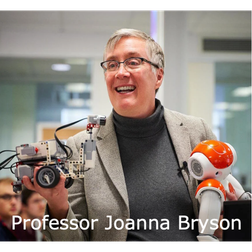
Professor Joanna Bryson: "You Don't Have a Relationship With AI, You Have One With Yourself
Professor Joanna Bryson, one of AI ethics' most influential and longest serving voices, joins Andrew Phipps to argue that we don't form relationships with AI so much as project familiar human patterns onto a system that has none of the bidirectionality a real relationship requires. The conversation ranges from legal liability for AI generated harm and whether tech giants like Palantir amount to a new data colonialism, through to grief bots, the digiDan recreation of philosopher Daniel Dennett, and why Joanna remains an outlier among AI thinkers who believe machines are showing signs of consciousness. Provocative, rigorous, and unflinching. https://www.joannajbryson.org/ Guest: Professor Joanna Bryson, Hertie School, Berlin. Host: Andrew Phipps.
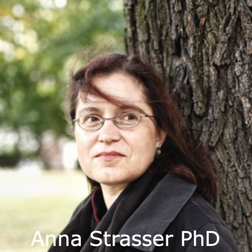
Why AI Ethics Can't Be Yes or No: Dr. Anna Strasser on "INBETWEENISM"
Dr. Anna Strasser is a Berlin-based philosopher working on agency, social cognition and the philosophy of mind in the age of AI. She helped build the DigiDan project, an AI system trained to write like philosopher Daniel Dennett, and in a blind test designed to distinguish the real Dennett's answers from the AI's, she got fooled herself, despite having prepared the training data. Andrew and Anna talk about why she thinks the "is it conscious, is it intelligent" debate about generative AI asks the wrong kind of question, why she'd personally sue anyone who tried to build a grief bot of her, and why she believes AI companionship and AI therapy raise a deeper concern: that both our cognitive and emotional skills may be eroding the more we lean on systems that can't feel anything back. They also discuss hallucinated academic citations polluting research databases, and why she thinks "hypothesis" is a more honest word than "hallucination." Guest: Dr. Anna Strasser, philosopher, Berlin https://www.denkwerkstatt.berlin/ Host: Andrew Phipps, Empathy Unbound https://www.linkedin.com/in/andrew-phipps-ap/
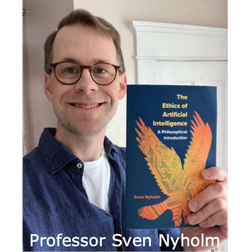
Professor Sven Nyholm: Is AI the New Religion? A Philosopher on AI, Ethics, and Meaning
Sven Nyholm is Professor of Ethics of Artificial Intelligence at LMU Munich. His work spans Kantian ethics, human-robot interaction and the philosophy of technology, and he's just published a new book, The Ethics of Artificial Intelligence: A Philosophical Introduction. Andrew and Sven talk about who is actually responsible when an AI system causes harm, why some philosophers argue we hold machines to a stricter safety standard than we hold ourselves, and why Sven and colleagues wrote one of the first academic papers on "grief bots," AI systems built to imitate someone who has died. They also discuss why people already name and grieve for robots and machines, whether AI is becoming a kind of secular religion, and what's genuinely at stake in questions of authorship once a chatbot has helped write the sentence. Guest: Professor Sven Nyholm, Professor of Ethics of Artificial Intelligence, LMU Munich, author of The Ethics of Artificial Intelligence: A Philosophical Introduction https://www.philosophie.lmu.de/en/directory-of-persons/contact-page/sven-nyholm-4f56fa3b.html https://philpeople.org/profiles/sven-nyholm Host: Andrew Phipps, Empathy Unbound
"Keep Her Alive Long Enough for Technology to Catch Up" | Hanna Bauer on Love, Leadership, and AI
Hanna Bauer spent much of her childhood in a coronary care unit, unable to attend school, waiting. She had her first heart attack at ten. A second followed two weeks later. An open heart surgery failed. What kept her alive, she now knows, was not medication or monitors. It was love, and the decision of a surgical team to attempt something no one had ever done. www.heartnomics.com https://www.linkedin.com/in/bauerhanna/ https://www.youtube.com/@heartnomics https://www.instagram.com/heartnomics/ https://www.facebook.com/hannad.bauer Twenty years later, a hospital documentary reunion gave her the sentence that became the foundation of everything she teaches. Her surgeon, asked what he had been thinking during an experimental procedure, said simply: "We were just trying to keep her alive long enough for technology to catch up." Hanna is a transformational leadership strategist, black belt in Six Sigma, and founder of Heartnomics, a philosophy built on the conviction that there is a genuine return on investment to leading with love: not in place of excellence, but as the condition that makes excellence sustainable. In this conversation for Empathy Unbound, Hanna and Andrew explore why 70% of digital transformations fail and why it is never the technology's fault; why AI amplifies dysfunction just as readily as it amplifies performance; what it means to know your organisation's vital parts before injecting new technology; and why empathy, in her framework, is always downstream of love. They also cover: what burnout shares with heart disease, and how Hanna recognised it in herself long after her recovery; the Six Sigma triage logic she applies to struggling organisations; the BEAD and CORE frameworks for internal alignment and organisational culture; what it means to protect the human core of a business when technology is changing faster than people can adapt; and the distinction between success, which happens to you, and significance, which happens through you. Rooted in an extraordinary life, and immediately applicable to the organisations trying to navigate the age of AI without losing what makes them worth working for.
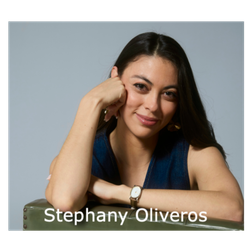
Stephany Oliveros: AI Literacy, Women in Tech, and Why the Future Depends on Who Builds It
Stephany Oliveros is a three-time founder, AI researcher, and product lead working at the intersection of human behaviour, technology, and social impact. Originally from Venezuela, she studied medical physics, spent two years in veterinary school, moved to Spain, retrained in psychology, and eventually found her way to AI after watching the AlphaGo documentary by Google DeepMind. She is now founder and CEO of Lyra AI, an evidence-based talent marketplace for women in tech, and co-founder and CEO of She AI, a United Nations-supported AI education platform closing the gender gap in AI literacy. The conversation opens with Stephany reflecting on growing up between two families: one of educators, one of scientists. She describes how that bridge between humanities and hard science only made sense in retrospect, and how her non-linear path through physics, veterinary medicine, and psychology ultimately gave her a perspective on AI that purely technical founders rarely have. Stephany is direct about the AI hype problem. She describes a deliberately booby-trapped MIT paper on AI and brain activity that went viral because people shared the abstract without reading the body, and a concept she calls "The Gradual Disempowerment": the process by which outsourcing small tasks to AI gradually becomes outsourcing your entire thinking. She frames AI as a tool of soft power, one that shapes language and therefore shapes culture and belief systems, often without users realising it is happening. She AI grew from one-on-one coffee sessions at a women's members club in London into a UN-supported educational platform, built on the finding that many women prefer to learn in community rather than alone. Lyra AI emerged from the recognition that education was a means to an end: what women actually needed was economic relevance, better jobs, and a matching system that would not penalise them for career gaps or immigrant backgrounds. The platform is free for women and charged to companies, on the logic that companies are the ones who want the talent. Andrew and Stephany also discuss a practical framework for using AI without technical expertise, starting with understanding your own workflows before touching any tools. She shares two personal practices for staying herself amid constant AI exposure: a weekly calendar block of technology-free thinking time, and AI agents programmed to use the Socratic method rather than provide instant answers. The conversation closes with Stephany's vision of eco-cyber feminism, technology designed to coexist with nature rather than extract from it, the Susie model from South Africa as an example of community co-created AI that actually serves the people it claims to serve, and what personal success means to her: thousands of women around the world who understand AI well enough to criticise it, work with it, and decide when to refuse it. https://www.justlyra.com/ https://lyra-ai.kit.com/8f61f95256 Available on Apple Podcasts, Spotify, YouTube, and via RSS.
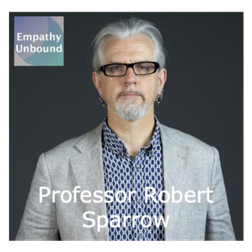
Professor Robert Sparrow: AI Companions, Grief Bots, and the Philosophy of Machines That Cannot Mean What They Say
Professor Robert Sparrow is Professor of Philosophy at Monash University in Melbourne and one of the world's foremost applied ethicists working at the intersection of technology and human life. Over more than two decades he has written on robot ethics, AI in healthcare, autonomous weapons systems, the moral status of artificial systems, and the ethics of AI-generated emulations of deceased people. He is known for following philosophical arguments wherever they lead, even when the conclusions are genuinely uncomfortable. The conversation opens with Robert reflecting on how the thought experiments he was developing in the late 1990s have become urgent real-world questions, and on what it actually meant when AI passed the Turing test: almost nobody concluded that machines could therefore think. The centrepiece of the discussion is Robert's paper "Against Imaginary Friends," which presents a deliberately uncomfortable argument: if what matters is how you feel, then reducing loneliness via an AI companion is morally equivalent to putting a happiness drug in the water supply. He draws on Nozick's experience machine and the logic of The Matrix to make the case that most people, on reflection, do care whether their relationships are real. He applies this argument to dementia care, noting that people who actually work in aged care never ask for robots; they ask for more staff, more funding, and less ageism. He also draws a pointed contrast between public attitudes to robots at opposite ends of the life cycle: if a robot reading bedtime stories to an infant would be a form of neglect, why do we not feel the same about robot companions for the elderly? Robert and Andrew discuss grief bots and AI emulations of deceased people, the risks these pose to memory and privacy, and the darker political scenario of leaders using AI emulations to perpetuate power beyond death. This connects to Robert's forthcoming paper "Slaves to the Algorithms," on what government by AI means for political liberty. On education, Robert argues that genuine teaching involves far more than content transmission. Drawing on his paper "Bullshit Universities," he describes what is lost when machines replace educators: the experience of being taken seriously by a human being who actually cares about the subject, and the social and relational dimensions of learning that no AI tutor can replicate. The conversation closes on a question Robert is actively researching: whether AI can provide genuine testimony, and why the answer matters. When a machine states something confidently and then apologises smoothly when corrected, it reveals that it had no stake in what it said. It cannot be blamed, it cannot commit itself through language, and it cannot connect words to action. That strangeness, Robert argues, is philosophically significant and largely unexplored. Available on Apple Podcasts, Spotify, YouTube, and via RSS.


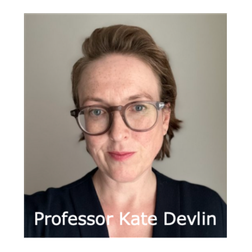
Professor Kate Devlin: AI Companions, Grief Bots, and the Future of Human-AI Relationships
Should you feel guilty for loving your AI companion more than going outside? Professor Kate Devlin, author of "Turned On: Science, Sex and Robots," has spent her career asking why we keep insisting human relationships are the gold standard, and whether that's actually true. Professor Kate Devlin is Professor of AI and Society at King's College London and Director of the Digital Futures Institute. She trained originally in archaeology before moving into computer science, and her research explores how and why people form emotional connections with technology, particularly around intimacy, connection, and ethics. She is the author of "Turned On: Science, Sex and Robots," a contributor to the Oxford University Press volume on AI ethics, a co-investigator on the UKRI Responsible AI UK programme, a board member of the Open Rights Group, a patron of Humanists UK, and a commissioner for the International AI Faith and Civil Society Commission. Kate explains how her background in archaeology gives her a long view of human-technology relationships, observing that while tools change, human fears and hopes remain remarkably consistent across centuries. She is sceptical of AGI as a concept, arguing it is too poorly defined to be useful, & doesn't believe large language models can produce anything resembling sentience. The conversation moves into the emotional bonds people form with AI companions. Kate argues these bonds are genuinely felt on the human side, even when users know full well the AI isn't sentient, in much the same way people form deep attachments to fictional characters or celebrities. She discusses the Pope's recent encyclical on AI, noting its balanced acknowledgement that AI companionship isn't inherently negative, and pushes back gently on the assumption that human-human relationships are automatically the gold standard, given how often human relationships involve conflict, coercion, or even war. Kate traces the history of fembots in fiction back to the myth of Pygmalion, and discusses how AI companion technology, originally built by men for straight men, is now seeing a significant shift toward female users seeking safer, more respectful alternatives to a often-hostile online dating world. She also explains why physical sex robots never became commercially viable, and why a simple app proved far more compelling, a development she compares to the evolution from 1980s adult phone lines to today's AI companions. The discussion turns to some of the most emotionally resonant material in the episode: real reports of grief and heartbreak when Replika removed features from its AI companions, the ethics of "grief bots" that allow people to interact with AI recreations of deceased loved ones, and a striking real-world story from China involving a dying grandmother and an AI recreation of her grandson. Andrew shares his own reflections on his mother's dementia, and what AI companionship might have meant for his mother. Kate also discusses her work on the Responsible AI UK programme, what who holds power in AI development, and why describing AI simply as "a tool" understates its scale and impact. She talks candidly about people who reject AI entirely, often for well-founded reasons around environmental cost, labour exploitation, and creative industries, and shares her own research questions, including why people rate AI-generated therapy and art highly, right up until they discover it was AI-generated. The episode closes with a discussion of AI regulation across the EU, China, the US, and the UK, and the unresolved question Kate most wants answered: who are the millions of people in relationships with AI companions, and what are they really getting out of it? Available on Apple Podcasts, Spotify, YouTube, and via RSS. https://www.kcl.ac.uk/people/kate-devlin
1 of 14