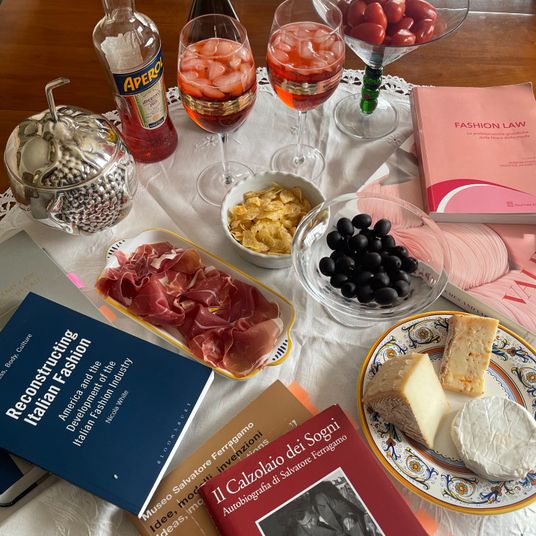
A Fashion Law Dinner Party with Fashion by Felicia

A Fashion Law Dinner Party with Fashion by Felicia

by Felicia Caponigri
Season 1
Armani’s Living Legacy: Behind the scenes of Giorgio Armani. Milano Per Amore in Milan with the Deputy Director of the Pinacoteca di Brera, Arch. Chiara Rostagno
The exhibition, Giorgio Armani. Milano Per Amore at the Pinacoteca di Brera in Milan, Italy opened shortly after the Italian fashion designer Giorgio Armani’s death in September 2025. The exhibition was planned closely with Mr. Armani, in collaboration with the Giorgio Armani Foundation, and with Mr. Armani’s team. What is the origin story of this exhibition? How did it come about and what can other fashion designers learn from this collaboration between the Pinacoteca and Mr. Armani? How do we value the emotional impact of Mr. Armani’s legacy, and the preservation of Mr. Armani's legacy through the Giorgio Armani Foundation? Mr. Armani left us a Fashion Law legacy, with his will, creation of a foundation, and through his collaboration with the Pinacoteca di Brera, a historic picture gallery and museum in the heart of Milan. At this Fashion Law Dinner Party the Deputy Director of the Pinacoteca who worked directly with Mr. Armani and his team, the Architect Chiara Rostagno, shares aspects of the exhibition’s negotiations, Mr. Armani’s ideation of certain installations, and the importance of the complimentary heritages of fashion and art between a public museum like the Pinacoteca and a private foundation like Mr. Armani’s.
A Special Edition Fashion Law Dinner Party: The 2026 Met Gala
This year’s Met Gala, with the dress code “Fashion is Art”, celebrated The Metropolitan Museum of Art Costume Institute’s exhibition “Costume Art”. As the official description notes, the “exhibition explores depictions of the dressed body across The Met’s vast collection, pairing garments with artworks to reveal the inherent relationship between clothing and the body.” The Met Gala isn't just a celebration of an exhibit, however - it's the best Fashion Law hypo! In this episode, we take a law and humanities approach to the 2026 Met Gala looks with Maria Sole Costanzo, Assistant Professor of Italian at Boston College. How could so many celebrities from Kendall Jenner to Hunter Schafer and Gracie Abrams be inspired by great works of art, from the Nike of Samothrace to works by Gustav Klimt? What parts of Madonna’s Leona Carrington-inspired look could be appropriated without permission from Leona Carrington’s estate? What fiduciary duties do the trustees of the Met, the museum’s curators, and even sponsors of the Met Gala have when culture meets commerce. Pop the Prosecco - and listen to the "hot takes" on this episode! More Fashion Law academic reading related to the Met Gala and the themes discussed in this episode: Felicia Caponigri, The Ethics of the International Display of Fashion in the Museum, 49 Case W. Res. J. Int'l L. 135 (2017) Available at: https://scholarlycommons.law.case.edu/jil/vol49/iss1/10https://scholarlycommons.law.case.edu/jil/vol49/iss1/10/ Litman, Jessica D. "The Public Domain." Emory L. J. 39 (1990), https://repository.law.umich.edu/facarticles/222/ Mala Chatterjee, Conceptual Separability as Conceivability: A Philosophical Analysis of the Useful Articles Doctrine, 93 N.Y.U. L. Rev. 558 (2018).Available at: https://scholarship.law.columbia.edu/faculty_scholarship/3584
In House Counsels Wear Marc Jacobs: A conversation with Ava Farshidi on how to represent iconic fashion brands and make your mark in Fashion Law
20 years ago The Devil Wears Prada took us behind the scenes of the job a million girls would kill for. In this episode, looking forward toThe Devil Wears Prada 2 ,we focus on the job a million fashion law students would kill for - an in house counsel position at a major fashion brand. Ava Farshidi, the Global In-House Counsel at Marc Jacobs, shares how she landed a job in-house as a confident law student by networking and building a book of contacts. We also get a behind the scenes look at what legal issues most often cross Ava's desk, and what legal issues she’s following the most for the fashion industry’s future. Avocate, the legal women's mentoring network Ava founded to build a community by connecting law students with attorneys, is also part of our conversation. You can learn more about Avocate here https://www.avocateforwomen.com/ .
The Chiara Ferragni Case: Fashion Influencing between False Advertising, Criminal Law, and Rebranding
On January 14, 2026, the fashion influencer Chiara Ferragni was cleared of criminal charges in Milan, Italy. The charges stemmed from what has been known as "Pandoro-gate", a campaign Ferragni created in collaboration with the Italian brand Balocco to promote an Italian Christmas cake in pink with Ferragni's logos. The specifics of the case were complex, and included a number of actors and forums, from administrative fines, to public regulatory bodies and non-profits, consumers, and a public prosecution. Why was this case such a flashpoint in Italy? What is the difference between the fines Ferragni paid to regulatory authorities in Italy and the criminal charges which were dismissed? How important was the legal strategy of Ferragni's lawyers, and what can we learn from this case? In this episode, Felicia speaks to Marco D’Ostuni, a partner at the international law firm Chiomenti in Rome. The conversation explains the difference between the competition and communication authorities in Italy who regulate fashion influencers' false advertising and public prosecutors' charges of simple and aggravated fraud that may be related to the same campaigns. The conversation also takes a deep dive into the legal strategy of Ferragni's lawyers and why it was so successful. Listeners might find the following articles of interest in light of this episode: Alexandra Roberts, False Influencing, https://www.law.georgetown.edu/georgetown-law-journal/wp-content/uploads/sites/26/2020/11/Roberts_False-Influencing.pdf TFL, In Light of Continued Violations, How Effective Were the FTC’s Letters Really?, https://www.thefashionlaw.com/in-light-of-continued-violations-how-effective-were-the-ftcs-letters-really/
What’s in a Fashion Collab Contract? Behind the Scenes of Fashion Industry Negotiations with Beatrice Grifoni
This holiday season you're like seeing celebrities and influencers collaborate with brands in an attempt to secure your purchase of the perfect branded holiday present. Brands take advantage of the celebrity connections and visual references we have in our consumer minds. The collaboration contract is the main legal document that cements the duties and obligations of both brands and talent for the holiday marketing campaigns we see today. Who owns intellectual property rights when a fashion brand collaborates with a celebrity? How did models negotiate fees for their appearance in social media posts, before social media marketing exploded? How do you negotiate with entertainment lawyers who make Ari Gold from Entourage look like a reasonable counterpart? How do you get a Creative Director and the CFO of a brand on board with demands that talent might make to appear in a brand’s latest marketing campaign? And what are some over the top requests celebrities make? To answer these questions, Felicia speaks with Beatrice Grifoni for a behind the scenes look at negotiating in the fashion industry. Formerly the Associate General Counsel at Warnaco and the Senior Counsel and then Legal Director of Intellectual Property, Communication and Design at Valentino for over 12 years, Beatrice now serves as Legal and Business Affairs Executive with EB Brands&Talent, a management agency that has access to celebrities and other top talent for brands’ campaigns.
Models' Rights and Fashion Weeks: A Conversation with Model Alliance and Fashion in Progress between New York and Milan
New York Fashion Week, and Milan Fashion Week, spotlight new fashion collections but, also, new and recognized faces - the models who wear the clothing and help to create the glamorous lifestyle and aura that brands sell to their consumers. Not all modeling work is glamorous, however, especially if a model finds herself (or himself) at a disadvantage under the contract they have signed with their modeling management agency. To solve the incongruence and opaqueness of modeling contracts and the often problematic conditions in which models work and labor, organizations like Model Alliance in New York and Fashion in Progress in Milan, advocate, raise awareness, and also help to shape new legislation, like the Fashion Workers Act. In this episode, we speak with Sara Ziff, the founder and executive director of Model Alliance in New York City, with Ambra Battilana Gutierrez, vice-president and co-founder of Fashion in Progress in Milan and a board member of the Model Alliance, and with Alessio Di Pietro, who is an Italian lawyer and Counsel at the “LAW”P firm in Milan, as well as the president and co-founder of Fashion in Progress in Milan. The conversation focuses on their fight for models' rights in the fashion industry and the work of their organizations. Disclaimer: This episode includes discussion about the dangers of sexual assault in the modeling industry and how financial insecurity can lead to the human trafficking of models and other abuses. Listener discretion is advised. To learn more about the Fashion Workers Act, the Model Alliance, and Fashion in Progress, visit the following links: Model Alliance, https://www.modelalliance.org/ The Fashion Workers Act, New York State Department of Labor, https://dol.ny.gov/fashion Kayleigh Ristuben, The Fashion Workers Act: Closing the Regulatory Loophole in the New York Fashion Industry, 33 Fordham Intell. Prop. Media & Ent. L.J. 908 (2023).Available at: https://ir.lawnet.fordham.edu/iplj/vol33/iss4/4 Fashion in Progress, https://www.instagram.com/fashion_inprogress/?hl=en
Spotlight on Careers in Fashion Law, Business & Heritage: Dealmaking and Value Generation From Luxury to Streetwear with Christopher Rucker, Principal, TwoSixTwoOne Group
Have you ever wondered what it takes to put a deal together between a major fashion brand and a creative? How to prepare for a meeting with a luxury conglomerate as an emerging brand's executive? How to define value in fashion between creative outputs and financial bottom lines? In this summer Fashion Law Dinner Party, we speak with Christopher Rucker, a fashion industry executive with experience as Chief Revenue Officer at the streetwear brand Sp5der, Vice President of Sales and Marketing for the luxury brand Pyer Moss, and currently the Principal of the strategic consulting group TwoSixTwoOne. Listen to hear more about how to build connections in the fashion industry and define your "ask", the role of the secondary market and authentication services in fighting counterfeits and identifying dupes that are relevant for a fashion brand's business activities, and behind the scenes information about where a Met Gala look goes after a celebrity wears it on the red carpet.
A Special Edition Fashion Law Dinner Party: The 2025 Met Gala
For fashion lawyers and scholars, the Met Gala is a dream hypothetical. This year, it was even more so thanks to the Gala's theme "Tailored to You" and the exhibition the Gala celebrated, Superfine: Tailoring Black Style. A celebration of black fashion heritage and black cultural heritage, the looks on the blue carpet raised legal questions. How does the Zoot Suit, a core part of the historic concept of a dandy, spur creativity in fashion thanks to its status as part of the public domain? Can we spot separable elements of Rosalía's dress? What was functional and what was ornamental in Janelle Monáe's accessories and cloak? And what legal relevance did eBay's presence on the red carpet have? To parse the intellectual property rights in looks at the 2025 Met Gala, from Doechii's Louis Vuitton monogrammed look replete with trademarks (including a tattoo!) to Dapper Dan's inclusion in the exhibition and new logo, Felicia Caponigri speaks with Naomi Price, an IP litigation associate at BakerHostetler. For further reading on some of the IP issues discussed in this episode, see Perzanowski, Aaron. "Tattoos and IP Norms." Minnesota Law Review 98, no. 2 (2013): 511-591. (Work published when author not on Michigan Law faculty.) ( https://repository.law.umich.edu/articles/2608/ ) Shontavia Johnson, BRANDED: Trademark Tattoos, Slave Owner Brands, And The Right To Have "Free" Skin, 22 Mich. Telecomm. & Tech. L. Rev. 225 (2016).Available at: https://repository.law.umich.edu/mttlr/vol22/iss2/2
Authentic Fakes in Fashion Practice? A Conversation with Abigail Glaum-Lathbury about Conceptual Fashion and its Critical Methodology
What would dupes, authentic fakes, or conceptual fashion that riffs on trademarks and their messages be without the designers who make and create this fashion? In Part II of this Fashion Law Dinner Party we speak with Professor Abigail Glaum-Lathbury from the School of the Art Institute of Chicago about her Project G.U.C.C.I - the Genuine Unauthorized Clothing Clone Institute. “[A] visual primer into copyright and intellectual property law and illustrate systems of exclusion and hegemony.”, Project G.U.C.C.I serves as a starting point for a broader, unvarnished conversation about the fashion system, its preoccupation with money, and a healthy skepticism for how brands are deploying their IP rights and using the law to condition fashion industry stakeholders and consumers.
Authentic Fakes? Dupes between Law & Heritage
Dupes - fake or replica products that may or may not be legal to produce and sell- seem to be everywhere. Between the "Wirkin", Dupes.com, and beauty dupes, it seems that many consumers are eager to prioritize value by buying "fakes" over brand loyalty and, perhaps, brands' heritage. But, is there a hidden authenticity to buying a fake, a replica, a dupe, of a Birkin bag or similar fashion or luxury product? What is the difference between a knockoff, a dupe, a fake, and other more specific legal terms like a counterfeit? And what role, and potential legal liability, can influencers have in consumers' desires for fakes when they advertise dupes? To explore the current state of dupes in the fashion industry, we first speak with Julie Zerbo, the Founder and Editor-in-Chief of The Fashion Law. While we might think of trademark law as the most applicable legal regime to dupes, false advertising law is increasingly crucial too, especially as we buy our dupes online. To explore “dangerous dupes” and the legal nuances of influencers' communications, we also speak to Alexandra Roberts, a Professor of Law and Media at Northeastern University School of Law.
1 of 4