Centre for Public Integrity

Centre for Public Integrity

by The Centre for Public Integrity
Season 6
Nick Feik: Investigative journalism and the accountability cycle
Will Partlett speaks with Nick Feik, former editor of The Monthly, about the role investigative journalism plays in Australia’s integrity puzzle. They discuss: Why difficult stories often need sustained public attention before they produce reform How reporting on Tasmania’s Ashley Youth Detention Centre and Robodebt exposed deeper institutional failures Why public inquiries, parliamentary pressure and civil society all matter to accountability The episode also examines the challenges facing investigative journalists, including defamation law, short media cycles and governments’ ability to delay or manage demands for reform. Full show notes: 00:00 Intro 02:40 Media economics and scarcity 04:59 The accountability cycle explained 06:40 Tasmania’s abuse investigation 11:12 Power and reform networks 12:14 Working with crossbenchers 13:45 The limits of royal commissions 19:05 Defamation and its chilling effect 23:02 Robodebt as a case study 26:59 The NACC and public accountability 28:34 Why details take time 29:27 Closing takeaways
John McKechnie on integrity, corruption and public accountability
Will Partlett speaks with John McKechnie, former Western Australian Director of Public Prosecutions, Supreme Court judge and Corruption and Crime Commissioner, about the limits of “integrity” as an institutional slogan. McKechnie reflects on WA Inc, the creation of independent prosecution and anti-corruption bodies, and why corruption commissions must do more than promote good culture. They must investigate misconduct, expose failures and help ensure public power is exercised for public purposes. SHOW NOTES: 00:00 Welcome and Guest Intro 01:06 Why Law School 02:24 Early Practice and Crown Move 04:12 Creating the DPP 06:09 WA Inc Taskforce Years 07:42 Epiphany to the Bench 09:37 Judge vs Prosecutor Mindset 11:18 Taking the CCC Job 13:19 CCC Powers and Jurisdiction 14:46 Prosecutions and Proof Limits 19:07 What Integrity Really Means 28:06 Velvet Glove Iron Fist 30:36 Wrap Up and Thanks
How to make integrity watchdogs truly independent - Deborah Glass Victoria's Ombudsman 2014-2024
What does it take for an integrity watchdog to be genuinely independent? In this episode, Deborah Glass — former Victorian Ombudsman and honorary fellow at Melbourne Law School — explains why the answer goes well beyond personal integrity. She discusses the real pressures created by executive-controlled appointments, funding battles and weak oversight, and sets out what stronger institutional design could look like. This is a conversation about why the fine print of integrity reform matters, and why democratic accountability depends on getting it right.
Season 5
Money, power and the Constitution
In this special edition podcast, former federal court judge The Hon Michael Barker KC speaks with Professor Gabrielle Appleby, Research Director at the Centre for Public Integrity and public law expert at UNSW Law & Justice, about how Australia’s Constitution distributes the power over money. They delve into the powers of the Senate, the significance of responsible government, and the historical compromises that shaped Australia’s constitutional framework, and how that played out in the dismissal of Prime Minister Gough Whitlam in 1975. This is a special episode for the upcoming 2026 National School's Constitutional Convention, aiming to foster a deeper understanding of Australia's political and legal landscape. Show notes: 00:00 Introduction to the Center for Public Integrity 00:20 Overview of the National School's Constitutional Convention 01:05 Introducing Professor Gabriel Applebey 01:31 Understanding Section 53 of the Commonwealth Constitution 02:11 Historical Context and Comparisons 03:21 The Role and Powers of the Senate 05:02 The 1975 Constitutional Crisis 08:52 Modern Implications and Reflections 14:02 The Framers' Intent and Modern Politics 28:22 The 1975 Constitutional Crisis 34:19 Modern Implications and Future Considerations 37:21 Concluding Thoughts
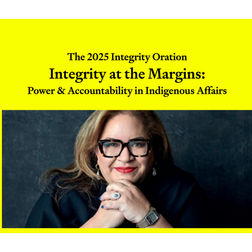
Prof Megan Davis AC - Integrity at the Margins: Power & Accountability in Indigenous Affairs
In this podcast episode from the Centre for Public Integrity, former federal court judge the Hon Michael Barker KC interviews Professor Megan Davis AC, one of Australia's leading constitutional law academics. Davis discusses her journey from law school to her significant contributions at the United Nations and her current role at the University of New South Wales. The conversation delves into Davis's work on the Uluru Statement, her views on constitutional recognition for First Nations people, and her skepticism and optimism about future reforms. The discussion also touches on various integrity issues within Australian politics, the discrepancies in indigenous representation, and the broader implications of these issues on democracy and self-determination.
Season 4
Jay Weatherill AO: Democracy's Challenges and the Path Ahead
In this episode of the Center for Public Integrity's podcast, the Hon Michael Barker KC, a former federal court judge, interviews Jay Weatherill AO, the 45th Premier of South Australia and recently appointed High Commissioner to the United Kingdom. They discuss Weatherill's background, influenced by his father's trade union work and his own early immersion into politics. Weatherall recounts his journey to becoming Premier and reflects on the various facets of democracy, the importance of integrity in governance, and the role of civil society. He shares his views on freedom of information reforms, proactive disclosure, the need for participatory democracy, and the challenges of balancing transparency with effective policy-making. Weatherall also touches on his future role as High Commissioner and the significance of democratic dialogue on the international stage. Show notes: 00:00 Introduction to the Podcast and Guest 00:58 Jay Weatherall's Early Political Influences 02:58 Lessons from Jay's Father 06:17 Jay's Path to Politics and Law 09:07 Entering Parliament and Early Experiences 14:30 Integrity and Ethics in Government 28:17 The Role of State Government in Democracy 29:35 Historical Insights on Democracy 31:25 Unionism and Representation 35:06 FOI and Government Transparency 44:04 Challenges in Policy Making 47:39 The Importance of Civil Society 51:01 Future Role in Diplomacy
ACT Chief Minister Andrew Barr
In this episode of the Centre for Public Integrity's podcast, host the Hon Michael Barker KC interviews Andrew Barr, Chief Minister of the ACT. The discussion explores the unique governmental structure of the ACT, combining state and municipal responsibilities, and the impacts of this hybrid model. Topics include the evolution and benefits of self-government, the proportional representation electoral system, political stability, and the growing influence of independents. Barr comments on the challenges of lobbying, the importance of transparency, and recent technological concerns such as AI and deepfakes in politics. He also touches on his own political journey, the significance of civics education, and ongoing efforts to ensure integrity in political financing and lobbying.
Peter Malinauskas: Reforming Political Finance the South Australian way
In this episode of the Center for Public Integrity's podcast, the Hon Michael Barker KC speaks with Peter Malinauskas, the Premier of South Australia, about the innovative changes to the state's Electoral Act that ban political donations, making elections publicly funded. The discussion delves into the motivations behind these reforms, the influence of Malinauskas' visit to the U.S., and the broader implications for democracy. They also explore the benefits of compulsory voting, the risks of lobbying, and the importance of teaching civics in schools to combat apathy and nurture informed citizens. Premier Malinauskas shares insights from his personal journey into politics and his hopes for the future of democratic engagement in Australia.
Season 3
Judge, Barrister, Royal Commissioner, Navy Commander & Deputy Chancellor: the Hon Margaret White AO
Margaret White AO was the first woman judge appointed in Queensland. Before that, she had already had a remarkable career from working in Barbados, as an academic and then on two of Australia's most significant constitutional law cases (Tasmanian Dams and Mabo). Following a lengthy period on the bench, Margaret then went on to run Royal Commissions investigating the racing industry and child protection in the Northern Territory. She reflects on their effect and how they emphasised her belief in the importance of robust regulation and accountability. Currently, she advocates for anti-corruption and democratic integrity as a director for the Center for Public Integrity, motivated by the belief that democracy requires constant vigilance and active participation to thrive.
Reforming Accountability: Constitutional Reflections on Modern Governance
What if the failures of a controversial government scheme and a historic referendum could ignite a revolution in our democratic process? In this episode, journalist Quentin Dempster sits down with Professor Gabrielle Appleby—one of Australia’s leading constitutional law academics and a board director at the Centre—to explore how her groundbreaking work strives for transparency, accountability, and reform in government. Drawing on her academic expertise and firsthand observations, Gabrielle recounts her dual role in pivotal democratic debates. She critically examined the shortcomings revealed by the RoboDebt Royal Commission, advocating for reforms to bolster support for in-house government lawyers and prevent systemic failures. Simultaneously, she played a crucial role in the campaign for constitutional recognition of the Voice, where she served as a constitutional specialist advisor during regional dialogues that laid the groundwork for the Uluru Statement from the Heart. Through her work with the Centre for Public Integrity, Gabrielle champions systemic reforms to enhance government transparency and accountability. Tune in for a thought-provoking conversation about how legal scholarship can drive transformative change in our democratic system.
1 of 3