What is actually working for podcasters right now?
To better understand how independent creators are building, publishing, promoting, and monetizing their shows, RSS.com surveyed 195 podcasters.
The responses reveal a creator landscape that is ambitious, resourceful, and increasingly interested in video, AI, and better growth workflows.
This survey is not meant to represent every podcaster – it reflects responses from RSS.com creators. Still, the patterns are clear: podcasters are publishing consistently, experimenting with new tools, and looking for ways to grow without adding more complexity to their workflow.
Key Findings
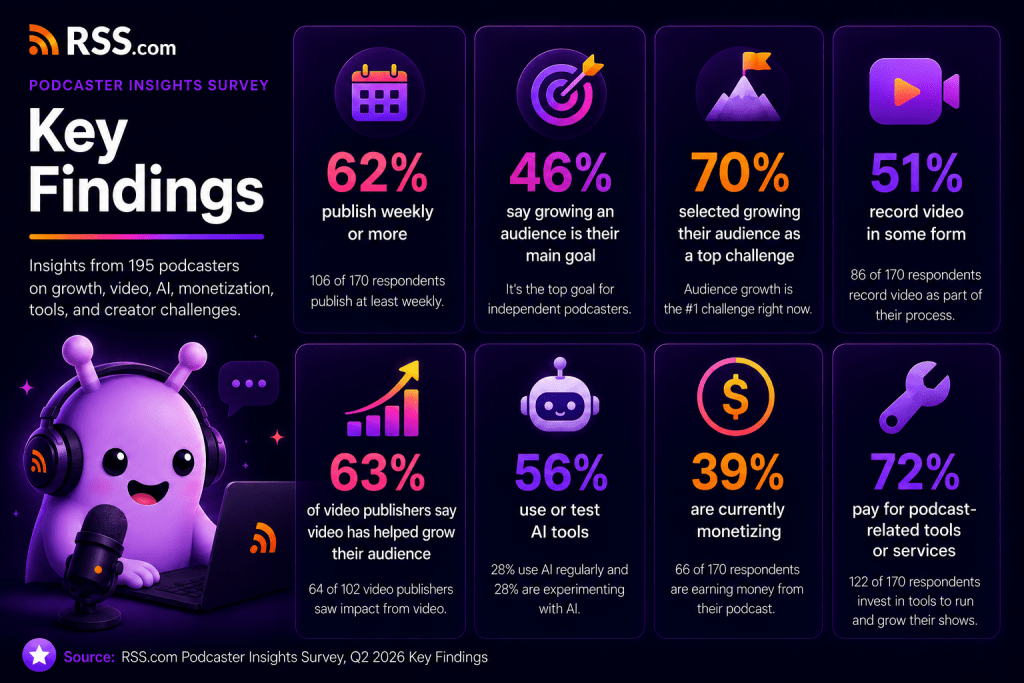
- 62% of current podcasters publish weekly or more.
- 46% say growing an audience is their main podcasting goal right now.
- 70% selected growing their audience as one of their biggest challenges.
- 51% record video in some form.
- Among respondents who publish video, **63%** say video has helped grow their audience.
- 56% are using or experimenting with AI tools.
- 39% are currently monetizing their podcast.
Audience Growth Is Still the Top Challenge for Independent Podcasters
The clearest takeaway from the survey is that podcasters are thinking seriously about growth.
When asked to select their biggest podcasting challenges, our respondents chose:
- Marketing / promotion: 18%
- Growing my audience: 70%
- Discoverability: 32%
- Monetizing my podcast: 24%
That matters because growth is not just a vanity metric for creators. Audience growth affects almost everything else: motivation, monetization potential, collaboration opportunities, guest booking, and long-term consistency.
Even creators who are publishing regularly are still asking the same question: how do I get this show in front of more of the right people?
These insights don’t reflect what beginners hope works. They reflect what experienced creators are actually doing as they hit structural growth ceilings.
Podcast Discovery is Fragmented
When asked for their primary source of new listeners, respondents pointed to several different channels:
- Podcast apps: 31%
- Social media: 29%
- Word of mouth: 20%
- Guests / collaborations: 8%
- YouTube: 6%
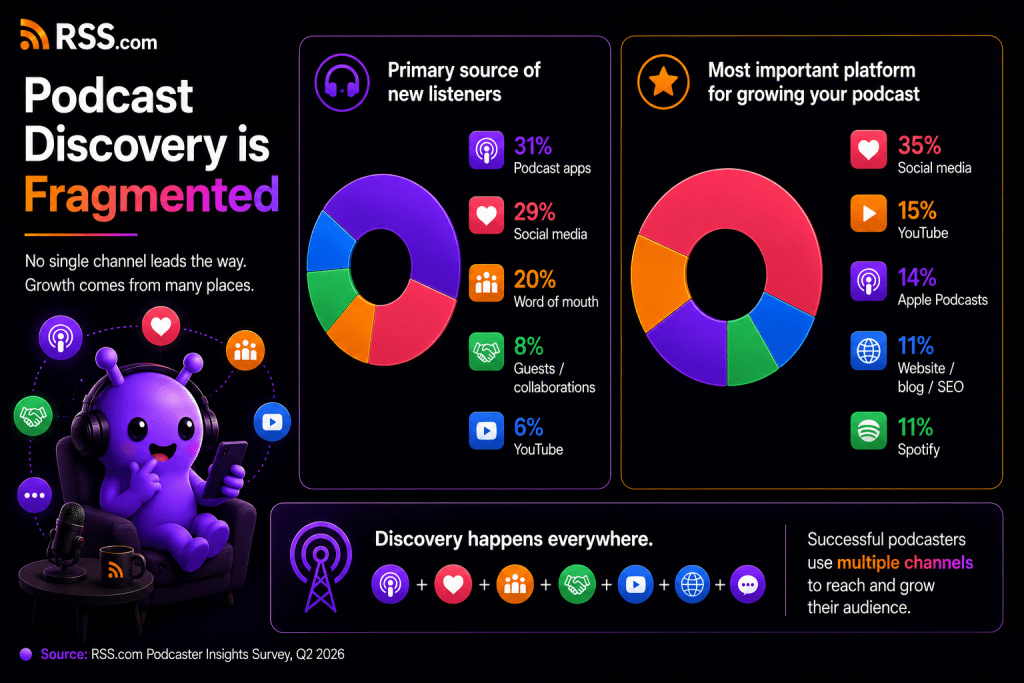
No single channel dominated. That suggests podcast growth is increasingly multi-channel. Creators are not relying on one app, one algorithm, or one promotional tactic. Instead, they are combining podcast directories, social clips, word of mouth, guest promotion, YouTube, websites, and communities.
When asked which platform is most important for growing their podcast, respondents ranked:
- Social media: 35%
- YouTube: 15%
- Apple Podcasts: 14%
- Website / blog / SEO: 11%
- Spotify: 11%
Note the gap here: 31% of respondents say podcast apps are their primary source of new listeners today, while 35% rank social media as the most important platform for growing their podcast. The channel podcasters credit for current listener acquisition isn’t the same channel they’re prioritizing for future growth.
The takeaway: creators still care deeply about traditional podcast platforms, but discovery is no longer limited to podcast apps. Social media, YouTube, search, and audience-driven sharing all play a role in helping shows reach new listeners.
Video Podcasting Is No Longer a Side Conversation
Audio remains central to podcasting, but video is now part of the workflow for many creators.
In the survey, 49% said they create audio-only content, while 35% record video and publish both audio and video. Another 15% record video but only publish the audio.
That means 51% of respondents record video in some form.
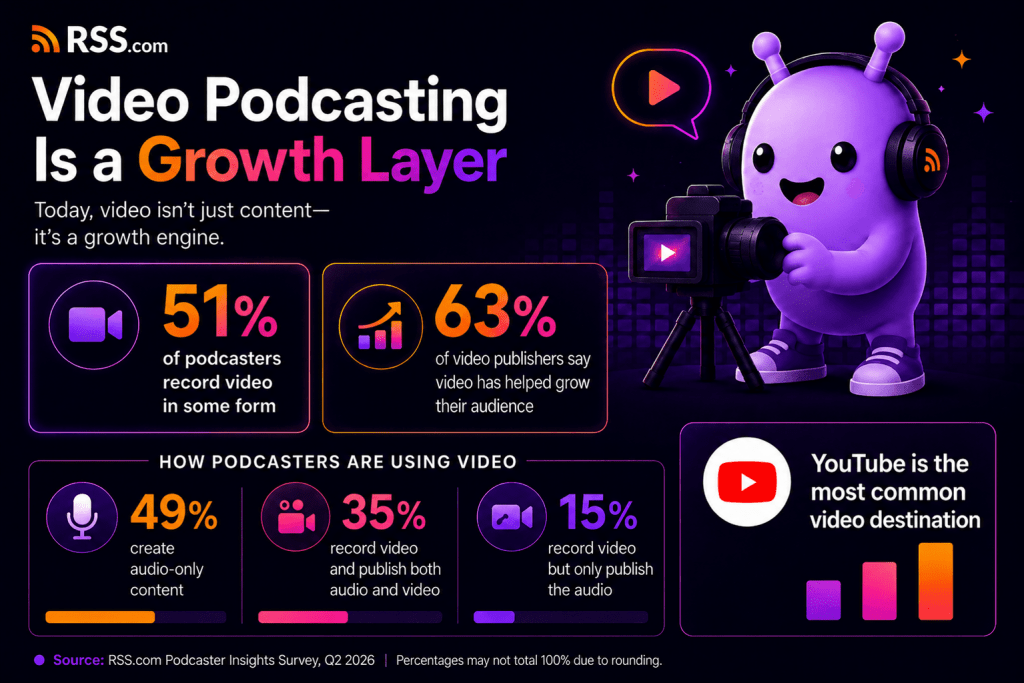
Among respondents who publish video, 63% said publishing video has helped grow their audience either somewhat or significantly. YouTube was the most common video destination, followed by social platforms, Spotify, and creator websites.
Video is not replacing audio podcasting. It’s becoming a top-of-funnel growth layer that creates discovery opportunities the traditional podcast directories don’t.
Industry-wide data shows the same shift: YouTube has overtaken Spotify and Apple Podcasts as the dominant platform for weekly podcast listeners in the US.
AI Is Becoming Part of the Podcast Workflow
AI tools are already showing up in how podcasters plan, produce, and promote their shows.
Overall, 28% of respondents said they use AI regularly, and another 28% said they are experimenting with AI. Combined, that means 56% are using or testing AI tools for their podcast.
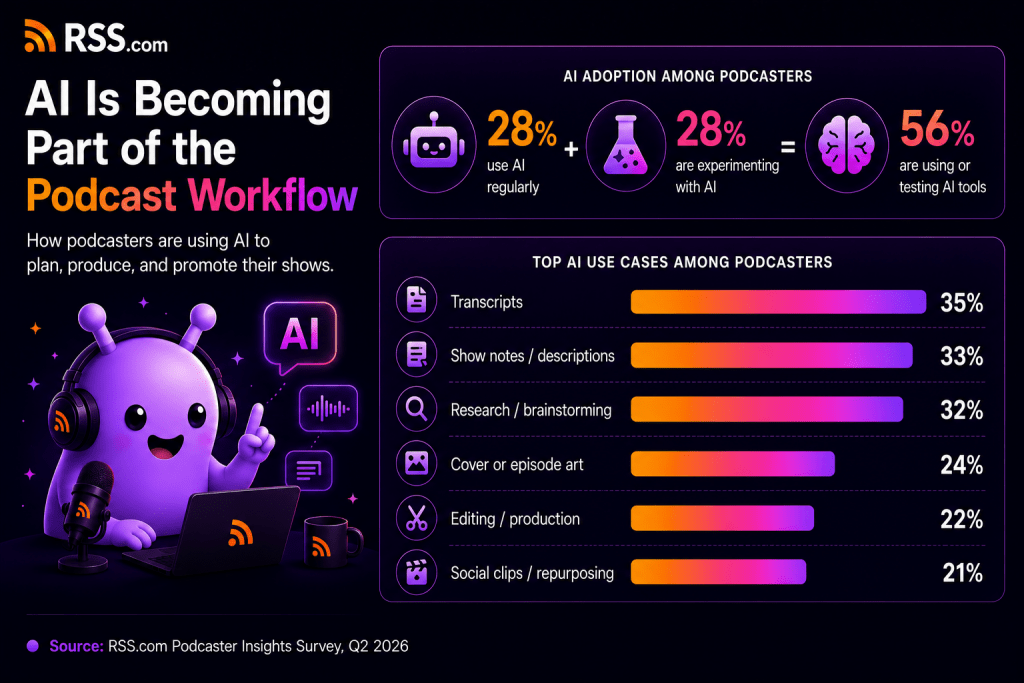
The most common AI use cases were:
- Transcripts: 35%
- Show notes / descriptions: 33%
- Research / brainstorming: 32%
- Cover or episode art: 24%
- Editing / production: 22%
- Social clips / repurposing: 21%
This points to a practical trend. Podcasters are not necessarily trying to automate the creative heart of their show. They are using AI to reduce the friction around the show: writing descriptions, creating transcripts, brainstorming topics, repurposing episodes, and speeding up production tasks.
With AI-generated transcripts on all paid plans, RSS.com makes it fast and easy to turn each episode into content that can be published, promoted, shared, and discovered.
Monetization Is Happening, but Growth Comes First
In the survey, 39% of respondents said they are currently monetizing their podcast, while 61% said they are not.
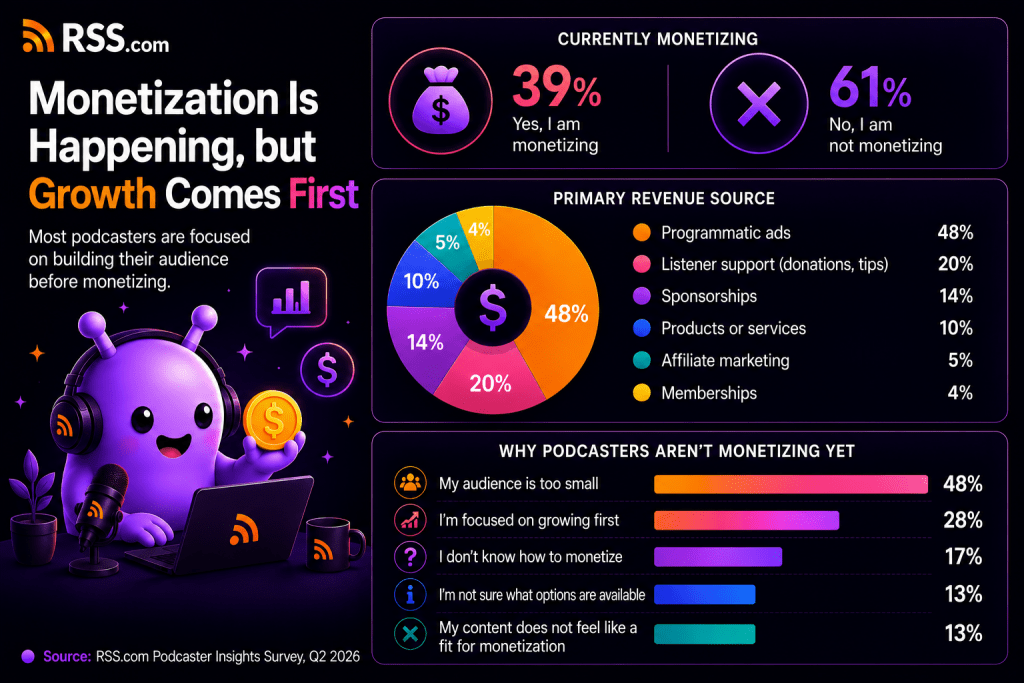
In the revenue-source question, 48% selected programmatic ads as their primary revenue source. Other revenue sources included listener support, sponsorships, products and services, affiliate marketing, and memberships.
With RSS.com’s PAID (Programmatic Ads Inserted Dynamically), podcasters on any paid plan can enable programmatic ads with as few as 10 downloads.
For respondents who are not currently monetizing, the most common barrier was audience size. Among non-monetizing respondents, the top reasons were:
- My audience is too small: 48%
- I’m focused on growing first: 28%
- I don’t know how to monetize: 17%
- I’m not sure what options are available: 13%
- My content does not feel like a fit for monetization: 13%
This shows a gap that podcast platforms, educators, agencies, and creator tools can help solve.
Podcasters need more than monetization features. They need a clearer path from publishing to growth to revenue. For many creators, monetization is not only a question of access. It is also a question of readiness, audience size, confidence, and knowing which options make sense for their show.
Podcasters Are Paying for Tools, but They Want Simpler Workflows
Most respondents are already investing money into their shows. 72% said they currently pay for tools or services related to their podcast.
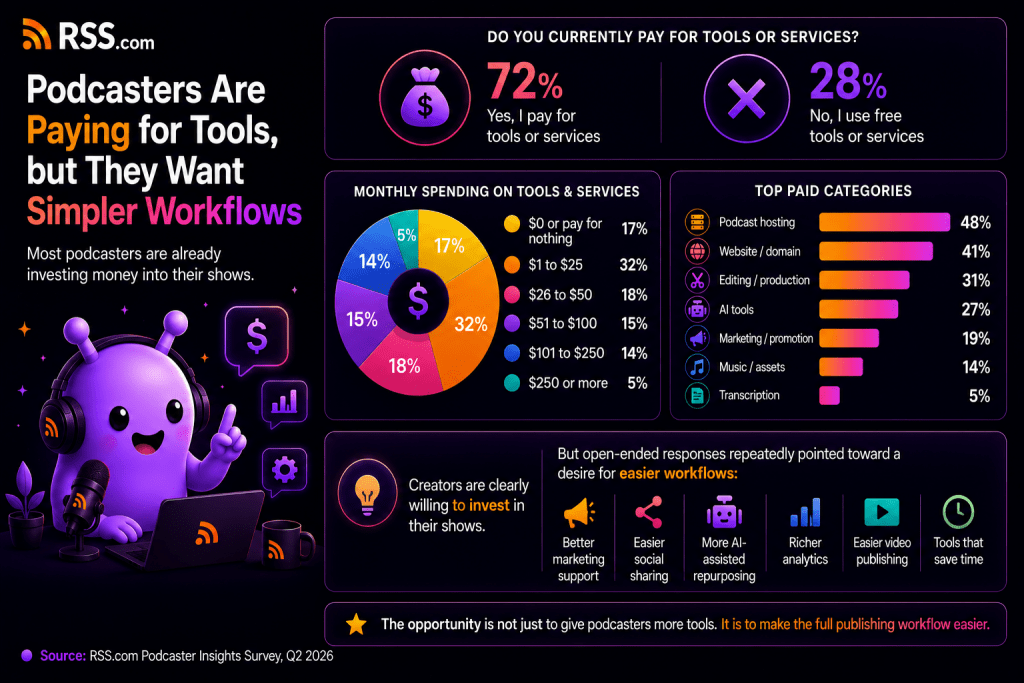
Monthly spending varied, but many respondents are operating on modest budgets:
- $0 or pay for nothing: 17%
- $1 to $25: 32%
- $26 to $50: 18%
- $51 to $100: 15%
- $101 to $250: 14%
- $250 or more: 5%
The most common paid categories were:
- Podcast hosting: 48%
- Website / domain: 41%
- Editing / production: 31%
- AI tools: 27%
- Marketing / promotion: 19%
- Music / assets: 14%
- Transcription: 5%
Creators are clearly willing to invest in their shows. But open-ended responses repeatedly pointed toward a desire for easier workflows: better marketing support, easier social sharing, more AI-assisted repurposing, richer analytics, easier video publishing, and tools that reduce the time required to produce and promote each episode.
The opportunity is not just to give podcasters more tools. It is to make the full publishing workflow easier.
What Podcasters Want Next
The open-ended responses add useful context to the quantitative findings.
When respondents described what would make podcasting easier, several themes appeared repeatedly:
- Better marketing and sharing support
- Easier social clip creation and episode repurposing
- Richer analytics and clearer performance insights
- More AI-assisted workflow tools
- Simpler editing, recording, and production workflows
- Better support for video publishing
- Clearer paths to monetization
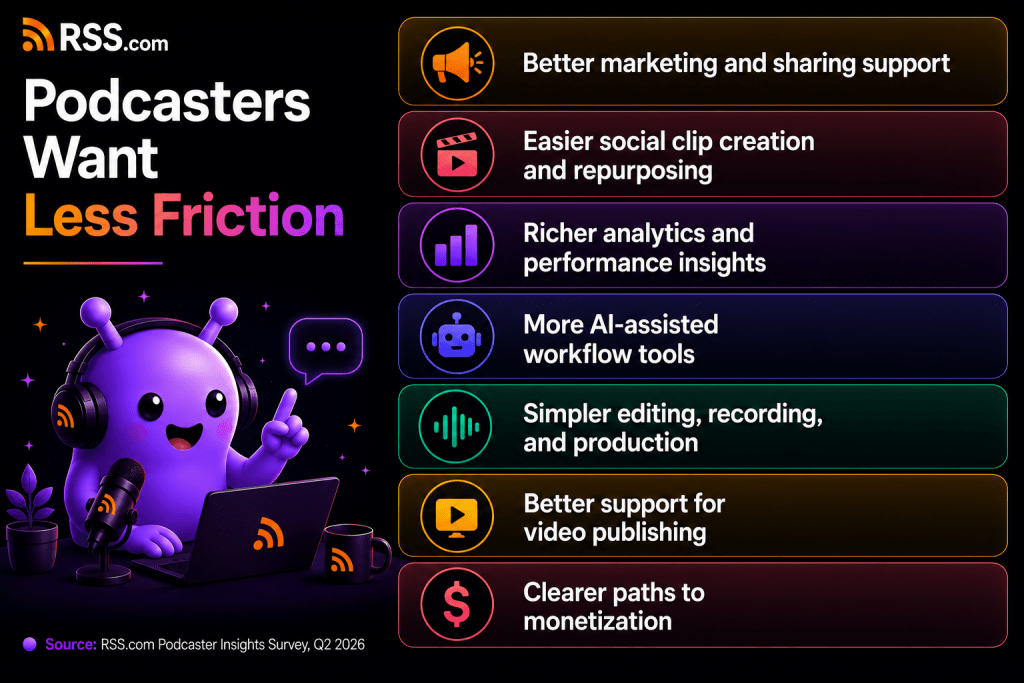
That feedback connects back to the central story of the survey. Podcasters are not only asking for more features. They are asking for less friction.
They want to publish consistently, understand what is working, share their shows more effectively, and grow without having to stitch together too many disconnected tools.
Survey Methodology
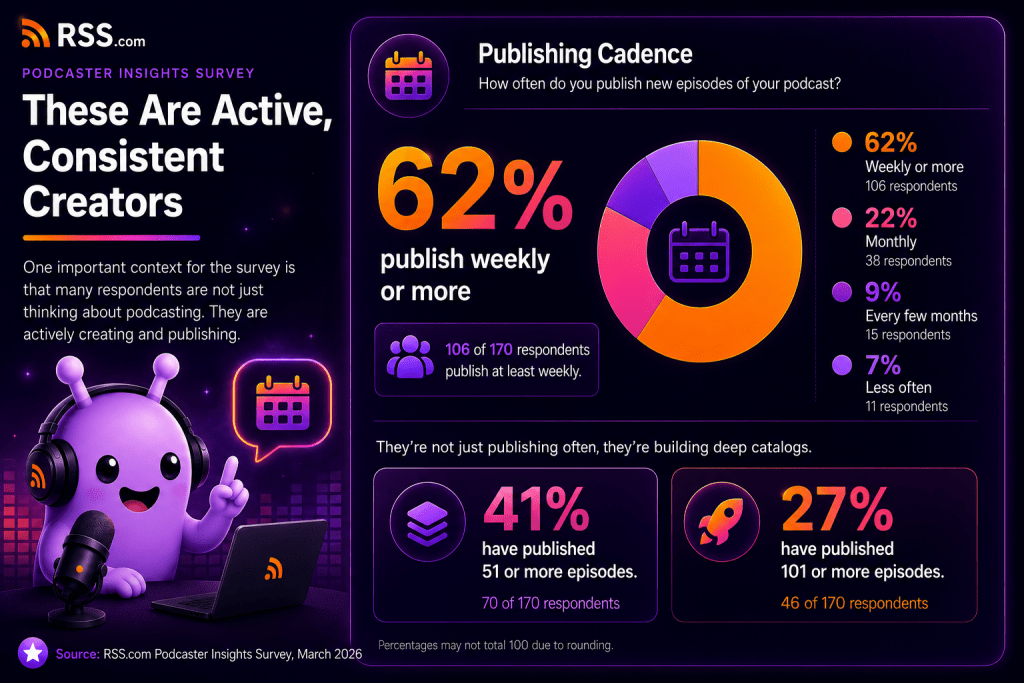
RSS.com surveyed 195 respondents in Q2 2026. Most core podcasting behavior questions were answered by 170 respondents, while some follow-up questions were shown only to relevant respondents. For example, monetization follow-up questions were shown based on whether respondents said they were currently monetizing. An optional open-text question about sharing links received 120 responses.
Because the survey was distributed to RSS.com users and respondents self-selected into participation, the results should be interpreted as directional insights from RSS.com podcasters rather than a statistically representative survey of the entire podcast industry.