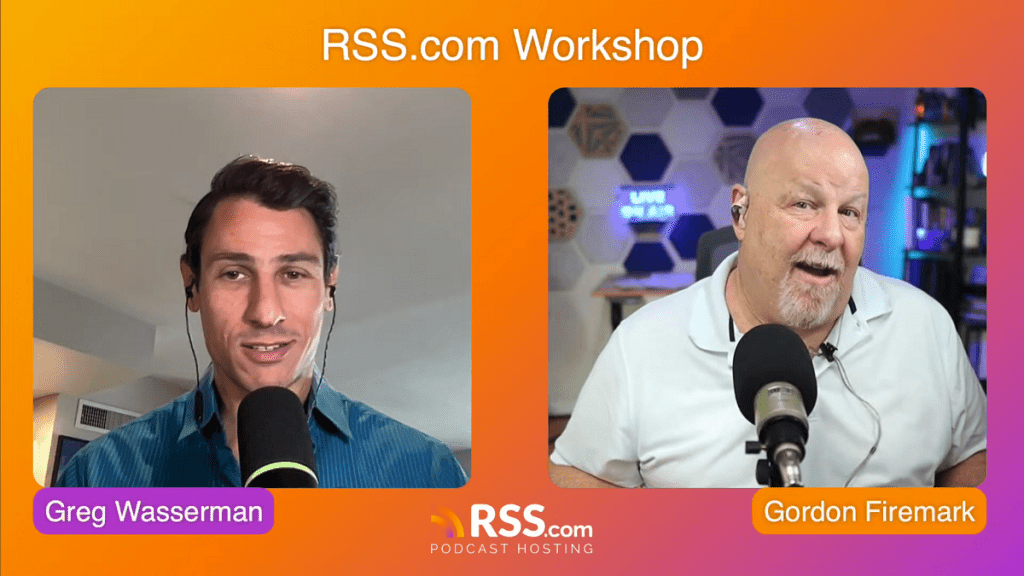
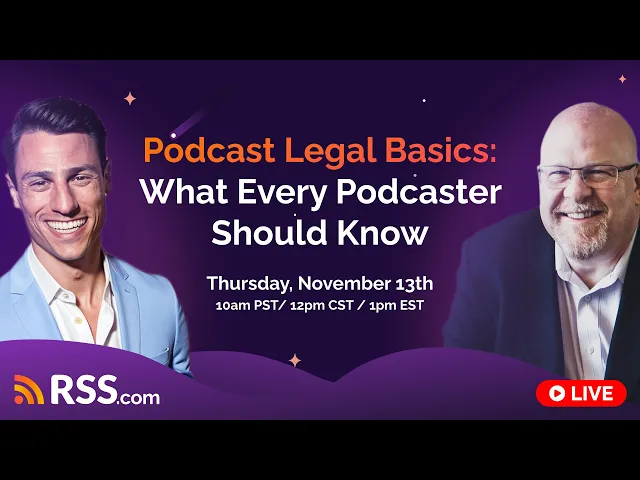
On November 13, 2025, RSS.com hosted entertainment attorney Gordon Firemark for a comprehensive live training on the RSS.com YouTube channel covering the legal essentials every podcaster needs to know. Known as “the Podcast Lawyer,” Gordon brought over 30 years of legal experience to help podcasters navigate contracts, intellectual property, monetization disclosures, music licensing, and liability concerns. Whether you’re just starting your show or looking to protect an established podcast, this session provides practical guidance on building a professional, legally sound podcasting business. Below you’ll find key takeaways from the training, followed by the full video and transcript so you can dive deeper into the topics that matter most to your show.
Key Takeaways
- Get guest releases signed! Every guest should sign a release agreement before appearing on your show to protect your rights to publish, edit, and repurpose content
- Contracts are essential. Have written agreements with anyone who touches your podcast (co-hosts, editors, producers, guests)
- Trademark early if possible. If your podcast name is valuable to your brand, consider trademarking it before someone else does
- Disclose paid relationships. FTC requires clear, conspicuous disclosure of any compensation, sponsorships, or affiliate relationships
- Music requires licensing. Use royalty-free music or subscription services like Epidemic Sound or Storyblocks to avoid copyright issues
- Fair use is a defense, not permission. Don’t rely on fair use for music or clips without understanding it could require legal defense
- Monitor what guests say. As the publisher, you’re liable for defamatory statements made by guests on your show
- LLCs aren’t always necessary. Weigh the costs and benefits based on your revenue and location before forming a business entity
Watch Podcast Legal Basics with Gordon Firemark: What Every Podcaster Should Know to Protect Their Shows:
Podcast Law 101: Contracts, Copyright, and Protection Strategies for Podcasters: Live Class Transcript
Please note: The transcript has been edited very briefly for readability. However, it was automatically generated using AI. Please excuse any typos.
Introduction
Greg Wasserman: Welcome everyone. I’m Greg Wasserman, head relationships for RSS.com and this is the November free training with RSS.com. And today we’re going to be talking about all things legal. If this is if you are here with the recording or live, thank you for tuning in. You are in for a great event as we sit down with Gordon Firemark who’s been doing this for 30 years.
He’s the podcast lawyer and we’re going to provide a slew of information regarding what it means to uh to think about your podcast from a legal standpoint. Cuz I can tell you the reason I brought Gordon in is I saw him speak at Podcast Movement and he was bringing in a bunch of little tidbits. I’m like, I had no clue about that. So, if I have no clue and I’ve been doing this for about 5 years, uh I can imagine many people are probably in the same boat uh that may be starting or like myself who’ve been doing this for a bit. So, without further ado, let’s bring in our guest here, Gordon Firemark. Gordon, great to have you.
Gordon Firemark: Hey, Greg, great to be here. Can you hear me?
Greg Wasserman: Thank you. Yeah, yeah.
Gordon Firemark: Okay, good.
Gordon Firemark’s Background
Greg Wasserman: So I guess the first thing is, is tell us a little bit about giving your mission. Let people know a little bit about yourself.
Gordon Firemark: So, as you said, people call me the podcast lawyer, and that is because I’ve been practicing entertainment media business and intellectual property law for, oh, gosh, 33 years now. And, I’m a podcaster myself. And so when I started my show, coming up on 17 years ago now, I went looking for legal, you know, doing the due diligence as a lawyer myself, I decided to investigate the resources and figure out what I needed to know about the law specifically for podcasters.
And what I found was there weren’t any resources. So I ended up sitting down and doing some research and identifying the areas where podcasting is different from film and television and music and, and all those things, and how everything sort of overlaps and, and wraps around each other, and that turned into a book. And when you write a book on a subject, you become an instant expert. I guess I could say that book is called the Podcast Blog and New Media Producers Legal Survival Guide, or just Podcast Law Book for short. And, it’s still the book on the subject. So it’s nice to be recognized as the author and as the expert of that kind of thing.
Greg Wasserman: Well, there you go. Now, you know everyone, we’ve got the expert here. So I guess if we dive into it, you know, the first question is always going to be around contracts, right? So do I need to create a contract with my co host? Do I need to create a contract for my guest? I mean, that was ultimately the question that started this whole conversation. Is your point about if I bring a guest onto my show, and even though I’ve sent them an email saying, hey, be a guest on my show, and they say, yes, I want to be a guest in your show, they’ve booked time to be on and record. That doesn’t actually mean that I have the right to the conversation and do whatever I want with it. They could ask to have it pulled. So, uh, let’s start there. Educate me – what did I get wrong?
The Importance of Guest Release Forms
Gordon Firemark: Well, you didn’t get anything wrong. It’s just that you didn’t take things quite far enough in, in the discussion. So the issue is this, that, yes, there’s this implied consent to be recorded when we show up to, you know, sit in front of a microphone on a camera and do an episode. But the question is, what’s the full scope of that consent? What can you do with that recording? What can’t you do? And it may not even include the right to publish it online. I mean, it’s sort of implicit that that’s what podcasting is.
But, you know, there could be an argument, Well, I didn’t know you were going to cut it up this way. I didn’t know you were going to do this. I didn’t know you were going to present to me that way or. Or that you were going to have other people on the show, that it was only going to be one segment, you know, so that consent, when it’s just implied from conduct, well, I think it’s also revocable and it’s also, again, the scope, the definition of what’s allowed is ambiguous. So that’s why I’ve been on a crusade for a number of years now to get every podcaster who has guests on their show to have those guests sign a release agreement. And that release is formal written consent to be recorded, to have it published, to have it edited, to have AI used to maybe take out noise and those kinds of things.
The release that I promote, podcastrelease.com includes that AI language. And just sort of the caveat that you can’t use the AI to change the meaning or the sound of the. Of the person’s voice, just. Just to sort of clean things up. And which I think is the way most of us would plan to use an AI tool anyway. So not too big of a stretch. The repurposing is another area where, you know, maybe you, after a few hundred episodes, you decide you’ve got enough to compile a book based on the interviews of people that you’ve talked to. So you want to be able to do that without having that guest from five years ago come out with [a] hand extended, saying, hey, where’s my piece of the action? Those kinds of things. Or, yeah, the takedown or.
This is one of the worst things that I see is the host shares a copy of the footage with the guest, and the guest then edits it or has their team edit it, and all of a sudden, there’s no host anywhere to be found. And the title of the show, nowhere. But okay, on that host, on the guest’s Instagram, there’s all this content, and it, you know, makes it look like it’s theirs. So as a host of a show, as a producer of a show, we want to own what we’ve created, and we put our time, energy and money and resources into. So the ownership questions become a thing as well. And so all of that is what goes into a proper podcast guest release.
Greg Wasserman: You heard it. I mean, I would never have thought about that until I heard that from you. And that’s why it’s great to have everyone hearing this now. So I actually went to your website and I got that form. So then anyone that’s listening, go to. What’s the website again?
Gordon Firemark: https://podcastrelease.com/.
Greg Wasserman: There we go. Easy, you’ve heard it. And if I just take the exact form you’ve got, I’m good. It’s, it’s, you’ve set it up so that there’s very little that a person needs to do besides that.
Streamlining the Guest Release Process
Gordon Firemark: What I generally recommend is just to streamline and make the process as friction free as possible is if you’re using a tool like calendly or acuity scheduling or one of those to book your guests to have your guests choose a time, build the form into that process so that they just as they’re going through, they’re checking boxes, they’re typing in their information, and then at the end they’ve got a box that says, I agree to the terms that are laid out above. And that’s enough for this kind of a contract.
Greg Wasserman: So not only is Gordon dropping in the legal advice here, he’s helping you with your strategies and your system. So take that tidbit, write that one down as well.
Gordon Firemark: Contracts are only valid and good if people will actually sign them. So you want to make it as easy as possible for them to sign it. I don’t want to say without thinking about it, but, you know, we click through, click wrap agreements all the time as we sign up for new services online. So it becomes sort of natural. Yeah, check, check the box and type your name.
Other Essential Podcast Contracts
Greg Wasserman: So, all right, so you’ve got the guest released. We’ve also talked about having other contracts. I think we’ve mentioned, you’ve mentioned to me you should have a contract with anyone that you’re doing business with. So who else are we missing here that a podcaster should be thinking about having a contract with?
Gordon Firemark: So my principle is that anybody who touches your podcast in any way, shape or form should be signed to a written contract or an online contract of some sort that articulates the rights and responsibilities of the parties. Who owns what, who gets what, what do you get to do with it? Same questions.
I sometimes refer to this as a podcast prenup. Certainly if it’s a co host or a co producer, you want to know you know, hey, if things don’t go well, who gets the house and kids, right? The audience that RSS feed is the kids, essentially, and the contents of the show is the house, right. All those assets. So you want to anticipate the possibility that there’s going to be some kind of a breakup down the line and, and try to address that.
Plus just giving clarity to, you know, how are we splitting revenues, how are we sharing expenses? Whose job is what in this whole mix? So co host agreements, co producer agreements. If you’re hiring an editor, that editor should sign a contract that says the work result, the results and proceeds of what I’m doing as an editor will belong to you, the company or the producer as a work made for hire. And that, that’s sort of magic language, but you have to be careful about how you throw it in there because here’s the thing.
When two or more people, well, excuse me, when one person who’s an independent contractor creates something original, creative work that’s copyrightable and contrary to what might, what we might think is how I’m paying for them to do this work. So therefore I own what they created. That’s not how the law works. Under copyright law, an independent contractor creates something, they own the copyright, unless they’re an employee where there’s full on payroll and all that, or there’s a written contract specifying that it’s a work made for hire that will belong to the employer in this scenario.
Greg Wasserman: So in this case, I guess it depends. But do you normally see me as the podcaster sending the contract to the editor or producer, or should I be expecting whoever I’m hiring as the editor producer, they would have a contract that I’d be signing as part of that work. Is it. Who do I typically see as is the person responsible here?
Gordon Firemark: It’s. I think it’s always better to be in control of the terms of the contract, if you can be. Now, that’s not to say you wouldn’t negotiate if the editor sends over their contract, you could always ask them, hey, drop, include this language, include a provision that says that. But it’s a good idea to just have a template in mind so you know what language you’re asking for.
My experience is that a lot of these freelancers who do this kind of work, they don’t even know that what I was just telling you about the contractor owning the stuff, and so they wouldn’t think to include those, those kinds of terms in the contract or they’re trying to get away with not including it. So you have to be critical and think about it. So it doesn’t really matter whose contract form it is, as long as it includes the stuff. And that’s the nature of negotiation, is have the conversation, talk it out beforehand so there’s no misunderstandings or hard feelings later on.
So you’ve created a great resource for guesting. Have you also created all these other resources for, as you just said, for the editor and producer for my co host, or is that where I’m turning to Gordon going, hey Gordon, I need you to help write this up for me?
Gordon Firemark: Well, either or. So, yes. The podcast Guest release@podcastrelease.com is my free lead magnet that gets people into my ecosystem and hearing from me with some frequency.
Greg Wasserman: It’s good content, everyone. I do it, I get it.
Gordon Firemark: Yeah. But I do have forms and templates for lots of the other kinds of things that podcasters and online entrepreneurs encounter. PodcastLawforms.com is my store where I offer those things for sale. They’re all fairly low priced, pretty easy, low cost kinds of things. But if you have a co host arrangement, you want a co host agreement, you can find one there. If you’re co producing a show where you’re going to share ownership of the thing, there’s an agreement form for that, your, your website terms and privacy policy and those kinds of things, we’ve got templates for those things as well. So really podcastlawforms.com or easylegaltemplates.com for the stuff that’s not directly podcast related.
Greg Wasserman: Perfect, thanks for that. All right, so let’s change tunes here and the next side is branding. Right? Like, do I need, do I need a trademark? I mean, if we think about most of us that are starting a podcast, I would love to make it my full time job. I would love to make money on this. But it’s a sense, it’s kind of a hobby right now. When do I cross the barrier of going, you know what, I’m going to trademark my brand, I’m going to trademark everything. I’m going to spend money right now, even more upfront to do that as opposed to most, you know what I’m worried about even starting and hitting play, and we’ve heard that plenty of times is you’re overthinking it. Just record and start getting out there. But we’re talking on the legal side, so where does that fit into it?
Trademark Considerations for Podcasters
Gordon Firemark: So great question. And the answer, like most lawyers will give to a lot of questions about do I need a trademark? Do I need this? Is it Depends. So sorry about that. But this is one of those where it really does. If the title you’ve chosen for your podcast is really distinctive and significant as a brand name, that is people will identify it as you are the source from, from which this content is coming, then that’s a, that’s a valuable thing. That’s trademark.
Trademark is a word, a symbol, a phrase, a logo, whatever, some kind of an indicator of source or origin that is affixed to goods or services. So you give a title to a podcast that’s you’re attaching it to those, to the entertainment or information service. So do you need a podcast? If it’s distinctive enough to qualify, then yes, you can get a trademark registered to protect against other people entering the marketplace and using confusingly similar titles. Right.
So the question to ask is, would it hurt if somebody else came along and started a show with the same or very similar name as mine? And if the answer to that is yes, then it’s time to consider a trademark registration. It’s not cheap, it’s not tremendously expensive, but you know, it’s an investment in, in the show. So you have to ask yourself, is this worth an investment of a couple of thousand bucks to, to protect against that possibility that there will be confusingly similar titles and shows out there?
Greg Wasserman: I like that you say investment, right? Because like, yeah, we’re always trying to tell you, look, you invest in your podcast, you’re investing in you hosting with RSS.com there’s an investment in your host, you’re investing in the tools and the platforms you’re using because you’re looking at this and treating it like a business. And that is going to separate you from someone who’s not. So that is a good point.
Gordon Firemark: We are all paying for services like RSS.com, like Streamyard or eCamm in the case of this live stream, those kinds of tools, and we pay for things like our microphone. We all are sitting on this call with probably thousands of dollars worth of gear to make it possible for us to record audio, to record video, to light us ourselves and, you know, decorations in the background and all of that kind of stuff. Isn’t it worth spending that kind of similar money, not, not extraordinary money, but a couple of thousand bucks to protect against these kinds of interlopers coming in with names that are confusing to the audience. And nowadays with the AI stuff happening, I think we’re going to see more and more and more shows on similar topics that adopt similar sounding names and brands. And it’s something we have to think about.
Greg Wasserman: So from that standpoint, if you’ve gotten your show and it’s been around for a bit, you didn’t go down the process of trademarking and then someone else came out and released the show and they decided to trademark it. Yep.
Gordon Firemark: Yeah, you’ve heard my story already. I’m going to tell the story.
Greg Wasserman: Okay.
A Trademark Cautionary Tale
Gordon Firemark: Okay. So the short answer is that the way trademark law works is first to adopt the brand and use it in interstate commerce is the. Is entitled to own and claim the trademark, but without registration, it’s very hard to prove that you were there first and that you know that you were entitled to sue or have an injunction or restraining order, those kinds of things.
The story that I’ll tell is about a very prolific podcaster who was there sort of in the earliest days, and one of the OGs in the podcasting space who had this really has a really cool title that uses. Is a kind of a buzzword that causes a sort of three triple entendre kind of a meaning in the space. And he launched his show, you know, what, 17 years ago now, something like that. He’s actually one of the people I followed when I was trying to learn how to podcast myself. And so he came to me maybe five, four years ago now and said, I want to register the title for my show. It’s been too long, I just need to get it going.
Okay, great. So we get the process started. I run a search and sure enough I find that there’s a new outfit that hasn’t even launched a podcast yet, but they’ve reserved the name by registering their trademark, which has the same buzzword in it, very similar sounding names, definitely the same commercial impression. And so anyway, we submitted our application for registration, but theirs is already in the works. And so before we were really able to file an OPP of their trademark or anything like that, theirs was approved. And that meant that my client’s application was blocked as long as they were still sort of pending and there.
So their application is approved, but they haven’t actually started using it yet. So it’s an intent to use a trademark. And that means that once they provide proof that they’ve put it into commerce, they can get their trademark registered. So meanwhile we’re waiting to see what’s happening because we could. There’s. We still had some aces up our sleeve and we were able to file a lawsuit to cancel the trademark registration once it was registered.
But we’re in limbo while they haven’t launched. So anyway, so that, you know, means a lawsuit and expenses and all that. We are waiting. And every six months they keep renewing, extending their time to file this proof until finally they got out to three and a half years or something like that. And the trademark office said, that’s it, you’re done, no more extensions, it’s abandoned. So it took almost four years for the registration, the application that we filed to actually get approved. And now he’s got the trademark and everything’s good.
Greg Wasserman: But during that limbo period, you kept producing, you kept creating, or you were, you had to stop.
Gordon Firemark: Well, actually, no, we didn’t have to stop because he was there first. So legally he had a right to keep using it, but we didn’t have a right to stop them from using it and causing that confusion in the marketplace. And, and you know, fortunately they never launched a show, so we didn’t actually have the problem of the real confusion. But it could have been a problem, especially if they had launched in a big way and put some real money behind it and things. So, you know, this all because he waited. He didn’t set up his protections early on in the process. And as a result, we ended up having this extra friction, extra trouble in the process. But all’s well that ends well.
Greg Wasserman: There you go. So make sure you put a lot.
Gordon Firemark: Of expense associated with it too. Right. I mean, he’s paying me to deal with this for every six months for three and a half years.
Greg Wasserman: So once again, if you plan better, if you, if you want to make this an investment, that is something you definitely should be looking at. Avoid the legal fees there later. Right. Dealing with like back issues, it’s like, all right, I need a better chair. It’s like, well, I’m not gonna spend the $200 to get a better chair. But then my back starts hurting and now I’m spending money. Yeah, right. Yeah, right, right.
Addressing Past Episodes Without Releases
Greg Wasserman: So there’s a question here that I saw in the chat that I missed and I want to come back to from our interview. If you run an interview based podcast and have already begun publishing that show.
Gordon Firemark: Yeah.
Greg Wasserman: Can you go back to your guests and go, hey, I’m sorry, I’ve got it. And I know I’ve had this recently, a show that I was on, they’ve updated their contract so they send it to me to say, please sign. But this is now an instance where I haven’t signed anything. And now the host is coming to me saying, oh, I would love for you to do this. What happens in that situation?
Gordon Firemark: Well, I mean, it’s fine to do that. It’s fine to go back and ask them for a signature after the fact. But I would say the more time that has passed, the less likely that person is going to actually sign because they just don’t want to be bothered with it. Right. That said, I don’t generally recommend going back for old, old episode guests unless you have a concrete plan to start repurposing and remonetizing that content in a different medium.
And I’m not saying, you know, putting your show from years ago back now on YouTube or something, but I’m saying if you decided to put a book together or put it behind a paywall, inside an online course or those kinds of things, that’s when you really need to consent because there’s money involved, there’s opportunities for trouble to come up. So, you know, you want to. I guess I would say let’s triage that problem. Let’s decide whether or not it’s bad enough to bother going.
Greg Wasserman: I don’t know. When I think about it, when I think about this question and listening to you talk, it’s like, imagine three years from now, a guest I had on my show, they were “small time” at that point, but three years from now, who knows, maybe they will blow up during the.
Gordon Firemark: News and now they’re running for president.
Greg Wasserman: Running. Right. Running for office. Right. So they may be going, all right, we got to get everywhere that you’ve spoken. We need to have it pulled down. So in some regards, it makes sense to just be proactive and go, you know what? I don’t know who this person is going to be. And this is my motto. Life is about time, relationships. You have no clue where anything’s going to take you. If you did, I would have a crystal ball and we’d probably not be having this conversation, but it might be worth it to just have it. But as you said, they may not sign it because it’s like, look, it’s been six months, it’s been two years, I’m not signing this. But, like, it’s really just going to come down to no harm, no foul. And if they say, no, I’m not signing it, then you just know I’m not going to be able to do additional stuff with that in the future. But at least I’ve got it.
Gordon Firemark: And we’re still sort of relying on that implied consent to something. And then we, you know, if it comes down to it, we can duke it out in court over what they actually consented to. And, you know, just ask the jury or the judge to be a reasonable person and inject themselves into that situation and say, this is what I think it means. You know, that’s not as good as a written contract, but it’s. It’s okay. Yeah.
And, you know, the fact of it is, the intervening time is going to lead to people feeling like, well, now I have to read and understand this thing. And there are always going to be people who won’t sign your release agreement. And to that I see they think highly enough of themselves or their agents and lawyers think highly enough of them that they don’t think they should have to sign something to get the media coverage. And maybe they’re right. We should make an informed decision about whether or not we’re going to have them on the show if they haven’t signed that release. So my experience is that the folks who put up roadblocks and, and object to signing a release, they’re the ones that turn out to be trouble all the way down the line. Either they’ve got a, you know, they come back with editing notes and they, well, you got to cut that out and you got to change this.
Or they’re the one who comes and says, no, you better just take that down. I know you invested your resources in making this episode, but too bad. Take it down. And what’s worse is if you’ve got sponsors of the show that are paying for that episode to be up and live, and you take it down because you had a demand from an unhappy guest, well, now you’re breaching the contract with the sponsor. So it’s a danger zone. So that if you’re going to be monetizing your show, especially having those contracts with everybody in contact, including the guests, including the co hosts, the producers, the editors, everybody really matters.
Greg Wasserman: There you go. All right, so planning ahead is a key one. Gordon’s already given us some systems. How do we operate that into our calendar and calendar booking options? Anything else that I’m missing on the branding side from a legal standpoint?
Gordon Firemark: Well, I think the branding is. You have to be consistent about it. So, you know, trademark protection comes from adopting the brand that you choose. And, you know, trademark and brand are sort of synonyms. I mean, after all, when I said that, what’s a trademark? It’s a distinctive word, phrase, or symbol that is affixed to the goods to indicate where they came from.
Well, what was it we used to do with cows where we’d sear a symbol into the Hide of the cow. And what was that called? Branding. Okay, so we’re applying a brand to the goods to tell what ranch it came from. Same exact thing here. So adopt a good. A good distinctive mark and use it consistently. That means don’t put the in front of it some of the time, but not all of the time. Don’t change the exact. The wording of things or the way it’s stacked or, you know, the more you can do to be consistent, the better in that arena. And that’s really just about being identified the same every time.
Monetization and Disclosure Requirements
Greg Wasserman: Amazing. All right, so the next one, if you brought up monetization sponsors, what do I got to know from the monetization, from an affiliate that. That becomes. I mean, RSS.com we’ve got the ability to use PAID. So your programmatic ads that are inserted in there. But also, I want to make money. I’m either, like yourself, promoting my goods, or I am getting paid by someone to promote it. What do I have to do from a legal standpoint within my podcast to let people know that I’m getting paid for whatever the service is?
Gordon Firemark: Yeah, well, all of what we’re talking about here is really just about professionalism, injecting a dose of professionalism into what we’re doing so that we’re best positioned to monetize and to grow our audience and influence and all that. When it comes to advertisements in your show, it needs to be pretty clear that what the person is hearing is now an ad. Sometimes that’s a host doing a host read. Just saying, okay, we got to pay the bills. So let me tell you about Casper Mattresses or whatever it is.
You’re welcome, Casper, you just got a plug, you know, so that’s one way of doing it. Another would be to have some kind of a sound effect or a segment divider that lets people know, okay, what’s coming next is different content.
When you’re doing affiliate ads or if you’re doing a show that you do unboxings or product reviews and things like that, there’s a lot of disclosure that’s required. The FTC, the Federal Trade Commission here in the states, is the consumer protection agency responsible for looking at false and misleading advertisements. And they consider that an endorsement is a kind of advertisement.
So if I’m talking about a product that I like and I’ve been compensated for reviewing it or saying what I say about it, then the audience has a right to know, because after all, they should make an informed decision to buy. Maybe they trust my word. But maybe they won’t if they know that. Well, Casper Mattress has paid me a bunch of money to say that, which they didn’t, by the way. I’ll just be transparent about that. Likewise, if you have a guest who’s paid to come on the show, pay to play, it’s a thing.
Doesn’t the audience have a right to know that this guy who just wrote a book about alternative medicine and is trying to sell the book, that he, you know, paid me 10,000 bucks to come on my podcast and talk about it? I think the audience has a right to know. So clear and conspicuous disclosure of any time, kind of beneficial relationship, whether it’s payment or they send you free goods or, you know, whatever.
And maybe you’re getting a commission, an affiliate transact. We’ve all heard those, those disclosures before. You know, there’s one guy who does a great job of it who just says, you know, I’ve got links to these things in my, in my show notes, and if you use one of them, I will get paid a little bit. It won’t cost you anything else. So thank you very much for using my link. That’s all you have to say. And I think that complies with Amazon’s rules in particular. They’re strict about it, but the FTC can be pretty strict, too.
Greg Wasserman: So do I have to say. So disclosure, does disclosure have to be in. So you know what I’ve got. If I’m thinking about podcasts, there’s a couple ways, right? So I’ve got a bing, a ding or whatever, a noise going like, all right, it’s going to be a commercial, which from a user standpoint, I’m going to skip because I’m like, oh, you’ve already kind of prepped me here, but I’m going to skip it there. Right?
So where’s the fine line of creating content? But also that legal piece, do I need to put that ding in there? Or knowing that a user is probably going to skip my ad now, or can I just weave my way and going like, you know what, my back is hurting. I always are talking about this like my back was hurting. I could use a good mattress right now and yada, yada, yada, yada, right? Go use my link. Yada, yada, yada, Right? Is it implied then that I’m getting compensated because I put in there? Or do I have to verbally put it into, hey, I’m getting paid for this, or does it just have to be in my show notes in the episode. And I don’t have to actually verbally say it on the episode. I’m good enough if it’s in the episode description, letting you know Gordon was paid for his time coming on this show. Casper’s paying me if you click on this and you buy it, or I’m getting paid directly by Brand X. Not from an affiliate standpoint, but they’re just paying me a straight cpm, which is completely different than an affiliate standpoint. So there’s a lot of nuances there. Walk me through that.
Gordon Firemark: Yeah. So we shouldn’t assume that our audience is picking up on those subtle cues. Okay. We should all. What the rule requires is clear conspicuous adjacent disclosure. And that means that when you say the message that you have to disclose about, you put the disclosure right next to it. And it needs to be as, as big and bold and loud as the, as the statement itself, the disclosure. And you know, it shouldn’t be, it shouldn’t be easy for your audience to miss it. I mean, of course, if they’re skipping around, they’re gonna, they’re gonna jump over things. But clear conspicuous adjacent, those are the, those are the rules. And you see it on Instagram, you see it on Twitter, and. And what’s the Other one on TikTok where you’ll see hashtag ad or hashtag paid or something like that.
Greg Wasserman: But that’s different because it’s visual versus auditory. So.
Gordon Firemark: Right. So with podcasts, if you’re doing an audio only podcast, then it needs to be an audible disclosure. But if you’re doing show notes, then it should also be in the show notes right next to that link. You can just say paid affiliate link, you know, something like that. And if it’s visual, if you’re doing a video show, then you may even, especially if you’re showing the product, you may even want to put up a disclosure on the screen. Say it out loud if you can. But you know, it may make sense just to have, you know, paid promotion or something like that come on the screen. And it’s always a fine line because we don’t want to be perceived as overly commercial, but we don’t want to.
Greg Wasserman: Give a person a reason to skip. Going like, all right, now a word from our sponsors is like, well, legally I had to put that. But now I know you’re going to skip the, the ad because.
Gordon Firemark: You know, do you though? Because I think that good shows with good hosts, when they say, okay, time to pay the bills or. And you know, this show is brought to you by. I don’t think everybody skips through it because they know it’s going to be 15 seconds and then we’re back to the meat of the show. If you are respecting your audience and honestly giving these disclosures is a form of showing respect to the audience’s intelligence and. And their rights, I think audiences will stick around for a little bit of that.
Now, if you’re going to say, well, let’s pay the bills. So here’s seven minutes of ads, which we’ve all heard those shows, right? Then, you know, you deserve to have it skipped over the whole show. So, yeah. So, you know, I think that’s the watchword, is be professional and show the appropriate respect to your audience and your guests and everybody else.
Greg Wasserman: So there you go. You could either do at the beginning and have the trust with your audience that they’re not going to be skipped, or as long as you’ve got it in there going like, you know, let’s talk about my back. And, you know, this was the. This little segment was brought to you by sponsor X or however you want to do it. But as long as you’re letting people know, there’s ways to do that.
Gordon Firemark: Well, and another component of this is truthfulness. So if you and I are talking and you talking about your back pain and I say, you know, ever since I got my Casper, Matt, I’m sleeping better, I’m waking up feeling better in the morning, I don’t have the back pain and the neck pain that I used to have, da, da, da, da. Then I better actually use a Casper mattress, right? And if not, then I should say, you know, I haven’t tried it, but I hear great things about this mattress or that nutritional supplement or whatever it is. So it needs to be truthful and it needs to be transparent. So they paid me to mention this product. You know, that’s a little overt, actually. But, you know, Casper is one of our sponsors of this show, and we’re really grateful to them for their support. That’s all you have to say.
Greg Wasserman: So from that standpoint, if. If the brand is not a sponsor, per se, they’re not paying me, but they’re paying me if you actually convert. So on the affiliate side, is there certain language that a person has to use? Because I’m going like, hey, this is sponsored by. But it’s technically not. But I want to make my show feel like I have a sponsor and it feels bigger than it is. Is there something I have to do on that?
Gordon Firemark: You know, I think that. No. I don’t think there’s any specific language you have to use. I mean, saying sponsored by implies a certain kind of a relationship that probably isn’t there when it’s an affiliate link. But I think it’s fine to just say, you know, we have a really nice arrangement with XYZ company who have agreed to give us a small commission on sales when you purchase using the link that we’re going to put in our show notes. So we’re really grateful for that and can’t say enough nice things about the company.
Greg Wasserman: There you go. I love it.
Gordon Firemark: It’s pretty easy to do it organically in a way that sounds conversational and, and friendly, I guess you could say.
Greg Wasserman: No, I mean, that’s. We. We’ve all heard the host red ads where it’s like, this sounds like an ad, probably because the brand is making them say X, Y and Z. And the, the best ads are those that sound really natural that, that, that get integrated into the show, become the content. I mean, this is what I tell anyone that’s. That’s watching this and listening to this.
Like, RSS.com we’ve got an affiliate program you’re hosting with RSS.com they should be a sponsor of your show going, this show is hosted on RSS.com and here’s my affiliate link. And if you’re looking to start a podcast, like, go ahead and sign up with my link and start hosting. And there you got a great staff and yada yada, and there you go.
Gordon Firemark: And when you use this coupon code that I’m providing you with from their courtesy, then, you know, everybody wins.
Greg Wasserman: Yeah, right. Exactly.
Gordon Firemark: Yeah. Be sure to ask for Greg.
Greg Wasserman: See me in the community. There you go. There you go. I don’t think I’m missing any questions, but if anyone’s got questions that’s in here, please put them in there. Is there anything else I’m missing on the affiliate sponsor disclosure side of things?
LLC Formation Considerations
Gordon Firemark: Not so much on that side of things. One question I get a lot about. Well, there’s a few questions we haven’t talked about. Music and clips and things like that. But one of the questions that I get a lot of is, do I need an LLC or a corporation for my podcast?
Greg Wasserman: Okay.
Gordon Firemark: And my answer is, again, it depends. It sort of depends on where you are financially, where you are geographically, because some places it’s more expensive to have an LLC than it is another, you know, depending on what state you’re in.
For example, here in California, it’s very costly and oftentimes it just doesn’t make financial sense until the show is generating lots of revenue. But an LLC is really good because it can insulate you from liability for the things that happen on or in your show. It can allow you to create that podcast prenup, kind of an agreement with your co hosts, your co producers, because everybody becomes a member of the LLC under the operating agreement that outlines the roles and relationships.
It also lets you raise financing if you need to get investors or something like that. And there are some tax advantages to having a business entity that can write off certain expenses that we ordinary individual mortals can’t. So there are lots of good reasons to do it. But you have to do the cost benefit analysis and really there’s no answer. But to talk to a lawyer, talk to an accountant who can really analyze whether or not it’s going to be beneficial or not for you.
Greg Wasserman: So you’re saying the fact that RSS.com allows people to start monetizing after 10 downloads, you’re like, great, I can start making income right away. So the cost benefit of what’s the write off of having an llc and the fact that at least I’ve got income coming in because, like, that’s always. And then you start talking about your affiliate codes and affiliate links and you can start making some money. But it’s, as you said, the cost benefit side of it.
Gordon Firemark: If the savings that you realize from having the LLC exceed the income that you would be generating. I’m sorry, exceed the cost of running the llc, then it’s worthwhile. So you are making enough income to justify the expense because of the savings and other benefits that you get then. Then, yes, but it’s. It’s not an easy equation. You really have to ponder it and think it through.
Greg Wasserman: I got one question here, going back to the affiliate side. Is it good enough to say we’re supported by affiliate partnerships with that work? I assume so.
Gordon Firemark: No, I think that’s not conspicuous enough and adjacent enough. I think that if you are, again, it has to be adjacent to the message. So if you say when you buy or if you say, hey, I love this microphone and I’m using it on my podcast and I’ve got a link to it in Amazon, then you haven’t met the requirement because you haven’t said, and when you use my link, I will get paid.
Greg Wasserman: So if I said we’re supported by our affiliate partnerships, such as, I have got this mic, here’s my link to buy it, I’m throwing in more there.
Gordon Firemark: Yeah, you might do Something like in the show notes, maybe you’d say, buy from our affiliate. Use our affiliate links when you buy, and we will see a little. A little commission on the sale, and we appreciate it. And then you can just list them all. But if you just make a blanket statement, there was a friend, actually a client of mine, who was doing something similar to saying, some of our links above may be affiliate links. And that doesn’t tell us enough information. So unless you’re going to go through the trouble of explaining what affiliate partnership means, and most of our audiences don’t know or care about that unless they’re also Internet marketers.
Greg Wasserman: All right, we’ve got two major content topics to continue to go through, so let’s go to the next one. You alluded to it, music royalty, and we’ve got a question in there already. So we’ve all heard people getting taken down because. By other platforms because of music. I know there’s a huge podcast network out there with most of their shows all in the music space.
And I’m always wondering, like, how much money are they spending to be able to play this music? Right? So, like, talk to me. What is it that I need to think about, not only for a popular song that I want to play in there and talk about it from that, but also my intro music and any other music that I’m throwing throughout the episode?
Music Licensing and Copyright
Gordon Firemark: Well, there are so many different permutations of what can go on here. One is that you want to use a particular track as the opening theme for your show. Back in the early days, everybody wanted to use the opening lick from AC DC Back in Black as the opener of their show Bomb. You know, I won’t sing anymore.
Greg Wasserman: He also does karaoke. Come on.
Gordon Firemark: Yeah, right. But, yeah, so. So that. That is the kind of thing that absolutely needs permission because, you know, there’s a. There’s a licensing industry around music for this kind of thing, so you need permission for that. Likewise, if you’re using music as sort of an underbed of. Of the. Of the content of the show, you know, just as underscoring or, you know, to accent a point or something like that. Same thing. If you’re not transforming that music, if you’re just using it to enhance to.
To sort of decorate the show, you’re going to need permission from the copyright owner. So copyright is an interesting thing because as I said earlier, when. When one person creates it as an independent, they own it. Likewise, when two or more people create something, they own it jointly. And so most of the stuff that we want to use in our show, a clip of audio, a clip of video, a piece of poetry, you know, reciting from a text of a book or something.
All of that is protected under copyright law. And that means that the owner has the exclusive right to copy, distribute, perform, display and make things based on or derived from the original. So that’s what copyright is. So you need permission from the owners of the musical composition, the songwriters and the publisher and you need permission from the record label that owns the recording to the song. So two permissions right there and two different sets of rights do you need. So it’s sort of four stop shopping just to get a music license.
So I generally am recommending to folks use royalty free music that you, you know, just pay for it once and, and, and don’t worry about it. Be wary. Because not all royalty free music is created equal. Some of them it’s a per use license fee and some of it’s a subscription or once you’ve bought it and downloaded it, you can use it over and over again. So you need to read those terms of use really carefully.
Greg Wasserman: I’m glad you brought that up because that was literally the question we’ve got here is the concern about royalty free music and wondering is it, am I going to get in trouble with it? And I think the answer there is royalty free music. It’s, it’s legit. Just read the terms in terms of what is, what is the royalty you have access to on, on the music?
Gordon Firemark: There are a couple of them out there that I really like and they, and both of the ones I’m going to mention are subscription based. So as long as you remain a subscriber, anything you produce during that time frame is grandfathered in you. Anything that’s in their catalog you can use. One of them is Epidemic Sound.
It’s great at 16, 17 bucks a month or something like that. And they’ve got access to this giant library of, of music that’s lots of different sounds and vibes and sound effects and things as well. The other one is Storyblocks, I believe it’s called that it’s not just music but like video clips and things like that where you can get.
And it’s similar, it’s a subscription that as long as you’re a subscriber, you use what’s in the catalog and include it in your show. And then you just. They have a way that you tell the them about your channels and then they don’t do takedowns and flag Infringements and things. So if they know that’s a YouTube channel that belongs to one of our customers, they just hands off with that YouTube channel, for example. So it’s pretty, it’s pretty slick approach and relatively cost effective.
Greg Wasserman: Well, to that point. And I was, it was, it wasn’t a question someone just asked, but I thought of myself is, so if I stop paying the $16 a month, do I have to take down my.
Gordon Firemark: Okay, well that’s what I mean by grandfathered. So anything you create while you’re a subscriber, you have permission for forever.
Greg Wasserman: Okay.
Gordon Firemark: Just don’t create anything new using that material after your subscription lapses.
Greg Wasserman: Gotcha. So three years from now, my back catalog, I. It worked good. Because I was paying for it at that point. Point.
Gordon Firemark: So that is maybe [you] decide to retire your show and there’s no point in paying for the license anymore, but all those old episodes can stay up and online and you don’t have to worry about it. Awesome. Yeah. Although I have seen a situation where somebody was subscribed to one of them and the company changed hands and then the subscription didn’t change hands or something. And so now it was the, the, the wrong company was the licensee under the. Yeah, so, but that was just, you know, an outline.
Greg Wasserman: Yeah.
Fair Use and Music Reviews
Gordon Firemark: So one other scenario that you mentioned in asking about music, if you don’t mind, Greg, is please. The scenario where you’re talking about the song. Right. Maybe you’re doing music reviews, you’re reviewing the album or, or the video or whatever the TV show, and you’re using clips that falls into an area where the phrase for fair use is thrown around quite a lot. And a lot of people know the term, but don’t really know what it means.
Greg Wasserman: So guilty, as I said.
Gordon Firemark: Yeah. Right. So let me, let me cover it really briefly. So fair. In the US we have free freedom of speech under the first amendment of our Constitution. Free speech, free press. That means that when you make a law that says you can’t use that thing that you want to use, you can’t play that song in your podcast. Well, guess what? Isn’t that an abridgment of my right of free speech? So the thing is that copyright law is also enshrined in the Constitution.
So we have this inherent conflict that needs to be addressed. So the court, starting in the mid-1900s, early 1900s, started addressing this and created this defense to claims of infringement based on the First Amendment called fair use, basically saying that under certain circumstances we are going to allow what would Otherwise be an infringement of the copyright when it sort of supports a public policy favoring free speech. So we have to look at four balancing factors.
You could say, what’s the purpose and character of the, of the, of the infringing work? What’s the nature of the original work? What’s the amount and substantiality of the portion that’s been used without permission? And then the fourth factor is the impact or effect on the value of the original or the market for the original. So here, when it’s music, we have a very robust marketplace for music licensing. So the impact on the value is always going to be fairly high. So maybe using just a tiny little snippet of a piece of music, or it’s not a very substantial part of the song or something like that.
And the real question is, are you somehow transforming the nature of that original? So if you’re talking about a song in, in a music review where you’re sort of doing a documentary analysis of the song, that’s very different. It’s educational and informational rather than just being a substitute experience. Hey, listen, let’s listen to the song, right? So that might be fair use, it might not. Mostly, I think most review shows tend to land as fair use. And we don’t hear about a lot of copyright owners going out after them.
However, there’s a guy on YouTube who does these very detailed, complex breakdowns of pop songs. His name is Rick Beardo, and I think he’s a drum guy originally, but he does these deep dive analyses and he keeps getting YouTube strikes, content strikes against his stuff and having to fight them. And he’s got lawyers involved and spending, you know, tens or hundreds of thousands of dollars defending himself so his channel doesn’t get taken away. So there is a scenario where it isn’t fair use or you may have to fight to prove it’s fair use. So you gotta choose your battles. It’s a defense to copyright infringement, and that means that someone’s either suing you or making a claim and you gotta defend it. So that’s why I generally recommend just, just pay for the music you’re gonna use. And don’t expect to be using the latest from the Rolling Stones or the Beatles or. Well, the latest from the Beatles. That’s weird, but you know what I’m saying.
Greg Wasserman: Yeah, yeah.
Gordon Firemark: Basically the latest dual lethal.
Greg Wasserman: Use your discretion here and know that if something does happen, if you do get a legal takedown request, it’s, it’s, it’s probably justified. At the same time, we’ve seen it and I’ve seen it a lot, which is why, you know, RSS.com we’re big proponents of, hey, if you get taken down from Spotify or YouTube as. Because of their own technology, their own views of, of rights and so forth, like that’s going to happen and you’re going to spend the time trying to fight it. And most of the time it’s very difficult to do that. So know that you may not get taken down from other listing platforms, but those two may just based on their, their own contracts with music companies and so forth.
Gordon Firemark: Yeah, yeah. You know, and as you mentioned, the technology, right. YouTube has the Content ID system and Spotify has a similar program that sort of algorithmically goes through and looks for music and just actually just sort of deletes episodes from, from time to time. They don’t even ask or give you an alert. I think they do have to give you some kind of an alert that it’s been taken down. But it is what it is. But companies, other companies, other hosting companies like rss, like Spot, like not Spotify, like I heart other. These other companies have, you know, they have to protect themselves against being sued for contributory infringement because they’re participating in the distribution of that allegedly infringing material.
So the way the DMCA, the Digital Millennium Copyright act works is that if somebody sends a notice to the company, hey, this piece of stuff on your service is infringing on my thing here. So take it down. The company is insulated from lawsuits. It’s what we call a safe harbor from these lawsuits as long as they have a policy for taking it down and they follow the law about how to do that. And that gives the alleged infringer a chance to repost the material, get it put back up by sending a counter notification. It’s sort of complicated stuff, but that’s why these companies are taking stuff down, is because they’re, they kind of have to if they don’t want to get sued. We can debate all day long whether or not it really works or not, but it’s a bit of a game of whack a mole if you’re the owner of the copyright.
Defamation and Libel
Greg Wasserman: Well, last topic here in the last few minutes and we could keep talking about this, but this is why you’ve got your resources on your website and this is why people should pay attention. But the last one is I come I start speaking poorly about Gordon on my podcast, right? I. I should be able to say whatever I want. I mean, it’s a podcast. Right. Like I could speak it. We can put [out] false lies. We can do defamation. Yeah. So let’s talk about defamation, libel. And, and what kind of, what do we have to, to worry about with our podcast and what we do and don’t say?
Gordon Firemark: Well, leaving aside the aphorism that there’s no such thing as bad publicity, there is such a thing as bad publicity. When somebody comes out and says something false that’s harmful to [their] reputation. That is what we call libel. Libel is the digital transmitted, published version of defamation. The oral exchange of the same information would be called slander, just for people’s clarity. So defamation is a false statement about a person that causes them harm to their reputation or their standing in the community. And yeah, that. You’ve got to be careful if you are creating content where you’re talking about people or talking about people, even sort of in the abstract, you know, the president of that company, not naming the person still possible to identify who is the president of that company. Right.
So if, if you’re, if your information is false, you could be liable for the harm that that causes. So that means you have to fact check. You have to verify that everything that is said that could potentially be harmful. And sometimes that’s sort of a hidden target. You have to fact check. Right. So yeah, that’s sort of the basic message. Have multiple sources that corroborate what you’re saying, that kind of thing. And be careful as a host, if your guest comes on and says so and so is a pedophile, you better be able to show that they were convicted of a crime of pedophilia. If you’re going to call them that. Calling somebody a psychopath, well, that’s a psychological diagnosis. But again, is it real or is it Memorex?
So do the fact checking as much as you can. When you are talking to a guest and they say something controversial, controversial, call them out on it. Wow, that’s quite a statement. Where do you have support for that? Or is this just an opinion and give them a chance to couch it as their opinion? Because opinion is genuinely truthful, held view of something and that’s protected speech. You’re allowed to have your opinion and even tell people what your opinion is. As long as you’re not telling it as a fact, so am I.
Greg Wasserman: So if you said something like that as the host of the show, are they coming after me for bringing someone on to my show who I can’t control what this person says or is it. Yes, you can control you can’t control what they say, but you could control. Did you put that episode up? Did you put that information out?
Gordon Firemark: Well, let me ask you this. If, if a journalist wrote something false about you in the New York Times and it harmed your reputation, would you sue the journalist or would you sue the New York Times?
Greg Wasserman: New York Times.
Gordon Firemark: You sue them both.
Greg Wasserman: Okay.
Gordon Firemark: The publisher is liable for publishing the harmful information. Now, there are exceptions and defenses for bonafide media companies, and I think we as podcasters could take advantage of some of those where we’d have to prove more than mere negligence in order to make a claim against a podcast or a news media or something like that.
And when the person we’re talking about is a public figure or a public official, they have to prove an extra element, and that is that the statement was published without knowing knowledge of the falsity or reckless disregard. That’s what we call actual malice. So when you’re talking about the president or your congressman or the sheriff of your town or something like that, they have a little extra hurdle to get over to prove a case of defamation. It makes it pretty hard to prove you didn’t, you knew or should have known that it was false.
Closing Thoughts
Greg Wasserman: Sweet. Well, we’ve covered a lot here. Is there anything in the last few minutes that you want to leave anyone that’s either paying attention now or watching this in review? Right.
Gordon Firemark: Yeah. Well, I think I want to just come back to this notion of injecting a dose of professionalism into everything we do. And my, at my, my mission in life is to help creators get their messages out so they can have the impact and the influence that they want and achieve some income that they want as well. And the way to do that, I suggest, I will tell you, is to get your legal and business affairs things taken care of as early as possible, get squared away, have a system in place for protecting your intellectual property, for onboarding your team, for making contracts with the folks that you need to make contracts with, and, you know, just a structure for the business, that LLC or that corporation, if it makes sense or if nothing else, having a partnership contract with your co producer or something like that. So systems is really the answer to that. And I can tell you more about systems if you like.
Greg Wasserman: I love, I love the fact that you, you hammered that. Even coming at it from a legal lens, Gordon’s coming at it with the same lens that you should be thinking about, systems process strategy. And if you have, and I know we, we stress you’ve heard this, probably a thousand times in the sense of just hit play, just hit record and get something out there. You’re overthinking, you’re overthinking. But there is something to be said about having your systems, your process, your strategies in place because they’ll protect you. That will also make things easier and will probably stop you from fading in the long term because you’ve got a system in place. So with that, Gordon, last thing, I guess I know you’ve said it, but where can people find you?
Gordon Firemark: Well, my name is an easy one to remember, so go to gordonfiremark.com that is where I have all of my online courses, my legal forms and templates, my free training and stuff like that. You can find me on YouTube and, and most social media as G. Firemark. I think Instagram. It’s my full name, Gordon Firemark, because, you know, nothing’s ever easy. And, then if you’re interested in my podcasts, tune into my YouTube weekly podcast on Thursday afternoons, Legit Podcast Pro, where I share some short tips for creators to learn more about this kind of stuff we’ve been talking about today. And my old show, long one long running show, 16 plus years in the works, is called Entertainment Law Update. And you can find that in all the usual places.
Greg Wasserman: Amazing. Well, Gordon, thank you so much for spending the time with us today and everyone that’s watching, thank you guys for spending the time making it all the way here to the end because we filled an hour with a lot of information and we’ll be having a lot of resources. But once again, RSS.com is the place to start your podcast to monetize and we thank you for this. And we’ll have our next training going on in the next month. So with that we’ll sign off and thanks a lot.
Gordon Firemark: Thanks for having me. It was great.
Greg Wasserman: Likewise.
About the Hosts

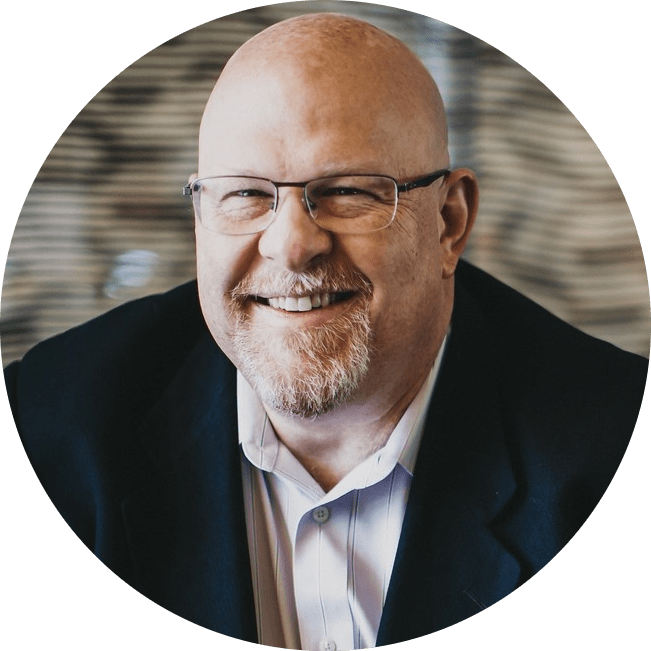
Gordon Firemark is a Los Angeles-based entertainment lawyer, producer, and educator known as “The Podcast Lawyer™” for his expertise in podcasting and digital media law. He advises creatives in film, theater, and new media, and is the author of The Podcast, Blog, & New Media Producers’ Legal Survival Guide. Firemark also hosts the “Entertainment Law Update” podcast.
Greg Wasserman has worked across the podcasting ecosystem, leading three listening platforms, helping shape an AI-powered content repurposing tool, and now serving as Head of Relationships at RSS.com, one of the world’s top podcast hosting providers. But his impact doesn’t stop there. Greg is a connector across industries, known for creating conversations that spark unexpected opportunities.