Unapologetic Edge: Where Grit Meets Growth

Unapologetic Edge: Where Grit Meets Growth

by Philippa Scott
Season 1
Episode 12: Neurodivergence and Perimenopause: The Hidden Psychosocial Risks Leaders Can't Ignore
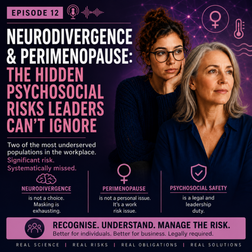
What if some of the biggest psychosocial risks in your organisation are sitting inside populations your strategy has filed under diversity, inclusion or personal health? In this episode of Unapologetic Edge, Philippa Scott explores two of the most systematically underserved populations in the Australian workforce: neurodivergent employees and women in perimenopause. Many neurodivergent employees are carrying the invisible cognitive and physiological cost of masking in workplaces designed around neurotypical norms. At the same time, women in perimenopause may be managing disrupted sleep, cognitive changes, anxiety, fatigue and significant shifts in capacity while being assessed against performance baselines established before their physiology changed. These experiences are often treated as individual issues. The workplace consequences are much bigger. In this episode: • What neurodivergence means in the workplace • Why masking creates an invisible additional job demand • How neurotypical workplace design can increase psychosocial load • Why disclosure should not be the foundation of a neurodivergence strategy • How managers can better support neurodivergent employees • Why perimenopause belongs in the workplace psychosocial safety conversation • How hormonal changes can affect sleep, cognition, concentration and workplace capacity • Why senior women may leave roles during perimenopause • Practical workplace adjustments that can reduce unnecessary load • The common risk connecting neurodivergence and perimenopause • Why invisible psychosocial risk is still organisational risk The central question for leaders is simple: Does your psychosocial safety strategy account for the load your organisation cannot easily see? Resources 👉 Take the Burnout Audit https://link.ashleyshaw.ca/widget/quiz/JRjMsrscDzvbw5M6XW1S 👉 Book a Strategy Call https://calendly.com/pippa-fantasticfutures/strategy-session About Philippa Scott Philippa Scott is a psychosocial safety specialist and nervous system-informed leadership consultant. Through Unapologetic Edge, she helps leaders and organisations understand the human mechanisms underneath burnout, workplace behaviour and psychosocial risk.


The High Performer Who Is About To Quit (And Won't Tell You)
Episode 11: Why High Performers Burn Out Quietly Most organisations assume people in distress look distressed. The problem is that high performers often don't. In this episode of Unapologetic Edge, Philippa Scott explores one of the biggest blind spots in psychosocial safety and burnout prevention: the employees most at risk of significant burnout are often the least likely to tell you they're struggling. Because high performers have built their identity around being capable. Around managing whatever comes their way. Around being the person who keeps everything moving when everyone else is overwhelmed. The same qualities that make them valuable often make them invisible when they're approaching burnout. In this episode: • Why high performers are underrepresented in burnout research • The hidden relationship between performance and masking • Why high achievers often avoid asking for help • How burnout presents differently in high performers • The early warning signs leaders miss • Why increased output can be a sign of burnout • The role of nervous system activation in high achievement • How psychosocial hazards disproportionately affect high performers • Why your best employees often leave without warning • What leaders can do differently Resources 👉 Take the Burnout Audit https://link.ashleyshaw.ca/widget/quiz/JRjMsrscDzvbw5M6XW1S 👉 Book a Strategy Call https://calendly.com/pippa-fantasticfutures/strategy-session About Philippa Scott Philippa Scott is a psychosocial safety specialist and nervous system-informed leadership consultant helping organisations understand the human factors behind burnout, psychological safety and sustainable performance.
Why do I get defensive in difficult conversations?
Why do intelligent, capable people suddenly become defensive, reactive, dismissive or withdrawn during difficult conversations? Most people assume it's a communication problem. Often it's a nervous system problem. In this episode of Unapologetic Edge, Philippa Scott explores what is actually happening inside the brain and body during difficult conversations, workplace conflict, performance reviews, leadership discussions and moments of perceived challenge. Because your nervous system is not designed to be rational under threat. It is designed to keep you alive. The problem is that modern workplaces routinely trigger the same threat response that evolved to protect us from physical danger. When that happens, your ability to listen, think clearly, stay curious and make good decisions begins to narrow. Understanding this changes the way you think about leadership, communication, workplace relationships, psychological safety and psychosocial risk. In this episode: • Why difficult conversations trigger threat responses • What happens when the nervous system detects danger • Why leaders become defensive • How threat responses impact communication • The relationship between nervous system regulation and psychological safety • Why regulation is not the same as staying calm • How activated leaders unintentionally create psychosocial hazards • Why workplace conflict often becomes repetitive and difficult to resolve • The hidden nervous system problem underneath many organisational challenges Resources 👉 Take the Free Burnout Audit Discover which dimensions of psychosocial load, stress and burnout may be impacting your performance, wellbeing and capacity. https://link.ashleyshaw.ca/widget/quiz/JRjMsrscDzvbw5M6XW1S 👉 Book a Psychosocial Safety Strategy Call Discuss psychosocial hazards, leadership capability, workplace wellbeing, burnout prevention and compliance obligations. https://calendly.com/pippa-fantasticfutures/strategy-session About Philippa Scott Philippa Scott is a psychosocial safety specialist, trauma therapist and nervous system-informed leadership consultant helping organisations understand the human factors that drive burnout, psychosocial risk and workplace culture.
Can a workplace wellness program actually make burnout worse?
Most organisations have wellness programs. Most organisations still have burnout. That's because burnout isn't primarily a wellbeing problem. It's a systems problem. In this episode, Philippa Scott explains why many workplace wellness initiatives fail to create meaningful change, how psychosocial hazards drive burnout, and why Australian organisations need to focus on risk management rather than symptom management. If you've ever wondered why employee wellbeing programs aren't producing better outcomes, this episode explains the missing piece. n this episode you'll learn: ✔ Why workplace wellness programs often fail ✔ The difference between wellbeing and psychosocial safety ✔ Why EAP programs are not psychosocial risk controls ✔ What Australian WHS legislation actually requires ✔ How leaders can reduce burnout at its source ✔ Why managing hazards matters more than managing symptoms Questions Answered Why are wellness programs not reducing burnout? What causes workplace burnout? What is psychosocial risk? What is psychosocial safety? How do employers manage psychosocial hazards? Why are employees still stressed despite wellbeing initiatives? Resources 👉 Take the Burnout Audit - https://link.ashleyshaw.ca/widget/quiz/JRjMsrscDzvbw5M6XW1S 👉 Book a Strategy Call - https://calendly.com/pippa-fantasticfutures/strategy-session
Unapologetic Edge | The 14 Psychosocial Safety Hazards Every Leader Must Know
Are you legally required to manage psychosocial hazards in the workplace? What are the 14 psychosocial hazards under Australian WHS legislation? How do you identify psychosocial risks before they become burnout, turnover, complaints, workers compensation claims, or regulatory issues? In this episode, psychosocial safety specialist Philippa Scott explains all 14 psychosocial hazard categories that Australian organisations are required to identify, assess, and manage. You'll learn: ✔ What psychosocial hazards are ✔ Why psychosocial safety is now a workplace health and safety obligation ✔ The 14 psychosocial hazards explained in plain language ✔ Common workplace examples of each hazard ✔ What leaders, HR professionals, People & Culture teams, and business owners need to do to reduce psychosocial risk ✔ The difference between wellbeing initiatives and actual psychosocial risk management Whether you're a leader, manager, HR professional, WHS practitioner, safety officer, or business owner, this episode provides a practical introduction to Australia's psychosocial safety requirements. Questions Answered In This Episode What are the 14 psychosocial hazards? What is psychosocial risk? What is psychosocial safety? What are employers legally required to do? What are examples of psychosocial hazards in the workplace? How can organisations identify psychosocial risks? What is the difference between burnout and psychosocial risk? How does psychosocial safety legislation affect leaders? ⏱ TIMESTAMPS 0:00 – Introduction & strategy call offer 0:29 – Why 14? The legal landscape explained 2:25 – Hazards 1–5: Job Demands, Low Control, Poor Support, Lack of Role Clarity & Poor Change Management 4:57 – Hazards 6–10: Recognition, Organisational Justice, Workplace Relationships, Remote/Isolated Work & Physical Environment 7:28 – Hazards 11–14: Violence & Aggression, Bullying, Harassment & Conflict 9:11 – What the legislation actually requires (and what it doesn't) 10:27 – Wrap-up, next week's episode & how to take action About Philippa Scott Philippa Scott is a psychosocial safety specialist, nervous system-informed leadership consultant, trauma therapist, speaker, and founder of Unapologetic Edge. She helps organisations understand psychosocial risk, leadership behaviour, workplace burnout, neurodiversity, perimenopause, and the hidden factors affecting employee wellbeing and performance. 🔗 LINKS & RESOURCES 👉 Not sure where your organisation actually sits? Take the free Burnout Audit: https://link.ashleyshaw.ca/widget/quiz/JRjMsrscDzvbw5M6XW1S 📅 Ready to turn your list into action? Book a Strategy Call: https://calendly.com/pippa-fantasticfutures/strategy-session?month Related Topics Psychosocial Safety Psychosocial Hazards Workplace Burnout WHS Legislation Australia Leadership Development Psychological Safety Workplace Wellbeing Nervous System Leadership People and Culture Human Resources Workplace Mental Health Burnout Prevention Employee Wellbeing Australian Workplace Health and Safety
You're Not Managing Stress. You're Managing Liability.
Psychosocial Safety Is Now a Legal Duty (Australia): What Leaders Must Do in 2023+ Philippa Scott introduces a new Unapologetic Edge series on psychosocial safety, asking leaders when they last felt genuinely confident their organisation isn’t harming employees in a way that would withstand inspection, a claim, or legal scrutiny. She explains that in 2023 WorkSafe Australia updated model WHS regulations to explicitly include psychosocial hazards, making psychosocial risk a legal duty of care like physical risk, with 14 hazard categories organisations must identify, assess, control, and review. Scott argues most organisations manage few or none and often rely on engagement surveys, EAPs, or wellbeing programs, which support individuals but don’t meet legal obligations or address structural causes. She highlights leadership behaviour as a key driver of hazards and leaves listeners with an audit-readiness question, inviting them to share the episode and complete a free burnout audit in the show notes. 00:00 Burnout Audit Invite 00:25 Are You Causing Harm 01:20 Why This Matters Now 02:19 What Changed Legally 03:33 Psychosocial Hazards Explained 04:39 Leadership As The Vector 06:32 Risk Management In Practice 07:36 Why Surveys Aren't Enough 08:28 Audit Question And Next Steps 08:59 Wrap Up And Episode Two Most leaders are behind on psychosocial safety not because they don't care, but because nobody explained what the legislation actually requires. In this episode, Philippa Scott breaks down what changed in Australian WHS law, why leadership behaviour is the primary vector for psychosocial hazards, and the specific gap between what most organisations think they're doing and what they're legally required to do. inks: Burn Out Audit https://link.ashleyshaw.ca/widget/quiz/JRjMsrscDzvbw5M6XW1S | Book a Strategy Call - https://calendly.com/pippa-fantasticfutures/strategy-session?month | Website unapologeticedge.com
You're Not Resilient. You're Just Really Good at Enduring.
Most leaders are exceptional at resilience. The problem is they've quietly lost touch with capacity, and they've rebranded the gap as strength. In this episode, we pull apart two words that get used interchangeably and create entirely different lives. Resilience is your ability to return; capacity is how much you can hold. They need each other, but confusing them produces elite-level endurance dressed up as wellbeing. We cover: — Why resilience without respect for capacity becomes endurance — How leadership culture actively rewards this confusion — What capacity actually is (and why it changes constantly) — Where leaders specifically come unstuck — Three reflection questions that tend to get loud at 3am This one is for leaders, coaches, and anyone who's ever congratulated themselves for getting through something they probably shouldn't have had to get through at all. Reflection prompts from this episode: 1. What are you currently calling resilience that might actually be overextension? 2. Where have you increased your ability to cope instead of changing the conditions? 3. If you genuinely honoured your real capacity this month — not your aspirational capacity, your actual one — what would need to change? www.unapologeticedge.com
The Hidden Cycle of Motherhood: Why Perimenopause Isn't the Problem — It's the Wake-Up Call | Unapologetic Edge
Most women arrive at perimenopause believing something has gone wrong with them. The rage feels disproportionate. The exhaustion goes beyond tired. The grief doesn't have a clear source. And yet the people around them — sometimes even their doctors — hand them strategies for coping with symptoms rather than language for what's actually happening. In this episode, Philippa Scott introduces The Mother Awakening Cycle: a six-stage developmental framework built on more than two decades of work with mothers across every stage of life. The cycle describes the identity and nervous system transitions that motherhood initiates — not once, but repeatedly — and explains why perimenopause is not the origin of the crisis. It is the moment the crisis can no longer be ignored. The six stages are: Initiation, Accommodation, Fragmentation, Awakening, Reclamation and Integration. Each stage is explored through the specific lens of the perimenopausal woman — the one who held everything together for decades, who is only now beginning to understand what that holding cost her, and what becomes possible when she finally stops. What You'll Hear in This Episode Why perimenopause is one of the most significant Initiations a woman will ever move through — and why nobody prepares us for it as a developmental threshold rather than a medical inconvenience. The Accommodation stage: the years of stretching and adjusting and coping that look like capability from the outside while the nervous system quietly tightens beneath the surface. Fragmentation: what it actually is when the system can no longer hold the load — and why it is the signal, not the diagnosis. The Awakening: why perimenopause and psychological awakening so frequently arrive together, and what becomes possible when a woman understands that the cracking open is the invitation, not the collapse. Reclamation and Integration: what it looks like on the other side — not perfect, not fixed, but regulated, grounded, and finally done with a life that stopped fitting. The One Sentence to Take Away Motherhood is a cycle of awakening. Not a role to survive. Mentioned in This Episode The Mother Awakening Cycle — Philippa's six-stage developmental framework for maternal transition The Regulated Mother Method — the methodology supporting nervous system regulation and identity reclamation - https://www.fantasticfuture.com.au/mother-awakening-regulated-method Burnout Audit — free diagnostic tool for women in perimenopause: LINK Sacred Reclamation Challenge: LINK Next Week Week 2: The Accommodation Trap — how perimenopause collides with years of invisible stretching, and why the most capable women are often the most at risk. Connect With Philippa Website: www.uapologeticedge.com Instagram: https://www.instagram.com/unapologetic_edge/ Facebook: https://www.facebook.com/profile.php?id=61580380703849 YouTube: www.youtube.com/@unapologeticedge-perfectstorm
Resentment Isn’t a Character Flaw: What It’s Really Telling You
In this episode of Unapologetic Edge, Philippa explores resentment, not the loud, obvious kind, but the quiet, simmering resentment that shows up in capable, high-functioning women who don’t recognise themselves anymore. This conversation reframes resentment as unexpressed boundary information, not bitterness, ingratitude, or emotional immaturity. You’ll learn: Why resentment isn’t anger gone wrong How it builds when effort exceeds emotional and relational return Why resentment often increases in perimenopause and midlife How motherhood intensifies resentment through invisible labour Why gratitude and suppression don’t resolve resentment when you’re depleted What resentment is actually asking for — and what it’s not Resentment isn’t the enemy. It’s information. And learning to listen to it may be the beginning of a more sustainable way of living. www.unapologeticedge.com
Perimenopause & the Mental Load: Why You Can’t Hold as Much Anymore
In this episode of Unapologetic Edge, Philippa speaks to a quiet but pervasive experience many women are having in midlife: The sense that you just can’t hold as much as you used to. Nothing dramatic has changed. The job is the same. The family is the same. Life, on paper, looks familiar. Yet everything feels heavier. Your mind feels full before the day has begun. Your tolerance is thinner. You’re closer to overwhelm — and often carrying shame for struggling when you “should” be able to cope. This episode unpacks why that experience is not a personal failing, a lack of resilience, or a discipline problem — but a predictable nervous-system shift that happens during perimenopause. In this episode, we explore: What women are really describing when they talk about the mental load Why the mental load isn’t about tasks, but about constant anticipation, monitoring, and emotional holding How invisible and unacknowledged labour drains nervous system capacity Why strategies that worked for years suddenly stop working in perimenopause How hormonal changes affect stress tolerance, emotional regulation, sleep, cognition, and recovery Why burnout emerges when demand stays the same but capacity quietly changes How irritability, brain fog, emotional flooding, and resentment are early signs of overload Why “just doing less,” resting more, or becoming more organised often doesn’t resolve the issue The additional layer of complexity when mothering older children or neurodivergent children in midlife How self-blame compounds exhaustion — and what shifts when you move from judgment to curiosity Rather than asking “What’s wrong with me?”, this episode invites a different question: What is my system responding to right now? This conversation reframes overwhelm as information, not failure — and opens the door to working with your nervous system rather than pushing against it. Reflection to sit with after listening: What feels like too much right now? Instead of fixing it, what might change if you listened to what that feeling is telling you? www.unapologeticedge.com
1 of 2