
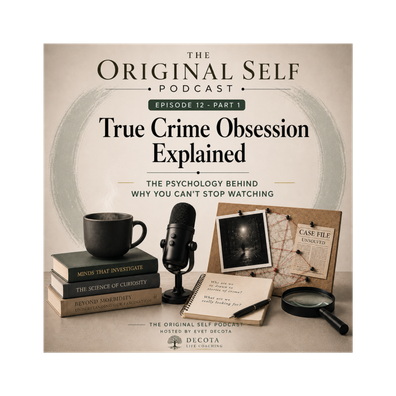
Episode notes
You told yourself you were going to bed early. And yet here you are.
In Part 1 of this two-part series, psychology-informed life coach Evet DeCota breaks down the real science behind our true crime obsession — and why it says more about us than we think.
This isn't about morbid fascination. It's about evolution, threat intelligence, justice, community, and the complicated cost of consuming other people's worst moments as entertainment.
In this episode:
- Why the pull toward dark content is evolutionary — not a character flaw
- The safety information hypothesis: why women are the core true crime audience and why that's completely rational
- The dopamine-suspense loop that makes these stories impossible to turn off
- What true crime actually gives us — empathy, justice reform, community, and fear processing
- The hidden costs: anxiety, desensitization, sleep disruption, and secondary traumatic stress
- The ethical question the genre rarely asks: at what point does engagement stop serving justice and start serving our entertainment?
- Real stories from three women whose true crime consumption shows up in their real lives — including one who used what she'd learned to get herself out of a dangerous situation
Part 2 drops next week — featuring a guest who didn't watch the Lori Vallow Daybell sentencing on a screen. She got on a plane.
🎙️ Hosted by Evet DeCota 🌐 decotalifecoaching.com 📩 Reach out about coaching or the podcast at decotalifecoaching@gmail.com
Keywords
#TrueCrime
#TrueCrimePodcast
#TrueCrimeObsession
#TrueCrimePsychology
#MorbidCuriosity
#WomenAndTrueCrime
#SafetyInformation
#MindsetPodcast
#DeCotaLifeCoachingPodcast
#WatchTrueCrime