
Episode notes
When a dyslexic teenager says, “I don’t care,” it may actually mean, “I care so much that I cannot let anyone see me struggle.”
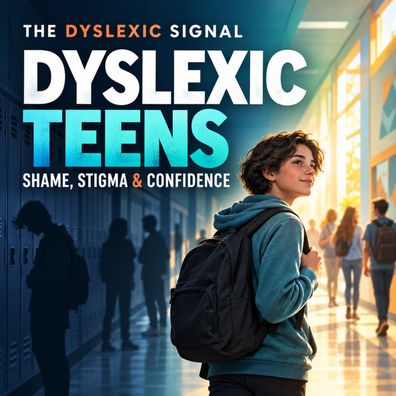
In this episode of The Dyslexic Signal, Lauren and Harrison explore how shame and stigma can affect dyslexic teenagers at home, at school, and in social situations.
Listeners will learn how hidden shame can show up as anger, avoidance, perfectionism, joking, refusing to read aloud, hiding grades, or rejecting help. The episode explains why these behaviors should be approached with curiosity rather than immediately labeled as laziness, defiance, or a lack of motivation.
Parents and educators will receive practical guidance for protecting confidence without lowering meaningful expectations. The episode also includes three self-advocacy scripts teenagers can use, strategies for responding to bullying, and a simple “3-2-1 Confidence Card” exercise that helps teens recognize their abilities, identify helpful supports, and ask for what they need.
Who This Episode Is For
- Dyslexic teenagers
- Parents and caregivers
- Teachers and school administrators
- Counselors and educational professionals
- Mentors and youth advocates
- Anyone supporting a young person with dyslexia
Disclaimer
This podcast provides general educational information and lived-experience discussion. It is not intended to provide medical, psychological, educational, legal, or diagnostic advice. Dyslexia and emotional health affect each person differently. Parents and caregivers should consult appropriately qualified educational or healthcare professionals for individualized guidance.
Take statements about wanting to die, feeling hopeless, being a burden, or having no reason to live seriously. In the United States, call or text 988 for the Suicide & Crisis Lifeline. Call 911 when there is immediate danger. Listeners outside the United States should contact their local emergency or crisis service.
Resources
Research on learning-disability stigma: https://doi.org/10.1177/00222194221087383
Growing up with dyslexia—child and parent perspectives: https://doi.org/10.1002/dys.1729
Developmental dyslexia and mental health: https://doi.org/10.3390/ijerph20021653
School connectedness and emotional well-being: https://doi.org/10.1002/dys.1775
StopBullying.gov—Youth with disabilities: https://www.stopbullying.gov/bullying/special-needs
988 Suicide & Crisis Lifeline: https://988lifeline.org/
If this episode helps you, follow The Dyslexic Signal and share it with one teenager, parent, teacher, or counselor who needs this conversation.
Understand the signal. Reduce the shame. Make the next step possible.