
Episode notes
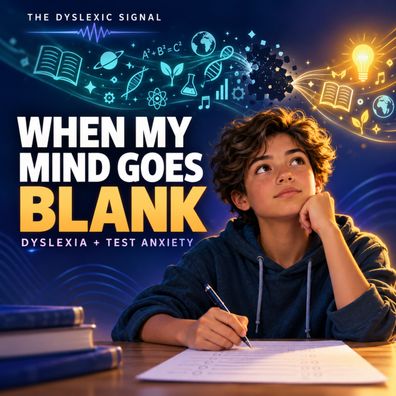
Have you ever understood the material at home, only to sit down for a test and feel as though everything disappeared?
In this episode of The Dyslexic Signal, Lauren and Harrison explain why learning information and retrieving it under pressure are not always the same. For dyslexic students, the combined demands of reading, remembering directions, organizing an answer, managing time, and worrying about mistakes can heavily load working memory.
You will learn:
- How working memory supports test performance
- Why anxiety can compete for attention and make retrieval harder
- Why going blank does not automatically mean a student failed to study
- Two respectful sentences students can use to ask for help
- The five-part Recall Ready Plan for studying
- A 60-second reset for moments when the mind goes blank
- How the 3-2-1 Confidence Card can strengthen evidence-based confidence
- Why testing accommodations should be individualized and connected to what the test is designed to measure
Who This Episode Is For
Dyslexic teens and adults, parents and caregivers, teachers, counselors, learning specialists, and anyone trying to understand the gap between knowing the material and showing that knowledge during a test.
Disclaimer
This podcast provides general educational information and lived experience. It is not intended to diagnose dyslexia, anxiety, a memory disorder, or any other medical, psychological, developmental, or learning condition. It is not a substitute for an individualized evaluation or professional advice. Anyone experiencing severe, persistent, or worsening anxiety should speak with an appropriately qualified healthcare, mental-health, psychological, or educational professional.
Resources
Owens et al. (2014), anxiety, working memory, and cognitive test performance: https://pubmed.ncbi.nlm.nih.gov/24387098/
Nelson et al. (2015), test anxiety among students with reading disabilities: https://pubmed.ncbi.nlm.nih.gov/24153402/
What Works Clearinghouse, Organizing Instruction and Study to Improve Student Learning: https://ies.ed.gov/ncee/wwc/PracticeGuide/1
International Dyslexia Association, Accommodations for Students with Dyslexia: https://dyslexiaida.org/accommodations-for-students-with-dyslexia/
U.S. Department of Education, Section 504: https://www.ed.gov/laws-and-policy/individuals-disabilities/section-504
If this episode helps you understand a student differently, share it with one parent, teacher, counselor, or teen.
Understand the signal. Reduce the shame. Make the next step possible.