Ibogaine: The Molecule, The Plant, and The Promise

Ibogaine: The Molecule, The Plant, and The Promise

by Jim Mitchell
Season 1
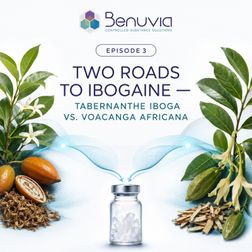
Episode 3 · Two Roads to Ibogaine - Tabernanthe iboga vs. Voacanga africana
AI
This episode reveals why the plant everyone talks about is not the one industry actually uses. The discussion contrasts T. iboga — with its low yield, slow growth, and conservation pressures — against Voacanga africana, which dominates the alkaloid trade due to high voacangine content. The strategic chemistry of converting voacangine to ibogaine via ester hydrolysis and decarboxylation is explained at the level of approach and significance. CITES status and Gabonese heritage controls are addressed, as is the sustainability argument for Voacanga. The episode closes with implications for impurity fingerprints and sourcing for future clinical programs.
Episode 1 · Origins — From Bwiti Ritual to Addiction Medicine
AI
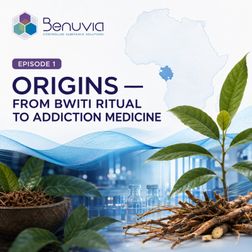
This episode establishes the series through a narrative arc of discovery and suppression. Beginning with the Bwiti spiritual tradition in Gabon and the cultural significance of the iboga plant, the hosts trace Western scientific isolation of ibogaine in the early 1900s and its brief mid-century use as a stimulant tonic. The episode centers on the Howard Lotsof story — the 1962 accidental discovery of anti-addiction activity — and the patient-advocate movement that followed. It concludes by explaining U.S. Schedule I status and the rise of offshore clinics, then pivots to the modern psychedelic-medicine wave, state initiatives, and federal interest, finally laying out the ten-episode journey ahead.
Episode 2: The Plant & Its Chemistry — Botany & Pharmacognosy of Iboga
AI
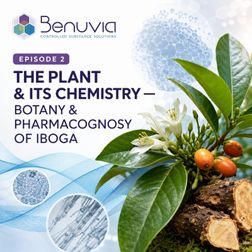
The second episode grounds the listener in botanical and chemical fundamentals. It covers Tabernanthe iboga taxonomy, morphology, and why the root bark concentrates alkaloids. The hosts map the iboga-alkaloid family — ibogaine, ibogamine, tabernanthine, ibogaline, coronaridine, and voacangine — highlighting the shared isoquinuclidine fused to indole skeleton. Biosynthesis via the monoterpene indole alkaloid (MIA) pathway is explained from strictosidine through the iboga-type skeleton. The episode concludes by addressing alkaloid distribution across tissues and variability by provenance, setting up the sourcing and quality themes that follow.
Episode 4 · From Field to Feedstock - Cultivation, Sourcing & Sustainability
AI
Episode 4 follows raw material from field to feedstock, examining the agronomy of both source species and why cultivating iboga is genuinely difficult. The discussion covers wild collection versus cultivation in West Africa, the ethics of heritage and benefit-sharing under the Nagoya Protocol, and conservation pressures from overharvest. From a supply-security perspective appropriate to a future approved drug, the hosts address what a CDMO must grapple with. The episode concludes with emerging non-agricultural routes — plant cell culture and synthetic-biology production of iboga alkaloids — offering a forward-looking path to de-risking supply.
Episode 5 · Getting the Molecule Out - Extraction, Isolation, Purification & Impurity Profiling
AI
This episode bridges chemistry and quality by explaining how ibogaine is separated from plant material and purified to an API specification. Acid-base alkaloid partitioning and the distinction between crude total-alkaloid extract and purified ibogaine HCl form the conceptual foundation. Analytical identity and purity — via HPLC/UPLC, LC-MS, and NMR — are covered as orthogonal controls. Impurity profiling is addressed in detail: plant-related congeners, noribogaine, and process-related impurities. The episode emphasizes GMP specification thinking (assay, related substances, residual solvents, heavy metals) and the real-world harm driven by uncharacterized underground material.
Episode 6 · Building the Cage - Total Synthesis Semi-Synthesis
AI
Episode 6 is a synthesis seminar: it explains the iboga skeleton as a classic synthetic challenge and surveys landmark and modern approaches. Buechis 1966 total synthesis is framed as the reference point, with modern asymmetric and step-economical routes explained at the level of strategy and key bond-forming ideas (e.g., Diels-Alder construction of the isoquinuclidine). The industrial semi-synthesis from voacangine is discussed strategically, as is its access to noribogaine. The hosts explain how synthetic strategy enabled next-generation analogs and address the realities of total versus semi-synthesis economics at scale. The episode concludes with a bridge: we can make it — now what does it do?
Episode 7: Polypharmacology - How Ibogaine Actually Works (and Noribogaine)
AI
This episode delivers the definitive mechanistic tour: ibogaine is a textbook "dirty drug" acting across many targets. The hosts enumerate its bindings — NMDA antagonism, α3β4 nicotinic acetylcholine receptor antagonism (the leading anti-addiction hypothesis), κ- and μ-opioid activity, σ1/σ2, and SERT/monoamines — and weigh their relative importance. Neurotrophic effects (GDNF/BDNF) and the psychoplastogen concept are introduced. Noribogaine, the long-lived O-demethylated metabolite, is given equal weight, with CYP2D6 polymorphism explaining interindividual exposure variability. The discussion of pharmacokinetics — lipophilicity, accumulation, duration — ties mechanism to the observed addiction-interruption phenomenon and bridges to the safety episode that follows.
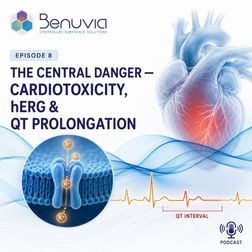
Episode 8: The Central Danger - Cardiotoxicity, hERG & QT Prolongation
AI
Episode 8 is the series safety cornerstone. Cardiotoxicity is introduced as the single biggest barrier to ibogaine becoming an approved medicine. The mechanism is explained at the channel level: hERG (Kv11.1) potassium-channel blockade leads to delayed repolarization, QTc prolongation, and potentially fatal torsades de pointes. The hosts address why the risk window is extended (given the long half-lives of both parent and noribogaine), enumerate risk factors (baseline QT, hypokalemia/hypomagnesemia, bradycardia, drug interactions), and highlight the special vulnerabilities of the opioid-detox population. The real-world death record is reviewed honestly. Mitigation science — cardiac screening and monitoring, electrolyte optimization, and the magnesium co-administration hypothesis from the Stanford MISTIC study — is covered as the practical framework for risk reduction.
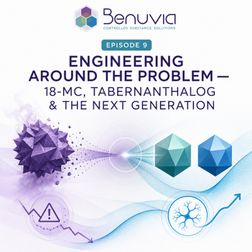
Episode 9: Engineering Around the Problem - 18-MC, Tabernanthalog & Next-Generation Analogs
AI
Episode 9 tells the medicinal-chemistry redemption arc: how chemists tried to retain ibogaines therapeutic core while deleting cardiotoxicity and the multi-hour hallucinogenic experience. 18-methoxycoronaridine (18-MC) is presented as a selective α3β4 antagonist that sidesteps hERG and serotonergic hallucinogenic activity. Tabernanthalog, the function-oriented simplification from the Olson lab, is examined in detail — including its non-hallucinogenic, non-cardiotoxic profile, rodent efficacy for alcohol- and heroin-seeking, and clinical progression under Delix Therapeutics. The psychoplastogen thesis (the argument that the therapeutic effect may be separable from the psychedelic experience) is presented with its scientific pushback. SAR lessons and other ibogalogs (DemeRx/atai programs, noribogaine studies) are covered, with accurate pipeline status grounded to sources.
Episode 10: Into the Clinic - Indications, Trials Past, Present & Future
AI
The series capstone maps the full clinical landscape. The hosts review primary and secondary indications — opioid use disorder (the flagship), other substance use disorders (cocaine, alcohol, methamphetamine, nicotine), PTSD, TBI, and depression — with mechanistic rationale for each. An honest read of the evidence base is provided: decades of observational and offshore-clinic data exist, but randomized controlled trials are scarce. The landmark Stanford MISTIC magnesium-ibogaine study in special-operations veterans is analyzed for design, findings, and caveats. Current and future programs are detailed — DemeRx/atai (DMX-1002) for OUD, continued Stanford work, the Texas UTHealth-UTMB consortium (SB 2308), Oregon admitteds supervised-access law, and federal interest — all grounded to sourced information. Regulatory and manufacturing realities (Schedule I friction, cardiac safety as the gating issue, the GMP-supply burden) are addressed. The episode closes by synthesizing the entire ten-episode narrative and delivering a balanced verdict: real promise, real peril, real evidence gaps, and why the next few years are decisive.
1 of 2