
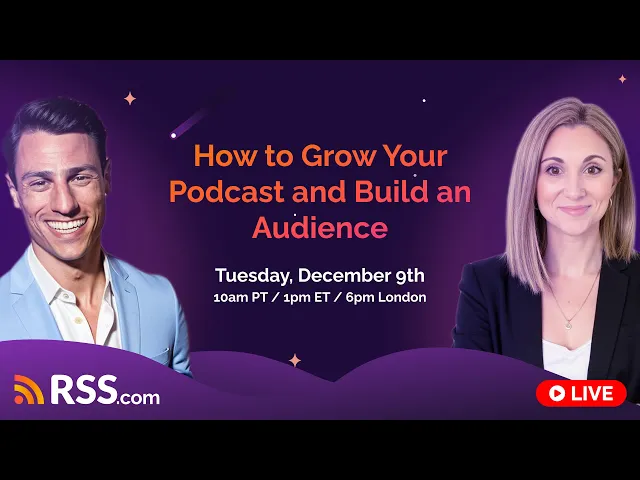
On December 9, 2025, podcast growth expert Stephanie Arakelian joined us on the RSS.com YouTube channel to teach a masterclass on “How to Grow Your Podcast and Build an Audience.” With seven years of experience launching networks and growing shows to millions of downloads, Stephanie shared the foundational strategies that every podcaster needs before diving into tactics like social media promotion or paid advertising.
This training breaks down the essential blueprint for sustainable podcast growth, starting with finding your why and building a deep understanding of your audience. Whether you’re just launching your show or looking to scale an existing podcast, this session provides actionable frameworks you can implement immediately. Below are the key takeaways, followed by the full training video and complete transcript.
Key Takeaways
- Find your why. Everything you do must connect back to why you started your podcast (building community, generating leads, sharing stories, etc.)
- Define success on your terms. Success could mean full-time income, a certain number of downloads, building a community, or simply creating consistently
- Know your audience deeply. Create detailed listener personas including age, motivations, pain points, and where they spend time online
- You are not pizza. You cannot please everyone. The more specific and niche you are, the easier it is to find and grow your dedicated audience
- Quality over quantity first. Focus on creating for a specific audience rather than trying to appeal to everyone
- Social media doesn’t directly convert to downloads. Use social to build brand awareness and community, then funnel people to your newsletter or other owned platforms
- Podcast swaps are powerful. Trading promotions with similar-sized shows in your niche is one of the best free growth tools available
- Big guests don’t guarantee growth. People listen for the host, not just the guest. Focus on your unique perspective and storytelling
- ChatGPT can be your co-founder. Use AI as a thinking partner to build audience personas, generate episode ideas, create show notes, and streamline your workflow
Watch the Full Training How to Grow Your Podcast and Build an Audience:
1. Find Your Why
Everything starts with understanding why you’re podcasting. Your why is your anchor when the work gets hard. It could be building a community, generating leads for your business, sharing stories, or making connections. Whatever it is, write it down and refer back to it when you’re deciding what content to create, which guests to book, or whether to continue an episode series.
ChatGPT prompt: “I’m starting a podcast about [topic]. Help me articulate my ‘why’ by asking me questions about my motivations, goals, and what impact I want to have on listeners.”
2. Define What Success Looks Like
Success isn’t just about download numbers. It could mean earning full-time income, booking clients, building thought leadership, or simply enjoying the creative process. Define specific, measurable goals so you know when you’ve achieved them. Be realistic about your timeline and resources.
ChatGPT prompt: “Help me define success metrics for my podcast. My why is [your why]. What are realistic goals I should set for year one, considering I can dedicate [X hours] per week?”
3. Know Your Audience Deeply
Create detailed listener personas. Go beyond basic demographics and understand their motivations, pain points, daily routines, and what other content they consume. Where do they spend time online? What problems are they trying to solve? What makes them excited? The more specific you are, the easier it becomes to create content that resonates and to find where your potential listeners are already spending time.
ChatGPT prompt: “Help me create a detailed listener persona for my podcast about [topic]. Include demographics, psychographics, daily habits, pain points, content preferences, and where they spend time online.”
4. You Are Not Pizza (And That’s Good)

You cannot please everyone, and trying to will dilute your message. The more specific and niche you are, the easier it is to grow. A podcast for “everyone interested in business” is competing with thousands of shows. A podcast for “women executives navigating career transitions in tech” has a clear, findable audience. Niche doesn’t mean small. It means focused.
ChatGPT prompt: “My podcast idea is [broad topic]. Help me narrow it down to a specific niche by asking questions about my unique angle, expertise, and ideal listener.”
5. Start with Quality, Then Scale
Focus on creating excellent content for your specific audience before worrying about reaching massive numbers. A smaller, engaged audience is more valuable than a large, disconnected one. Make sure your audio quality is good, your content delivers on its promise, and you’re consistent with your release schedule. Growth tactics only work when you have something worth growing.
6. Social Media Doesn’t Directly Convert
Social media builds brand awareness and community, but it rarely drives significant downloads. People don’t leave the platform they’re on to go listen to a 30-minute episode. Use social to stay connected with existing listeners, share your personality, and create discoverability, but don’t expect it to be your primary growth engine. The goal is to be memorable so that when someone searches for content like yours, they think of you.
ChatGPT prompt: “Give me 10 social media content ideas for my podcast about [topic] that build community and brand awareness without just saying ‘go listen to my episode.’”
7. Podcast Swaps Are Your Secret Weapon
Trading promotions with similar-sized shows in your niche (or adjacent niches) is one of the best free growth tools available. The average podcast listener subscribes to five to seven shows, so they’re already open to adding another. Reach out to podcasters whose audience overlaps with yours but whose content doesn’t directly compete. Think creatively about adjacencies. For example, a women’s leadership podcast might swap with true crime shows because both attract women aged 30-50.
ChatGPT prompt: “My podcast is about [topic] and my target audience is [description]. Suggest 20 podcast categories or niches that might have overlapping audiences I could approach for cross-promotion swaps.”
8. Big Guests Won’t Save You
People listen for the host, not just the guest. Just because someone has millions of social media followers doesn’t mean their audience will leave that platform to listen to your show. High-profile guests can help, but they’re not a sustainable growth strategy. Focus on being an excellent interviewer who asks unique questions and creates compelling conversations. Listeners return for your perspective and approach, not for whoever you’re talking to this week.
9. Use ChatGPT as Your Co-Founder
AI tools can help you think through audience personas, generate episode ideas, create outlines, write show notes, and develop growth strategies. Treat ChatGPT as a brainstorming partner to help you work through the strategic thinking required to grow your show. The prompts provided throughout this post are starting points. Adapt them to your specific situation and use follow-up questions to dig deeper.
The Bottom Line
Growing a podcast isn’t about hacks or viral moments. It’s about knowing why you’re doing it, understanding exactly who you’re serving, and consistently delivering value to that specific audience. All the tactical growth strategies in the world won’t help if you haven’t nailed these fundamentals first. Start with strategy, then add tactics.