What Comes Next
by What Comes NextSeason 1
What If Every Human Vanished Tomorrow? Wolves Would Move Into Your Street.
What if every human vanished tomorrow? Under New York, pumps push about 13 million gallons of water out of the subway on a dry day. This episode follows the real nights when that protection failed, from Hurricane Sandy in 2012 to the 2003 blackout, and the two places where land already shows what happens when people leave, the Chernobyl zone and the Korean border strip. The second half imagines the grid going dark with nobody left to restart it, the subway flooding within two days, and centuries of forest swallowing the suburbs. Full sources and credits are in the YouTube description.How Towns and Habits Would Change Without Penicillin (Episode 6 Short)
This one is our own imagining, and the Short says so out loud before it starts. Schools are built with windows that open wide, handshakes turn into nods, and clinics post the local infection count the way we post pollen. Then it returns to the real world, where drug resistant infections caused about 1.27 million deaths in 2019. Photographs of today's labs and medical campuses are by Carol M. Highsmith at the Library of Congress. The full story is in Episode 6 of What Comes Next, What If Penicillin Was Never Discovered?What Would Medicine Look Like Without Penicillin? (Episode 6 Short)
This one is our own imagining, and the Short says so out loud before it starts. The war is fought without the wonder drug, surgery shrinks to what cannot be avoided, sanatoriums never close, and the money pours into vaccines and phage therapy instead. The full story is in Episode 6 of What Comes Next, What If Penicillin Was Never Discovered?The Patient Who Got Half of America's Penicillin in 1942 (Episode 6 Short)
The first Oxford patient began to improve within a day in 1941, but the supply ran out and he died. In 1942 a dying patient named Anne Miller got half of all the penicillin in America, her fever broke by morning, and she lived to ninety. By D-Day, factories had about 2.3 million doses ready. Photographs are from the Library of Congress, including New Haven Hospital, where Anne Miller was treated. The full story is in Episode 6 of What Comes Next, What If Penicillin Was Never Discovered?How a Blister Killed the President's Son in 1924 (Episode 6 Short)
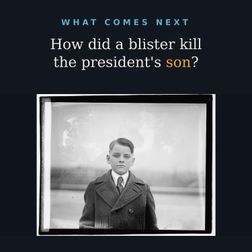
In 1924 sixteen year old Calvin Coolidge Junior got a blister playing tennis at the White House, and he was dead within a week. The Coolidge Foundation writes that antibiotics could have easily treated it. Four years later, Alexander Fleming found a mold on an unwashed dish. Photographs of Calvin Coolidge Junior and his family are from the Library of Congress. The full story is in Episode 6 of What Comes Next, What If Penicillin Was Never Discovered?What If Penicillin Was Never Discovered? A Blister Could Still Win.
What if penicillin was never discovered? In 1924 the president's sixteen year old son got a blister playing tennis at the White House and was dead within a week. This episode follows Alexander Fleming's unwashed dish, the first Oxford patient in 1941, the woman in New Haven who received half of all the penicillin in America in 1942, and the factories that made millions of doses before D-Day. The second half is labeled speculation. It imagines medicine, hospitals, towns and family habits growing up without penicillin, and then returns to the real fight against drug resistant infections today. This episode is history and imagination, not medical advice. Full sources and archival credits are in the YouTube description.Season 2
The Version of Project 2025's Chapter Three Its Critics Fear (Series 01 Episode 2 Short)
This one is our speculation, and the Short says so out loud before it starts. It pictures the version of Project 2025's chapter three that critics fear, where jobs follow elections the way they did before 1883. It ends on what critics and supporters would each call that government. The archival images are from the Library of Congress, and full credits are in the main episode's description. The full story is Series 01, Episode 2 of What Comes Next.The Job Application Question a Judge Halted in 2026 (Series 01 Episode 2 Short)
In May 2025 most federal job applications gained an essay question asking how the applicant would advance the President's policies. On September 11, 2026, a federal judge in Massachusetts halted it, finding it likely violated job seekers' First Amendment rights. That question is not in chapter three of Project 2025, but it sits on the same old line between skill and loyalty. The cover photograph shows applicants at the Civil Service Commission in 1936, by Harris and Ewing, from the Library of Congress. The full story is Series 01, Episode 2 of What Comes Next.Season 1
How Old Tally Sticks Burned Down Parliament in 1834 (Money Episode Short)
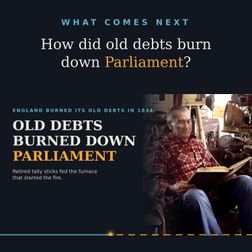
England kept its royal accounts on wooden tally sticks until 1826, with each stick split so both sides held a matching half of the debt. On October 16, 1834, workmen fed two cartloads of the retired sticks into a furnace under Parliament, and the fire spread through the Palace of Westminster. The cover photograph shows Tom Vaughan with his family's old store ledger in Texas, by Carol M. Highsmith, from the Library of Congress. The full story is the money episode of What Comes Next.Season 2
What Page 80 of Project 2025 Asked For and What the Government Did (Series 01 Episode 2 Short)
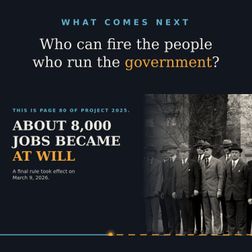
Schedule F was created in October 2020 and canceled in January 2021. Page 80 of Project 2025 says it should be reinstated. A rule built on that took effect on March 9, 2026, and on June 3 about 8,000 jobs moved into it. The personnel office says the roles remain career positions filled on merit. The cover photograph shows Veterans Bureau staff in 1923, from the Library of Congress. The full story is Series 01, Episode 2 of What Comes Next.