What Comes Next

What Comes Next

by What Comes Next
Season 2

How One Gunshot in 1881 Built the Civil Service (Series 01 Episode 2 Short)

Bonus
A man who wanted a government job shot President Garfield in 1881. Two years later Congress passed the Pendleton Act, which made people pass exams for covered jobs and made firing them for political reasons unlawful. Chapter three of Project 2025 now asks for more presidential power over who keeps those jobs. Every image is from the Library of Congress, and full credits are in the main episode's description. The full story is Series 01, Episode 2 of What Comes Next.

Who Gets to Fire the People Who Run Your Government? Page 80 Answers.

AI
In 1881 a man who wanted a government job shot President James Garfield, and two years later Congress passed the Pendleton Act, which built the civil service. Chapter three of Project 2025 asks for more presidential power over who keeps those jobs. This episode reads the chapter in its own words and checks it against the record, from Schedule F in 2020 to the Schedule Policy/Career rule that took effect on March 9, 2026, and the order that moved about 8,000 jobs into it. It also covers the September 2026 ruling that halted a job application question about the President's policies. As of October 6, 2026, the lawsuits over the rule were still pending. The last part is labeled speculation. It runs the idea twice, the way the chapter's supporters hope it goes and the way its critics fear it goes, and pushes both to 2050. This is Episode 2 of Project 2025, Chapter by Chapter, from What Comes Next. Full sources and archival credits are in the YouTube description.
Season 1

Did Money Really Begin With Barter? (Money Episode Short)

Bonus
AI
Adam Smith wrote in 1776 about a human "propensity to truck, barter, and exchange," and textbooks built a whole origin story on it. Anthropologists went looking for that barter village and never found it. David Graeber found that neighbors ran on credit, and that swapping mostly happened between strangers. The full story is the money episode of What Comes Next.

When Ireland's Banks Shut for Six Months in 1970 (Money Episode Short)

Bonus
On May 1, 1970, the staff of Ireland's four biggest banks walked out, and the branches stayed shut until November 17. Shops and pubs took checks that nobody could cash for months, and one publican near Dublin said he was not worried because he knew who signed them. The cover photograph shows New York police telling depositors their bank was closed in 1933, from the New York World-Telegram and Sun collection at the Library of Congress. Full credits are in the main episode's description. The full story is the money episode of What Comes Next.

What If Money Was Never Invented? Your Whole Life Runs on Who Trusts You.

AI
In 1970 Ireland's four biggest banks shut from May 1 to November 17, and the country kept trading on checks that nobody could cash for months. This episode follows that story back to how money really began. Adam Smith said it started with barter, but anthropologists never found the barter village. What they found was people keeping score, from clay receipts in Mesopotamia to the English tally sticks that set Parliament on fire in 1834. The second half is labeled speculation. It imagines a world where money was never invented, once as the best version anyone could hope for and once as the worst, and then pushes both versions to 2026. Full sources and archival credits are in the YouTube description.
Season 2

Page 80 of Project 2025 Became a Federal Rule in 2026

Bonus
AI
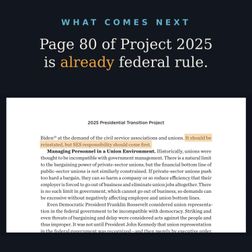
In 2023 the Heritage Foundation published a book that most people know as Project 2025. Page 80 asks for one change to the rules that protect federal workers from being fired, and a rule built on that line took effect on March 9, 2026. About 8,000 jobs moved into it on June 3. The photographs of the Old Executive Office Building and the Government Printing Office are by Carol M. Highsmith, from the Library of Congress, with no known restrictions on publication.

What If One Book Ran the Whole Government? Page 80 Is Already Federal Rule

AI
Project 2025 is a 2023 policy book from the Heritage Foundation, and one page of it is already federal rule. This episode reads what the Mandate for Leadership asks for in its own words and checks each proposal against the public record. Page 80 asks for a class of federal jobs whose holders can be removed without the usual appeals. The Office of Personnel Management made that a final rule on March 9, 2026, and Executive Order 14410 moved about 8,000 positions into it on June 3. Lawsuits in Washington and Maryland were still pending as of September 28, 2026. The episode also covers the education chapter, the Homeland Security chapter, what fact checkers found the book does not say about Social Security, and a chapter where two writers disagree with each other in print. The last part is labeled speculation. It runs the book twice, once the way its supporters hope it goes and once the way its critics fear it goes, and then pushes both versions to 2040. This is Episode 1 of Project 2025, Chapter by Chapter, from What Comes Next.
Season 1

Three States Signed the 13th Amendment Decades Late, and Nothing Changed

Bonus
AI
Delaware signed the Thirteenth Amendment in 1901. Kentucky waited until 1976. Mississippi voted yes in 1995 and forgot to file the paperwork until 2013. None of those dates changed the law, because the amendment already bound every state from 1865, and that is exactly what makes them worth knowing. The full story is Episode 3, Part 1 of What Comes Next.

The 13th Amendment Wrote an Exception about Slavery that was Never Removed
Bonus
AI
The Thirteenth Amendment abolished slavery and wrote an exception into its own text, for anyone convicted of a crime. That clause has never been removed, and as of the 2022 elections more than a dozen state constitutions still carried language permitting forced labor for prisoners. The full story is Episode 3, Part 1 of What Comes Next.

What If America Had Kept Its 40 Acres Promise to the Formerly Enslaved? $7.6M Part 2

AI
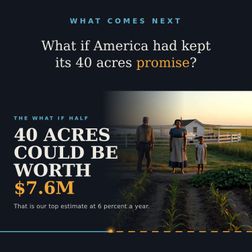
What if the families who were promised forty acres and a mule had kept their land? Part 2 of this alternate history follows one imagined family on Edisto Island, South Carolina, from 1866 into the 1950s, and then it runs the numbers on what Sherman's land would be worth today. The family is invented and the episode says so, while the island, the year and the land title are real. Along the way the story touches real anchors from Reconstruction, including the Black legislators of the era, Claflin University, which opened in 1869, and the 1921 attack on Greenwood in Tulsa, often called Black Wall Street. At Agriculture Department land values and our own assumed return, one grant would be worth $1.6 million to $7.6 million today, and all of the Sherman land would come to $16 billion to $76 billion. That is less than one and a half percent of the lowest estimate Part 1 opened with. Sources include the USDA, the Freedmen and Southern Society Project, Thomas Craemer in Social Science Quarterly, and the National Archives.
2 of 3