Truth about Local Government

Truth about Local Government

by Matt Masters

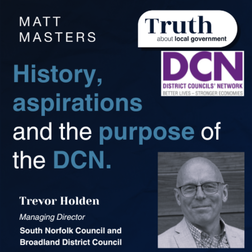
History, aspirations and the purpose of the District Councils' Network with Trevor Holden.

Sitting down with Trevor Holden, Managing Director, South Norfolk Council and Broadland District Council and Chair, District Councils' Network Chief Executives Group we discussed:- Where has local government and the District Council' Network (DCN). Although the context is different the challenges invariably remain the same, not enough money, recruitment, local government reform.- The role and future aspirations of the District Councils' Network, the purpose of the DCA to galvanise and empower the district councils network as a collective unit. Also, to help work on problems collectively that can be tailored them to individual nuisances on a local level.- Trevor's career journey into and then throughout local government and what he considers high performance to be in a local government Chief Executive.

How intelligent automation can help councils to innovate, save time and money. FT Mark Gannon.

Today we had IT leader, Mark Gannon on the TLG podcast to discuss "How intelligent automation can help councils to innovate, save time and money". Key points from our conversation: 1. I think there are still too many services in councils not digitised end-to-end which leads to waste and failure demand. The tools and capabilities exist to do so what is stopping councils from doing this? Do senior leaders and politicians get digital? 2. Most councils deliver similar services but there is still quite a bit of ‘we can’t do it like that as we are different / unique / special’. Can councils afford this approach anymore? There is great collaboration going on in some areas – how do we get more of this going? How do we encourage and sharing mindset in local government? 3. Data is trapped in silos and councils are missing out on the ability to understand their areas, create new insights and drive service improvements and early intervention to reduce costs. What are the challenges preventing councils from unleashing their data? What role do suppliers have in supporting this? Is there a skills gap in this area? 4. A lot of councils are still procuring for the non-digital age. Local government needs a radical overhaul of how it specifies and procures digital solutions and platforms. How can we make procurement quicker? How can ensure that those involved in procuring are aware of the latest developments in low-code, RPA, AI and IOT? 5. Councils spend a lot of money responding to problems once they have happened instead of using AI, data and IOT tools to help prevent issues from occurring in the first place. How do we improve the ability of councils to undertake more early intervention and predictive analytics? 6. Too many councils talk about improving digital services without really understanding good service design or involving their citizens in the design of those services. But a lot also spend too much time in the design phase and not the delivery phase. How can councils strike the right balance between pace of delivery and delivering the right things? Is there a role for developing internal consultants in councils to support transformation initiatives? 7. Local authorities are spending far too much money maintaining legacy applications that are expensive and not particularly effective which lead to poor citizen and employee experiences. Why are vendors making it hard for councils to transform? How can vendors help councils to rationalise their IT estate and connect applications together without charging huge prices? https://www.netcall.com/industries/local-government/citizen-hub/

.CEO Blueprint - guiding public sector leaders through commercial initiatives .

David Crowe - Project Director at Local Partnership LLP, has led on the creation of the CEO blueprint. The CEO Blueprint is intended to take council CEOs in England through a need-to-know, structured, risk aware and financially sustainable approach to developing commercial initiatives. The Blueprint covers 12 key considerations, from definition and strategy through to preventing failures and developing exit strategies

Addressing deprivation with regeneration FT Rose Rouse Part 2

Throughout districts in England, there are areas of deprivation and a key responsibility of the local authority in that area is to construct a plan that provides a tangible plan as to how that deprivation can be tackled. With Chief Executive, Rose Rouse of Pendle Borough Council, we discussed how Pendle has successfully regenerated key sites within its district and provided advice as to how this can be replicated by other councils. Pendle is an area that has feasibility challenges of development and there approach has made difficult projects a success. What is also interesting is the creation of new super districts as a solution for future local government reorganisation; and the continued need for investment in both place and people to address deprivation. A thought provoking conversation.

Addressing deprivation with regeneration FT Rose Rouse

.Throughout districts in England, there are areas of deprivation and a key responsibility of the local authority in that area is to construct a plan that provides a tangible plan as to how that deprivation can be tackled. With Chief Executive, Rose Rouse of Pendle Borough Council, we discussed how Pendle has successfully regenerated key sites within its district and provided advice as to how this can be replicated by other councils. Pendle is an area that has feasibility challenges of development and there approach has made difficult projects a success. What is also interesting is the creation of new super districts as a solution for future local government reorganisation; and the continued need for investment in both place and people to address deprivation. A thought provoking conversation.

Peer to peer investment in social infrastructure, an alternative funding stream for local authorities.

.Abundance is a regulated crowdfunding platform that has developed the Community Municipal Investment (CMI). A CMI is an innoative and powerful new model for councils to raise money from residents and the general public as an alternative to the Public Works Loan Board. CMIs not only provide a competitive source of funding for capital and investment programmes, but also a route for strengthening the relationships between councils and the communities they serve. The model was launched in 2020 and is now being used by 9 councils including Telford & Wrekin, West Berkshire and Westminster City Council. It has been used to finance the delivery of environment and climate projects in the council's capital programme.

The journey to secure Eurovision for Liverpool ft Philippa Horrocks

Philippa Horrocks was an instrumental part of the bidding team that secured Eurovision and was then the Special Projects Manager that helped deliver Eurovision. We talked through that experience and her journey through local government. Well done to Liverpool City Council and the Commissioners, who even when there were financial difficulties still embraced culture as a key aspect of Liverpool's identity.

The President of ACES - championing innovation, equality and data.

Sara Cameron is the President of ACES (The Association of Chief Estates Surveyors and Property Managers in the Public Sector) and we talked through her journey to being President; the challenges facing property leaders and teams in local government and where innovation can provide solutions to the challenges property leaders are experiencing.

The success of the Beeston Project - Broxtowe Council delivering for their community.

Thoroughly enjoyed sitting down with Deputy Leader Cllr Greg Marshall and Deputy Chief Executive Zulf Darr, at Broxtowe Borough Council to discuss the Beeston project. We explored the journey of this project, the hurdles that have been overcome, the legacy and impact the development has and what the future holds for place shaping in Beeston. This is a fantastic example of what local government can achieve, with ambition, governance and partnerships.

The meaning of communication, is the response you get.

Today I sat down with Camilla Mankabady, Director of Communications at Liverpool City Council. Formerly Editor of the BBC, ITV and Euro News. Her move into local government was inspired by her passion for Liverpool. We explored that transition, the art of communication and fundamentally what makes Camilla tick is this thought provoking conversation.
28 of 36