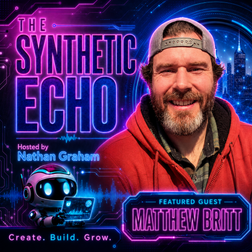
The System Needs You Dependent: Food, Water, Energy and the War on Abundance | Matthew Britt
What if scarcity is not the natural state of the world—but the foundation of the system we built? In this hard-hitting episode of The Synthetic Echo, Nathan Graham sits down with Matthew Britt to challenge some of our deepest assumptions about food, water, energy, health and humanity’s relationship with nature. Matthew has dedicated his life to what he describes as life, health and prosperity. His work focuses on helping communities create greater self-sufficiency by designing systems that work with nature rather than constantly fighting against it. The conversation begins with a provocative idea: There is no money in abundance. When people can grow food, access clean water and produce more of their own energy, they become less dependent on the corporations, institutions and centralized systems controlling those resources. Matthew argues that nature already offers abundance—but modern society has conditioned us to believe our basic necessities must always come from someone else. Nathan and Matthew explore: Why modern agriculture often fights against natural ecosystems The difference between monoculture farming and permaculture food forests How ordinary people can grow food without becoming traditional farmers Why perennial plants may be more powerful than annual gardens How food systems create dependency through chemicals, patented seeds and centralized production Why seedless food raises serious questions about control and scarcity How even small residential properties could produce meaningful amounts of food Why food prices remain high despite Canada’s massive agricultural capacity The hidden economic systems shaping dairy, produce and other essentials How water becomes scarce on a planet covered in it The possibilities surrounding wells, atmospheric water generation and alternative water sources Why bottled water may create more problems than it solves The complicated truth behind supposedly “clean” energy Why solar, wind, hydro and traditional fuels all require more honest conversations How AI could either deepen centralized control or help communities become self-sufficient This is not a conversation about abandoning technology and returning to the past. It is about questioning whether progress should mean greater complexity, greater dependence and greater disconnection from the natural systems that sustain us. Matthew’s vision of the future is not built exclusively around smarter cities, faster machines or more automation. It is built around resilient homes, regenerative land, local food, accessible water and technology that strengthens human independence. Because the future may not belong to the people with the most advanced systems. It may belong to the people who remember how to survive without them. Discover The Synthetic Echo https://syntheticecho.com/