
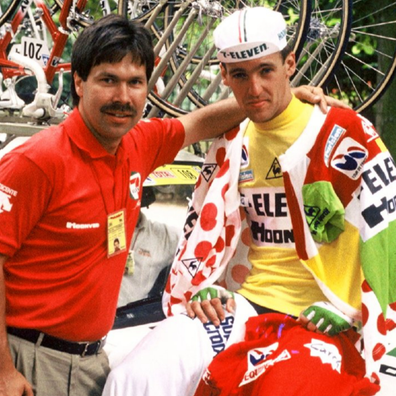
Alex Stieda Life before and after the yellow jersey. Still given er
Episode notes
In 1986, Alex Stieda became the first North American to ever wear the yellow jersey at the Tour de France. He raced professionally through an era when being a Canadian trying to make it in European cycling was a strange and lonely path — and he helped open a door that a generation of riders would eventually follow through.
But that's not really what this conversation is about.
Svein has known Alex for years, and what interests him more is what happens after the jersey. After retiring from professional cycling. After raising a family, going through cancer, and navigating all the chapters life throws at you — the guy still loves riding his bike. He still trains. He still sets goals. He still wants to see what he's capable of.
This episode goes back further than the Tour to understand what made Alex that way. They cover growing up in Coquitlam, BC, and the outsized influence of Alex's father — a German construction foreman who built his own house on a broken foot, led scout trips that would be illegal today, and once turned a piece of plywood into a toboggan to get his family off a snow-covered mountain in August.
They talk about how a 16-year-old hockey player bought a road bike for $20, strapped a rat trap to it, and rode solo to Salt Spring Island — and how that feeling of freedom and adventure turned into something more serious. How a neighbor two houses down happened to be the president of Cycling BC. How a coach named Baz Barry Lycett turned a group of Vancouver juniors into national track champions. And how, at 20 years old, Alex found himself alone in Belgium with a $500 grant, a military flight, and no cell phone, sleeping in a cold-water flat with an outhouse, taking "Belgian showers" with rubbing alcohol and cologne, and winning kermesse races while the local mafia collected his winnings.
Alex shares the full story of the day he snuck into the yellow jersey — showing up to a Tour de France road stage in a skin suit, faking a bathroom break to slip off the front, and riding flat-out until Phil Anderson rolled up beside him and said, "Mate, you're in the jersey." He talks about the chaos of that first Tour: no recon, no radios, staying on army cots in a school gym, and barely making the time cut after winning five jerseys in a single day.
They also get into the harder parts — the transition out of racing, the identity crisis that comes with no longer being "the guy," and how Alex rebuilt himself through the bike industry, IT sales, and eventually a move to Edmonton with no job lined up. And finally, the part Svein was most interested in: why, at 65, with a new indoor velodrome in Edmonton and nothing left to prove, Alex is back in training, coaching juniors, chasing provincial track championships, and thinking about his old coach Baz — who at 87 was still the oldest rider in the Tour of Victoria.
This one is about what keeps us moving. What competition gives us. How our relationship with sport changes as we get older. And maybe what we're actually training for when the results don't really matter anymore.
As long as I can still pedal my bike in a healthy way, that's gonna be a win. That's the long game.