The Reading Instruction Show

The Reading Instruction Show

by Dr. Andy Johnson
Season 22

The Read Act and the Lessons Beyond the Lesson

Recently, the Minnesota State Legislature passed the Read Act, sponsored by Democratic representative Heather Edelson. It’s a law based on the fad of the day; the shiny new thing called the “science of reading”. Ironically, this law is based on misconceptions and un-understandings related to both science and reading. This law states that I and other literacy professors in Minnesota must follow, with fidelity, the mandates put forth by state lawmakers. These are lawmakers who have never taught a kid to read, who have never read a research article related to reading instruction, and whose knowledge about reading instruction is reliant on the information given to them by radio journalists and podcasters (present company excepted). As part of the Read Act, the Minnesota Department of Education is now forcing me, a literacy professor at Minnesota State University, to teach things to my students that a wide range of research has shown to be ineffective in helping young children to become literate (that is, to use reading and writing for real purposes). I am forced to teach the preservice teachers in my literacy methods courses at Minnesota State University to engage in educational malpractice in their future classrooms. The Minnesota Department of Education mandates that these future teachers learn strategies that will impede their future students’ ability to achieve their full literacy potential. I must promote the de-literalization of children by telling teachers to focus primarily on lower-level reading subskills instead of higher-level cognitive functions related to reading and comprehension. Worse, I must teach them how to suck all the joy out of reading.

Zealotry in the Guise of Reading Science

I could live with a science of reading if the SoR zealots applied the scientific principles they claim to worship and adore to all of reading reality.  That is, if the scientific principles that they insist be used to determine what is effective reading instruction were also used to establish cause and effect, I could live with the zealotry.   But, they abandon their cherished scientific ideals when identifying problems and evaluating solutions to problems.  Look at the reading laws passed by 32 state legislatures.  Look at the testimony by “experts”.  You will see the word “science” used a lot, but science if much different from ‘I-think-isms’, anecdotal evidence, and personal experiences.

The Dance and the Joy of Reading Instruction

Dance has much to teach us about five areas of reading instruction: 1. Motivation.  2. Practice.  3. Dance dyslexia 4. Whole dancing. 5. Context.  Whenever a new SoR reading law is passed, the SoR zealots gather a bunch of children together for a picture, and they’re told to smile.  And you get pictures of happy smiling children with happy parents all smiling and being happy.  Wonderful.  It’s a joy façade. Behind the façade is an unwritten narrative.  These children were once unhappy and oppressed because of reading instruction.  But then a reading law was passed.  Now look at them.  Glory hallelujah, they’ve got SoR in their heart.  They’ve been saved by orthographic mapping.  Their lives are better because of decodable texts.  Now just look at how happy they are.  How can you possibly argue with happiness?  And why would you balanced-literacy devils make these happy children unhappy with your hell-based 3 cueing systems?

Science of Reading: Where's the Joy?

There is only one emotion that is good for learning: happiness and all its derivations.  Joy is a derivation of happiness.  Joy is pleasurable.  Humans are rewarded by their emotions for doing things that bring them joy.  They tend to repeat these behaviors.  Fear keeps us from doing certain things.  Fear of failure.  Fear of humiliation.  Also, things that make us sad or unhappy keep us from doing certain things.  Being forced to sit in a chair and perform like a trained seal creates sadness, boredom, and frustration. The SoR zealots fail to realize that we’re teaching children who just happen to be developing human beings, who happen also to be emotional and social beings existing in a sociocultural context.  We read and emote with the same brain.  It’s silly to think that one would not impact the other.  Positive emotions enhance learning, and negative emotions impede learning.  Take that to the bank, baby.  We’ve got plenty of research to support this.  So, we can say with some confidence that creating a positive emotional environment in which there is social interaction, safety, and joy is a research-based strategy. 

Reading, Religion, and Time

There are five kinds of time in a reading class. Allocated time. There is the amount of time allocated for instruction. Off-task time (OTT). There is OTT when students are doing things unrelated to the lesson or learning objective. TOT. There is also time on task (TOT), where students are actively engaged in learning activities. AET. There is Academic Engagement Time (AET). This is the time when students are cognitively and behaviorally on-task or engaged in learning activities that are within their zone of proximal development. Flow state time. Here the student is completely absorbed, focused on a single task or activity. They are directing all their attention toward something that they are motivated to do or be engaged with. Academic engagement time is good, but flow state time is the best for learning. Magic teachers, if they are empowered to make the choices that are best for their students know how to align reading instruction with students’ interests to create flow state time. But this does not occur in a structured literacy class. A teacher's #1 job is to help children fall in love with books. After that, much of reading instruction takes care of itself.

LETRS, Orthographic Mapping, and Ignorance Mapping

In becoming responsible consumers of educational research, we must ask four questions when claims are made that research has “proven these expensive, code-oriented, one-size-fits-all reading programs to be effective. 1. Are the results of these code-oriented reading programs persistent?  That is, do they last after the code-oriented instruction has been discontinued? 2.  Do the skills learned in these code-oriented reading programs transfer to real-life situations?  3. Do these code-oriented programs enhance students’ ability to create meaning with print?  There’s a difference between scores on a DIBELS test and creating meaning with print. 4. Are these expensive, mind-numbering code-oriented reading programs more effective than balanced literacy instruction which includes reading and talking about good books, and writing a sharing students' authentic writing or stories?  

Three-Cueing, Orthographic Mapping, and Ignorance Mapping

The Science of Reading zealots in Minnesota and in other states around the country (Wisconsin, Texas, Ohio, and others) have done something pretty remarkable.  (It’s remarkably bad, but still remarkable.)  They have banned words.  It is now against the law in Minnesota for me to include ‘the three cueing systems’ on my syllabi, reading assignments, or course outlines.  Imagine that.  A law telling me what I can and cannot say or can and cannot teach in my literacy methods class.  A law put together by people who know nothing of literacy instruction or research.  A law put together by people who sound out words instead of reading for meaning.  A law put together by people who look at every letter when they read.  A law put together by people who ignore syntax and semantics when they read.  A law that says I must ignore my three decades of research, scholarly work, and teaching experience.  It’s a law that states that I must ignore what a body of research from a variety of different fields has determined to be an empirical fact: that we use multiple forms of information to recognize words while creating meaning with print.  According to this brand-spank-n-new Minnesota law, I must instead lie to the students in my literacy methods classes.

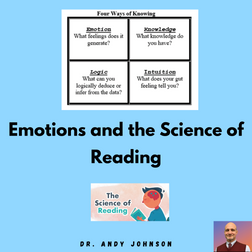
Emotions, Logic, Intuition, Knowledge and the Science of Reading

It’s an emotional response, make no mistake about that.  The decision to abandon good reading instruction and move to what the SoR zealots call structured literacy is an emotional response.  The decision to use hyperbole and pejorative statements to dismiss that with which you are unfamiliar is an emotional response.  The decision to take the argument out of an academic realm to a political realm, and to threaten and bully those who disagree is an emotional response.   The decision to give credence to a radio journalist and ignore real literacy experts is an emotional decision.  Now, there’s nothing wrong with an emotional response.  Emotions are wonderful things.  They are part of what makes us wonderfully and uniquely human.  I wish more decisions were more emotional.  However, good decisions, just like good literacy instruction – is balanced.
Exploring Creativity with Sven Johnson

In this podcast I interview Sven Johnson to talk about creativity and the creative process.

Killing Cows, Burning Witches, and Reading Instruction in Minnesota

There's a literacy inquisition going on in Minnesota. Science of reading zealots are on a holy crusade. They are banning books, banning words, and banning ideas. Books, words, and ideas are dangerous things. They could enable people to think – to think about things – and to think critically. There is a law now in Minnesota, based on the Read Act, sponsored by Representative Heather Edelson that I am NOT to teach the 3-cueing system. I cannot say it. I cannot mention it. I cannot have it on my syllabus. It's illeagal. I can’t even think about it. It’s dangerous. It’s a dangerous thing.
10 of 34