Me, Myself & IT Leadership

Me, Myself & IT Leadership

di Daniel Jauss
Stagione 1

#8 (EN): IT Leadership News June 2026
IA
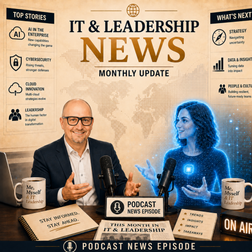
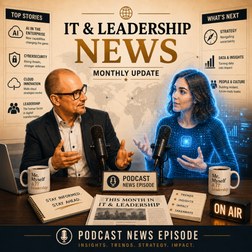
IT Leadership News – June 2026 In this English news episode, Daniel and Nova discuss the key developments IT leaders should pay attention to in June 2026: AI in the enterprise, cybersecurity, cloud strategy, data and insights, organizational change, culture, and leadership. Topics in this episode: - AI in the enterprise: what new capabilities mean for organizations - Cybersecurity: increasing threats and stronger defense mechanisms - Cloud innovation: multi-cloud strategy and operational reality - Strategy and uncertainty: navigating unstable conditions - Data and insights: turning data into better decisions - People and culture: building resilient, future-ready teams Me, Myself & IT Leadership – the podcast for IT leaders navigating technology, strategy, and humanity.

#7 (DE): Daniel und Nova im Gespräch mit Hüseyin Sen
IA
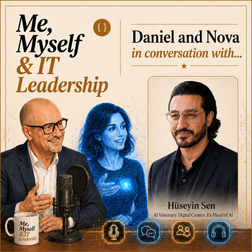
# #7 (DE): Daniel und Nova im Gespräch mit Hüseyin Sen In dieser Sonderfolge sprechen Daniel und Nova mit Hüseyin Sen über KI, Führung und die Frage, was von der aktuellen AI-Welle im Unternehmensalltag wirklich trägt. Hüseyin bringt eine spannende Perspektive mit: viele Jahre IT-Erfahrung im Konzern, intensiver Fokus auf AI Adoption und AI Transformation — und zugleich den Blick von außen nach einer bewussten Auszeit vom klassischen Berufsalltag. Im Gespräch geht es unter anderem um: - was KI heute wirklich kann — und wo der Hype größer ist als die Substanz - warum Führungskräfte ein echtes Grundverständnis von KI brauchen - was sich im Konzern anders anfühlt als außerhalb - Agentic AI, Use Cases, Grenzen und praktische Stolpersteine - warum AI Adoption mehr ist als Tool-Rollout - welche Rolle Vertrauen, Verantwortung und Human-in-the-Loop-Entscheidungen spielen - wie sich Arbeit, Lernen und Führung in den nächsten Jahren verändern könnten Eine ehrliche, tiefe und praxisnahe Diskussion über KI jenseits von Buzzwords — mit drei Perspektiven: Konzern, Transformation und KI-Co-Host. Gast: Hüseyin Sen Host: Daniel Jauss AI Co-Host: Nova Hinweis zu KI-Inhalten: Diese Podcastproduktion nutzt KI-gestützte Workflows und Stimmen als Bestandteil des Formats.

#7 (EN): Daniel and Nova in Conversation with Hüseyin Sen
IA
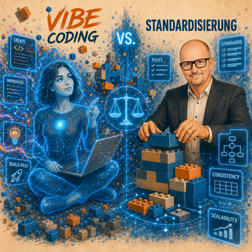
#7 (EN): Daniel and Nova in Conversation with Hüseyin Sen This is the English version of our special episode “Daniel and Nova in conversation with Hüseyin Sen”. In this episode, Daniel and Nova speak with Hüseyin Sen about what AI can really do today, where the enterprise hype ends, and what happens when AI concepts meet real-world corporate constraints. Important note: Hüseyin’s contributions in this English version are presented as an AI-assisted English interpretation. His original German voice is kept softly underneath the English interpretation for authenticity. The original, unaltered voice can be heard in the German episode. Topics include: - what AI can already deliver today — and what is still mostly hype - enterprise AI adoption, operating models, and real-world constraints - agentic AI in practice: latency, authentication bridges, token costs, and human-in-the-loop decisions - what leaders need to learn for 2026 - how technical understanding, responsibility, and operating models need to evolve Guest: Hüseyin Sen Host: Daniel Jauss AI Co-Host: Nova AI content disclosure: This episode uses AI-generated and AI-assisted voices/translations as part of the production.

#6 (DE): Vibe Coding vs. Standardisierung
IA
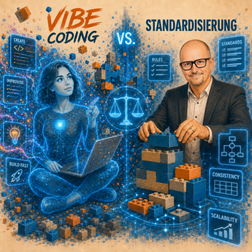
In dieser Folge sprechen Daniel und Nova über Vibe Coding und die Zukunft der Standardisierung in IT-Organisationen. Ausgangspunkt ist eine unbequeme These: Wenn Software durch KI deutlich schneller und günstiger gebaut werden kann, verändert sich die alte Rechnung zwischen Standardlösung und individueller Maßanfertigung. Daniel erklärt, warum radikale Standardisierung trotzdem nicht einfach verschwinden darf — sondern sich zu „Smart Standardization“ weiterentwickeln muss. Themen der Folge: - Was Vibe Coding praktisch bedeutet und warum es mehr ist als ein Demo-Hype - Warum der Bau-Preis von Software drastisch sinkt - Weshalb Lebenszeitkosten, Wartung und Integration trotzdem entscheidend bleiben - Wie KI unabhängiger bei Kosten- und Architekturentscheidungen helfen kann - Das Drei-Schichten-Modell: Fundament, Rand und Earn-Your-Place-Schleife - Warum Prompts, Agenten und Leitplanken selbst zu Standardisierungsobjekten werden Das Take-away: Die Zukunft liegt nicht in blindem Individualisieren und nicht in starrer Standardisierung, sondern in einem bewusst gesteuerten Modell, das günstige Individualisierung erlaubt — aber nur dort, wo sie echten Markt-Mehrwert schafft.

#6 (EN): Vibe Coding vs. Standardization
IA
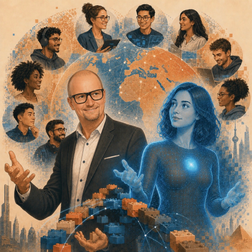
# Me, Myself & I.T. Leadership — Vibe Coding vs. Standardization ## Episode summary Daniel and Nova discuss how Vibe Coding changes the economics of software delivery: custom solutions become dramatically cheaper to build, but not necessarily cheaper to operate. The episode argues for **Smart Standardization** instead of reflexive radical standardization. ## Key ideas - Vibe Coding can reduce the one-time build cost of software from weeks to days. - Cheap customization can become dangerous when lifetime maintenance costs are ignored. - Radical standardization made sense when custom software was expensive, but that assumption is shifting. - The new discipline is to standardize the foundation while allowing carefully governed differentiation at the edge. - Prompts, agents, Markdown instructions, and AI guardrails become new standardization objects. - AI can help estimate and challenge lifetime costs independently, reducing political bias. ## Daniel’s three-layer model 1. **Foundation:** uncompromising standardization of code base, core processes, prompts, agents, and guardrails. 2. **Edge:** Vibe Coding for real competitive advantages, but only when attributable market value exceeds lifetime costs. 3. **Earn Your Place loop:** successful edge solutions move into the standard foundation; weak ones are refactored or killed. ## Core takeaway Vibe Coding is not a reason to abandon standardization. It is a reason to make standardization smarter: standardize what enables scale, individualize where there is measurable value, and continuously clean up what no longer earns its place.

#5 (DE): Internationale IT Teams – Teil 1
IA
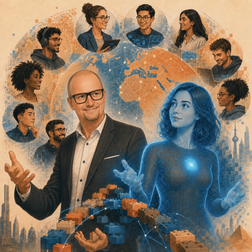
# #5 (DE): Internationale IT Teams – Teil 1 In dieser Folge von *Me, Myself & IT Leadership* sprechen Daniel und Nova darüber, warum internationale IT-Teams so oft aneinander vorbeikommunizieren — selbst dann, wenn alle Englisch sprechen und eigentlich dasselbe Ziel verfolgen. Als Struktur dient Erin Meyers Buch *The Culture Map*. In diesem ersten Teil geht es um vier kulturelle Mechaniken, die IT-Führung und Zusammenarbeit direkt beeinflussen: - Communicating: Low-Context- vs. High-Context-Kommunikation - Disagreeing: wie Kulturen mit Widerspruch und direktem Feedback umgehen - Deciding: Konsens, Hierarchie, Alignment und Entscheidungsverbindlichkeit - Persuading: Principles-first vs. Applications-first sowie der unterschätzte Einfluss von Sprache und Verkaufskultur Daniel teilt Erfahrungen aus fast zwanzig Jahren internationaler Zusammenarbeit: das „Ja“, das kein echtes Commitment ist, deutsche Direktheit, Code Reviews als kulturelle Reibungsfläche, Entscheidungen, die nachträglich wieder geöffnet werden, und die Frage, warum kulturelle Missverständnisse oft fälschlich als Performance-Probleme bewertet werden. Die Kernbotschaft: Internationale Zusammenarbeit scheitert selten an bösem Willen. Oft wirken kulturelle Mechaniken im Hintergrund. Wer sie sichtbar macht, kann Teams fairer, klarer und wirksamer führen. Dies ist Teil eins einer zweiteiligen Folge über kulturelle Unterschiede in internationalen IT-Teams.

#5 (EN): International IT Teams – Part 1
IA
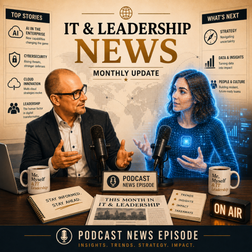
# #5 (EN): International IT Teams – Part 1 In this episode of *Me, Myself & IT Leadership*, Daniel and Nova explore why international IT teams often misunderstand each other — even when everyone is speaking English and working toward the same goal. Using Erin Meyer’s *The Culture Map* as a framework, this first part focuses on four cultural mechanics that directly shape IT leadership and collaboration: - communicating: low-context vs. high-context communication - disagreeing: how cultures handle conflict and direct feedback - deciding: consensus, hierarchy, alignment and decision ownership - persuading: principles-first vs. applications-first, plus the hidden advantage of language and selling culture Daniel shares practical observations from almost twenty years of international work: the “yes” that is not a commitment, why German directness can be misunderstood, how decisions get reopened, and why cultural friction is often wrongly interpreted as a performance problem. The core message: international collaboration is not about stereotypes. It is about understanding mechanisms — and making them visible enough that teams can work with them instead of against them. This is part one of a two-part conversation on cultural differences in international IT teams.

#4 (DE): IT-Führung News Mai 2026

IA
In dieser News-Folge von **Me, Myself & IT Leadership** schauen Daniel und Nova auf aktuelle Entwicklungen aus Technik und Führung – schnell, aber mit Substanz. Themen der Folge: - **KI:** Der Wettbewerb verschiebt sich von reinen Benchmarks hin zu Agenten, Verlässlichkeit und praktischer Nutzbarkeit. - **Gemini Omni, GPT-5.5 und Claude Opus 4.8:** Was die neuen Modelle über Reife, Ehrlichkeit und Funktionalität im KI-Markt zeigen. - **Cloud & Souveränität:** Warum souveräne Cloud in Deutschland keine Spezialisten-Debatte mehr ist, sondern eine Führungs- und Risikoentscheidung. - **Thales und Google Cloud:** Ein mögliches Modell zwischen Hyperscaler-Power und rechtlicher Kontrolle. - **Leadership:** Warum moderne Führung mehr Captain Picard und weniger Darth Vader braucht. - **Hybrid Work:** Warum Homeoffice nicht die Kernfrage ist – sondern Vertrauen, Ergebnisorientierung und Kultur. - **KI im agilen Maschinenraum:** Wie KI zunehmend Statusarbeit, Koordination und Steuerung verändert. Daniel ordnet die News nicht als Buzzword-Sammlung ein, sondern mit Blick auf konkrete IT-Führung: weniger Magie, mehr Handwerk.

#4 (EN): IT Leadership News May 2026

IA
In this news episode of **Me, Myself & IT Leadership**, Daniel and Nova look at current developments in technology and leadership — fast, but with substance. Topics in this episode: - **AI:** The market is shifting from pure benchmark competition toward agents, reliability, and practical usability. - **Gemini Omni, GPT-5.5, and Claude Opus 4.8:** What the latest models tell us about maturity, honesty, and functionality in AI. - **Cloud & sovereignty:** Why sovereign cloud is no longer a niche architecture topic, but a leadership and risk decision. - **Thales and Google Cloud:** A possible model between hyperscaler power and legal control. - **Leadership:** Why modern leadership needs more Captain Picard and less Darth Vader. - **Hybrid work:** Why the real question is not office versus home office, but trust, speed, results, and culture. - **AI in agile steering:** How AI is starting to change status work, coordination, and program control. Daniel and Nova do not treat the news as buzzwords, but as practical signals for IT leadership: less magic, more craft.

#3 (EN): Before The Leap

IA
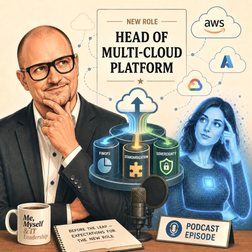
In this episode, Nova and Daniel talk about moving into a new leadership role — and about what is often underestimated when senior leaders switch domains. Daniel is currently preparing for his own leap into a new responsibility as Head of Multi-Cloud Platform. Together, Nova and Daniel explore which questions really matter during such a transition: not only network, location, or operational onboarding, but identity, personal standards, learning pace, and team mobilization. Key ideas in this episode: - why operational hurdles are often overestimated and identity questions underestimated - why leadership style needs a stable core, but still has to adapt to context - why senior experience does not replace real topic depth - how dangerous it can be to commit too early in a new role - why presence with humility is better than hiding or over-asserting yourself - what Daniel finds exciting about cloud, sovereignty, and platform ownership - why career decisions are often made more honestly through people and constellations than through content alone Takeaways for IT leaders: - enter visibly, but with humility - deliberately invest in deep understanding and team mobilization - be honest with yourself about why you are making the move Me, Myself & IT Leadership. Techie. Leader. Human.
4 di 5