Agree to Disagree About Gender

Agree to Disagree About Gender

di Laura T and Yvette N
Stagione 1

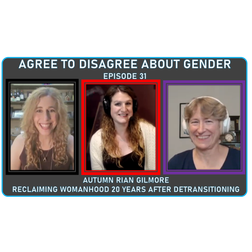
Episode 31 - Autumn Rian Gilmore - Reclaiming Womanhood 20 Years After Detransitioning

In this episode, we are joined by Autumn Rian Gilmore, better known as the Queen of Nuance (@autumnrain80) on Twitter/X Autumn medically and socially transitioned in her late teens to live as a woman, even going to far as to have an orchiectomy, before deciding to return to living to the male role where she spent the next twenty years Five years ago, in her early 40s, she decided to retransition again, and has been trying to make up for lost time. Here about her early childhood, why she decided to give up on her transition and become an anti-trans advocate, and how through the years, she continued to struggle with dysphoria. She describes how toxic dynamics within the trans community combined with extrinsic pressures to question her gender identity, and how she still sees those forces at play today. We hope you enjoy her fascinating story

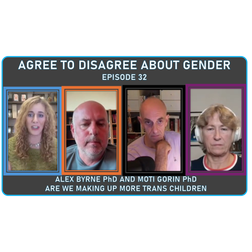
Episode 32 - Are We Making Up Trans Kids - Alex Byrne and Moti Gorin

Yvette and Laura are back after a 3 week summer hiatus with a new episode featuring bioethicist Dr. Mori Gorin and philosopher Dr. Alex Byrne to discuss their latest paper "Trans Kids - Making Up Children", where they propose a theory about how the transgender child comes to be, and if this provides any insight on how we should be thinking about the rapid rise in trans identification and medicalization We also discuss their role in the authorship of the controversial HHS report, Treatment for Pediatric Gender Dysphoria: Review of Evidence and Best Practices, and on the ethics of future research on trans adolescents We also learn about Byrne and Gorin's interest in the topic, and on the limits of free inquiry when evaluating vulnerable populations.

Episode 33 - Putting A Pretty Face on Trans Autosexuality - Schyler B.

Esplicito
Schyler B is a conventionally attractive woman in her 30s who exudes a down-home easy going affect, and whose smile and warmth invite you to want to get to know her better. If you saw her on line selling skin care products, home appliances, or time shares for a Caribbean resort, you would be more likely to stop and take a listen, and hear what she has to say. If she moved to your neighborhood, you'd want to be the first on the block to invite her for dinner. After the dishes are put away and the kitchen is tidies up, you would turn to your partner--or wonder to yourself--"I hope she likes us" Relatability, friendliness and warmth are key to making the sale, and to making connections. And this is especially important when the product is a tough sell, and where people are not necessarily looking for connection. Which is why Schyler, an integrated and binary trans woman is an especially compelling salesperson for transsexualism, and one of its most widely misunderstood features, the concept of autosexuality and autogynephilia Schyler B. has publicly spoken in the recent past about her experiences with transitioning and life as an integrated trans woman, and in particular, her experience of growing up experiencing autosexual gynephilic arousal - a phenomenon often described as autogynephilia. This is the term coined by sexologists to describe natal males who develop arousal and attraction to the thought of being female, or by taking actions to take on the appearance of being female. This has been proposed as one of the major triggers for gender incongruence and dysphoria in natal males, though this is highly contested. (Those more interested in the subject of autogynephilia can go watch our interview with psychologist Dr. James Morandini in Episode 8) https://youtu.be/XiJkGslk-zo She speaks of the necessity of destigmatizing and normalizing the phenomenon of autosexuality, just as the gay community once did with same-sex attraction. She is also the former co-host of Dollcast, a no-longer-active project which also aimed to show a more normal and relatable side of transsexuality, and to differentiate trans women who transitioned to live integrated lives as women from those who are pursuing transition to stand apart from cisnormative society . On this episode, we hear about Schyler's childhood and adolescence, her path to transition, her relationship to her partner before and during this process, as well as why she decided to go public despite having the ability to keep her history of transition private. We also discuss the concept of "pretty privilege" within the trans community, and on the role that appearance has in fostering relatability and respectability to people outside the trans experience. Please subscribe to Agree to Disagree About Gender for more content like this

Episode 34 - My Child Transitioned as a Teen - And Now She's Thriving As An Adult - Ms. Mbl

Ten years ago, Megan (Ms. Mbl) is a mother who's child told her at age 9 that he thought he should have been a girl. She supported her transition, and today according to our guest, her daughter "Leah" is at thriving adult enrolled at University. Today, it is unclear whether a parent in Ms. Mbl's situation would make the same decision. We are learning that the research on the ability of medical transition to improve the lives of trans children is unclear, we are hearing more stories of people who were transitioned as teenager regretting it as adults, and increasing tensions between parents who are trying to put the breaks on the desires of their children to pursue gender transition, and the children who seem intent to pursue their desires. On our show, we have shared the stories of some detranasitioners who have regretted decisions made for them as adolescents, but we have not yet had a guest on to talk about how this changed their child's like for the better. Which is why we wanted to talk to Ms. Mbl, and hear how she supported her child through this consequential process, to understand the rewards and regrets, and to understand if she would make the same decision today, knowing what she knows now. Ms. Mbl can be found on twitter at @missmbl2812
Episode 35 - I Don't Need You To Believe I'm A Woman: I Just Need You To Believe in My Rights - Cassie Pritchard

Esplicito
So begins one of the more provocative essays to emerge from the trans debate in recent weeks, and today we’re joined by its author, Cassie Pritchard Cassie Pritchard begins with what can sound like a striking concession: that securing the rights of trans women may not require persuading everyone that trans women are, in every meaningful sense, women. That challenges one of the central assumptions of modern trans advocacy. But it also raises a difficult question: can the rights, protections, and accommodations trans women have gained be sustained if we no longer expect the broader public to accept that underlying claim? Cassie Pritchard is a writer, labor organizer, democratic socialist, and trans woman whose work explores politics, labor, and the changing debate over transgender rights. A former Starbucks barista and union organizer in Los Angeles, she has written for The New York Times and The Argument and publishes her own Substack, The Cassandra Problem. In her recent essay, “I Don’t Need You to Believe I’m a Woman,” Cassie argues that trans advocacy should move away from demanding agreement over the meaning of sex and gender and instead build broader coalitions around pluralism, individual liberty, tolerance, and material protections for trans people.

Episode 36 - Is the Gender Critical "Trans Suicide Myth" Narrative Itself A Myth" - Dr. Tyler Black

Esplicito
Few arguments in the debate over transgender healthcare carry more emotional weight than suicide. Parents hear alarming accounts of what might happen if their child does not transition. Advocates describe gender-affirming care as lifesaving. Critics argue that the evidence cannot sustain that claim, and some have labelled the entire narrative a “suicide myth.” But what, exactly, is supposed to be the myth? That young people with gender dysphoria experience serious distress? That they face an elevated risk of suicide? That medical transition reduces that risk? Or that parents are routinely being pressured into treatment through frightening predictions about their children’s survival? These are different questions, requiring different kinds of evidence. Rejecting an exaggerated claim does not establish that the underlying concern is imaginary. Equally, taking that concern seriously does not establish that a particular treatment prevents deaths. oining us today is Dr. Tyler Black, a child and adolescent psychiatrist, suicidologist, and clinical assistant professor at the University of British Columbia. His work includes caring for young people in psychiatric crisis and examining how suicide evidence is interpreted and communicated. Dr. Black has also launched pediatricsuicides.ca, which is a open-access data source for global suicide statistics, covering 138 countries from 1952 to the present day. Today, we’re asking: “Is the Suicide Myth Also a Myth?” What do we know, what remains uncertain, and what should families hear?

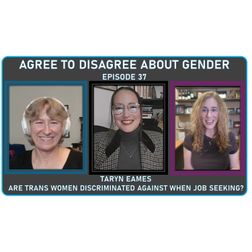
Are Trans Women Discriminated Against When Job Seeking - Taryn Eames

Laura often quips: "Looks don't matter, except when they do, which is nearly always". We all have a sense that people who are conventionally attractive catch more breaks then people who are plain, and this is likely more true for women than for men. But how much does this matter for trans women, who are more likely than natal women (and non-trans men) to be unemployed and in poverty. Taryn Eames, a PhD candidate in economics at the University of Toronto, sought to find out why. Are trans women less employable, or are they being discriminated against by employers? And how is this effected by their passability -- their ability to be interpreted as though they were natally female. To analyze if this was due to hiring discrimination, she sent out 10000 fake resumes to potential employers across Germany, The only details that they changes was that in some, the employee revealed a trans history, and in some, the employee was presumed to be a natal female. In addition, in half the resumes she included a picture that appeared classily female, and in the other half, the picture was masculinized to look trans. She discovered that employers gave a positive response 9% less often if the employee revealed a trans history but "passed" as female, but 32% less often if she did not pass, showing that trans women who do not pass are significantly penalized when job hunting. With Yvette away sick, Laura and Taryn discuss this research, try to tease out differences between attractiveness and passability and discuss if this is a problem that can (or should be) remedied.

Episode 38 - Villain Or Vindicated on Pediatric Gender Care - Dr. Ken Zucker

In 2015, one of the world’s best-known researchers of childhood gender dysphoria lost the clinic he had led for more than three decades. Toronto’s Centre for Addiction and Mental Health closed its child and youth gender identity service and dismissed its clinical lead, psychologist Ken Zucker. The clinic had come under intense criticism. Some accused it of practising conversion therapy by trying to steer children away from a future transgender identity. An external review found that its approach was out of step with emerging practice, although the reviewers said they could not determine whether it was practising conversion therapy. For many people, Zucker’s dismissal marked the end of an era in which clinicians saw childhood gender dysphoria as something they might try to resolve. Then the story took another turn. In 2018, CAMH acknowledged serious errors in the review’s account of Zucker’s conduct, apologized to him, and reached a financial settlement. Zucker saw that as a vindication. CAMH, however, stood by its decision to close the clinic. The apology corrected allegations about the man. It did not settle the argument about the care. That argument has become more urgent. Zucker was not a marginal figure. He chaired the group responsible for sexual and gender identity diagnoses in DSM-5, edited Archives of Sexual Behavior, and helped produce some of the most influential follow-up research on children referred for gender identity concerns. In one study of 139 boys assessed in childhood, only 17 were classified as having persistent gender dysphoria at follow-up. That finding has been cited to argue for patience before assuming a child will need medical transition. But what, exactly, did those studies establish? The children were assessed decades ago, more than a third did not meet the diagnostic threshold at their initial assessment, and the research cannot tell us whether Zucker’s treatment changed their outcomes. Nor can its percentages simply be applied to adolescents presenting for the first time today. Now the clinical pendulum appears to be moving again, at least in some countries. Following the Cass Review, England has moved toward broader assessment of young people’s mental health and development before specialist treatment. Sweden has urged greater caution with medical interventions for minors. Those changes revive questions Zucker spent his career asking: How does dysphoria develop? Which young people will continue to experience it? What else might explain their distress, and how can clinicians help them make sound decisions? Renewed interest in careful assessment does not, by itself, vindicate every aspect of Zucker’s old approach. In particular, it does not show that therapy can prevent a transgender outcome, or that prevention should be its goal. Zucker is still working on those questions. He has recently written with Michael Bailey about psychotherapy for gender dysphoria and is collaborating with Bailey and Lisa Littman on a study following adolescents and young adults over time. So was Ken Zucker a clinician punished for asking questions that medicine needed to ask? Or did his clinic cross a line between exploring a child’s distress and trying to determine who that child should become?
4 di 4