Agree to Disagree About Gender

Agree to Disagree About Gender

di Laura T and Yvette N
Stagione 1

Episode 21 - Jonni Skinner - Controversy and Compassion About Detransition Part 1
Jonni Skinner is a young man who spent 8 years of his adolescence and young adulthood living as a girl and young woman, before deciding to reclaim his identity as an effeminate gay man. He details how he came to believe that transition would be a better fit for his personality, his struggles with medicalization as a young person, and how he intends to face his future in his birth sex. Yvette and Laura touch upon why he tried to "trans away the gay", if he is now trying to "gay away the trans", and his advocacy for banning access to the type of care he beleives has left him permanently damaged.. We also discuss the intersection between identity and embodiment, what he envisions his life will be like going forward, and why he still has affection for the trans community. This is the first of 2 episodes, -please stay tuned for Part 2 next week

Episode 22 - Jonni Skinner - Controversy and Compassion About Detransition Part 2
In Part 2 of our conversation with Jonni Skinner, we focus on life after detransition: the challenges of re-integrating back into the male gender role after living for 8 years as a woman, staying positive despite facing hardships, his motivations to become an advocate for restricting access to medical interventions for minors, and on what his future might hold. Please take a moment to watch Part 1 if you haven't already

Episode 23 - Sasha Ayad - Avoiding Estrangement From Your Trans Child
Sasha Ayad is a license therapist who provides counselling to families where a child is transitioning or is experiencing gender distress. Her focus is on how parents can continue to be part of their child's life and avoid estrangement and promote reconcilement, even when they are not supportive of medical transition She joins Yvette and Laura on Agree to Disagree About Gender to have a heartfelt discussion on these issues Sasha became interested in the sharp rise in teenagers who declare they are trans for the first time during adolescence. She questions the practice of medical transition for minors, and her clinical work focuses on developmentally appropriate, least-invasive-first talk therapy. Seeing a great need to help parents, Sasha began running parent groups in 2019 both online and through in-person retreats. She is the co-author of the book When Kids Say They’re Trans, and writes regularly on Substack. She recently launched a new project called The Metaphor of Gender: on this YouTube Channel, identity goes beyond the literal. She uses radical curiosity and surprising insights to help adolescents and young adults better understand themselves and skillfully navigate the real world.

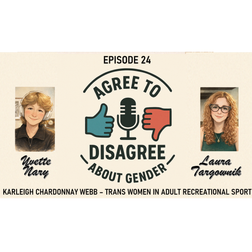
Episode 24 - Karleigh Chardonnay Webb - Trans Women in Adult Recreational Sport

Karleigh Webb is a woman who wears a lot of hats on the field and off. She is a sports journalist with 33 years experience as a television sports reporter/anchor, producer and now as a contributing sportswriter to Outsports.com. She is also the a training coordinator and peer support operator for Trans Lifeline. Karleigh is also an avid cycling, runner, triathlete/duathlete and is in her fourth season of women's football playing for the Connecticut Ambush of the American Women's Football League. Karleigh joins us to make her case about why trans women belong in women's sports at all levels. We discuss the implications of trans women's participation in contact vs. noncontact sports, competitive vs. recreational, and on the role sports can play in creating a sense of belonging for trans women Needless to say, this becomes a source of vigorous debate for Laura and especially Yvette who is firmly protective of women's sports being for biological women. This discussion gets lively and contentious, but remains civil throughout, as we continue to model how to have impactful conversations about controversies in the world of gender

Episode 25 - Maia Poet - Autism and Gender Dysphoria Part 1
Maia Poet spent 12 years of her adolescence and early adulthood believing she had a male brain in a female body, and eventually went on to live in the male social role amongst Orthodox Jews, Palestinian Muslims and secular Israelis for five years. It took living through two wars in the Middle East for Maia to begin the journey of questioning the conclusion she came to as a 12 year old, and eventually to divest from it entirely. Almost three years later, she is now a public speaker and writer who reflects extensively on Substack about her experiences of transition, desistance and detransition with a focus on exploring the overlap of conditions like ADHD, autism and gender dysphoria at the intersection of research and lived experience. She hopes to bring awareness to the ways in which the systematic overlooking of autistic traits and experiences in girls early in life, leaves them uniquely unequipped to navigate the psycho-social and sensory challenges of puberty, and therefore more vulnerable to developing conditions like sex or gender dysphoria and eating disorders around adolescence. Maia sits down with Laura and Yvette about the impact of autism and neurodiversity on the experience of living with gender dysphoria. Her perspective is imformed by her own experience of growing up autistic before it was commonly recognized in natal females, her relationship to her body and how she developed gender dysphoria, and how she came to live in a male role as an adolescent and young adult in Israel

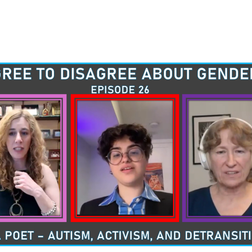
Episode 26 - Maia Poet Part 2 - Autism, Detransition, and Activism
Maia Poet joins us for Part 2 of our conversation about her theories of the interface between autism in natal females, the drive to transition and detransition, and how it informs her advocacy. We also discuss the evolution of her thinking on trans people, and her transition from a more adversarial to a more curious and collaborative approach Also, please check out Part 1 of our interview on our channel!

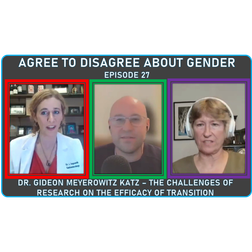
Episode 27 - Dr. Gideon Meyerowitz Katz - Can Data Settle the Debate on Pediatric Gender Medicine?
In this episode of Agree to Disagree About Gender, I speak with epidemiologist Dr. Gideon Meyerowitz-Katz, also known as Health Nerd, about pediatric gender medicine, medical transition for young people with gender dysphoria, and what the evidence can and cannot tell us. The quality of evidence around pediatric medical transition remains highly contested. Some argue that the existing research is too weak to determine whether these interventions improve outcomes for young people, make outcomes worse for some, or help certain groups while harming others. Others argue that continued access is necessary despite uncertainty, especially given the distress experienced by many adolescents with gender dysphoria. Dr. Meyerowitz-Katz is an epidemiologist and science communicator who writes about evidence, public health, and how to interpret data. His Substack, Health Nerd, has more than 33,000 subscribers, and he has written extensively about pediatric gender medicine, including arguments in favour of continued access to care despite the limitations of the current evidence base. In this conversation, we discuss: • Why the evidence base for pediatric medical transition is so difficult to interpret • What randomized trials, observational studies, and systematic reviews can and cannot answer • Whether better data could resolve the debate • How researchers should think about benefit, harm, regret, and uncertainty • Why pediatric gender medicine has become so politically polarized • Why data alone often fails to persuade people on either side of the issue This is a conversation about evidence, uncertainty, values, and the limits of epidemiology in one of the most contested areas of medicine. Guest: Dr. Gideon Meyerowitz-Katz / Health Nerd Show: Agree to Disagree About Gender #PediatricGenderMedicine #GenderDysphoria #MedicalTransition #HealthNerd #Epidemiology #GenderMedicine #EvidenceBasedMedicine #AgreeToDisagreeAboutGender

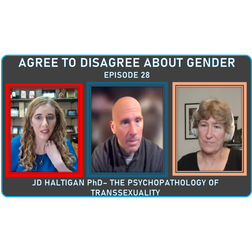
Episode 28 - JD Haltigan PhD - The Psychopathology of Transexuality
in this episode, we speak with developmental psychologist J. D. Haltigan about his controversial argument that transsexuality should be examined through the lens of psychopathology rather than treated solely as an identity altigan’s academic work has focused on developmental psychopathology, personality, identity formation and the ways psychological symptoms can be shaped by social environments. More recently, he has applied these interests to the rapid rise in gender dysphoria, particularly among adolescents, asking whether social media, peer influence and changing cultural narratives have helped transform diffuse psychological distress into a gendered identity. We discuss whether transsexuality is itself a form of psychopathology, or whether it is better understood as a response to underlying problems involving personality, identity development, autism, trauma or emotional dysregulation. Haltigan explains why he does not believe medical transition is an appropriate treatment, even when it appears to reduce distress, and argues that questions about transition cannot necessarily be settled by outcome studies alone. Laura argues that her successful transition demonstrates that even if you do consider transness to be psychopathologic, that transition can be one path by through which trans people can mitigate the impact of that psychopathology on their ability to function and thrive in the world. The conversation also considers a deeper philosophical divide. Should transition be judged primarily by its consequences, including whether it improves quality of life, or are there moral and conceptual objections that remain even when an individual reports benefit? Finally, we explore what may be driving the extraordinary increase in gender dysphoria and how Haltigan’s earlier work on identity formation and social-media-mediated psychopathology shaped his understanding of the phenomenon.

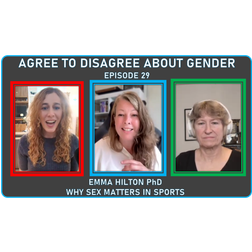
Episode 29 - Emma Hilton PhD - Why Sex Matters in Sports (But Is It The Only Thing That Matters)
Dr Emma Hilton is a developmental biologist at the University of Manchester, where her research has focused on developmental genetics and human genetic disease. She earned her PhD at the University of Warwick, studying early events in vertebrate embryonic development. Hilton became a prominent public voice in debates over sex and gender after writing about the biological basis of sex differences in athletic performance. She is the co-author, with sports scientist Tommy Lundberg, of an influential review examining testosterone suppression and retained performance advantages in transgender women. Her position is that male puberty produces enduring advantages in strength, speed, power and body composition that hormone treatment cannot reliably eliminate, and that female sporting categories therefore need to be defined by sex rather than gender identity. Beyond sport, Hilton is a co-founder and current chair of the board of trustees of Sex Matters, a UK advocacy organization that campaigns for biological sex to remain explicit in law, policy and language. Through that work, she has argued for female-only provisions in areas including changing rooms, healthcare, prisons and other settings where privacy, safety or fairness may be at issue. Her arguments have made her an influential and controversial figure in Britain’s gender debate, with supporters seeing her as a defender of women’s sex-based rights and critics regarding her advocacy as exclusionary toward transgender people. In this episode, we focus on why sex matters in sport, and whether it should be the only thing that matters, especially in societies that may also value inclusion. We also explore Hilton’s broader worldview about sex and gender, the principles behind her advocacy and the implications of drawing sex-based boundaries in public life.

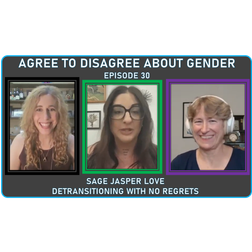
Episode 30 - Sage Jasper Love - Detransitioning with No Regrets

Sage Jasper Love spent 5 years of her life in her 20s living as a trans man. She was on testosterone, underwent a bilateral mastectomy, and found a trans partner. Then a few years ago, she decided to return to living in the female role. But distinctly from other commonly heard narratives, Sage has no regrets about her medical transition, and sees it as an important part of her identify development. Even while she awaits completion of her reconstructive breast surgery, and even as she has doubts about transition being offered to minors. We wanted to talk to Sage to better understand why she maintains this outlook, why she refuses to politically campaign against trans people and their rights, and on whether her experience has anything to teach other young people considering undertaking a similar gender journey Sage has a substack called Narrative Acts where she discusses her transition and detransition, including her essay "My Truth About Detransitioning", which was featured on The One Percent On this
3 di 4