The Remarkable SaaS Podcast

The Remarkable SaaS Podcast

por Ton Dobbe
Temporada 9
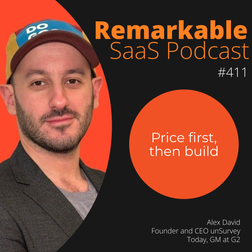
#411 – Alex David: The question AI made everyone forget
A story about thinking harder while everyone builds faster. This episode is for founders wondering why shipping faster with AI hasn't made their product any better. Building has never been easier. That's exactly the problem. Alex David spent a decade in pricing — Simon-Kucher, then Segment — before founding unSurvey, an AI company G2 acquired last year. Today, he leads AI Solutions there. His worry is simple: the tools got cheap, but good judgment didn't. While everyone rushed to build, he kept asking the question most people skip ”Is this even worth building?” This inspired me, hence I invited Alex to my podcast. We explore why the founders who win aren't the ones building fastest — they're the ones who know what's worth building. Alex shares why he walked away from a company that was working to start another and what a decade in pricing taught him about worth. You'll discover why the price was never yours to set — and what that changes about everything you build. We also zoom in on two of the 10 traits that define remarkable software companies: Master the art of curiosity (trait 4) Create momentum (trait 8) Alex's journey is an excellent example of the mindset that goes behind how remarkable software companies build something people just keep talking about. Here's Alex's approach to deciding what to build and what not: "The price is what the price is to the customer; that's what it's worth to them. You have two options: You build a product that is profitable within that constraint, or you have to spend a lot of marketing dollars to educate the customer on why they're wrong, and why it should be worth more." By listening to this episode, you'll learn: Why asking why matters more now that building costs almost nothing What real momentum is made of — and why founders manufacture it Why hope is what stops founders from pivoting in time Why acquisitions live or die on people, not terms For more information about the guest from this week: Guest: Alex David, Founder and CEO of unSurvey. Today, GM of AI Solutions at G2 Website: g2.com (and g2.ai)
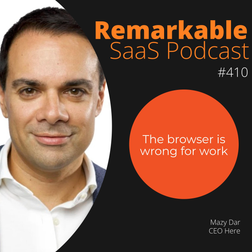
#410 – How Mazy Dar found room in Google and Microsoft's market — and won the world's biggest banks
A story about the market everyone assumed was taken. This episode is for founders wondering how to find room in a market owned by giants. The biggest software market in the world looked fully taken. Mazy Dar, CEO of Here, found room in it anyway. He spent 26 years on one pain the giants' browsers aren't built around — a browser made for work, not the public internet. The world's biggest banks now run mission-critical work on it. And this inspired me to invite Mazy to my podcast. We explore how you find room in a category owned by Google and Microsoft — and why the slice they leave open turned out to be sizeable. Mazy shares why he named the company after an idea rather than a product, and what he learned serving the most locked-down desktops in the world. We also zoom in on two of the 10 traits that define remarkable software companies: Acknowledge you cannot please everyone Sell the idea, not the product Mazy's journey proves that remarkable companies don't fight the giants head-on. They find the ground where they can become the only logical option. Here's one of Mazy's quotes that captures how he thinks about a problem hiding in plain sight: "This is not like a crazy concept. What's crazy is that in this one category of product, the web browser that's the most widely used in the world, it's the one area where the one size fits all seems to be the thing that everyone assumes is the correct answer." By listening to this episode, you'll learn: Why holding one problem for years can beat chasing the next trend What it really costs to let big customers design your product for you When to stop building only what your founding segment demands Why selling the idea outlasts selling the product For more information about the guest from this week: Guest: Mazy Dar, co-founder & CEO of Here Website: here.io Mazy's email: mazy@here.io
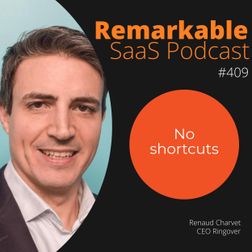
#409 – How Renaud Charvet chose ownership over speed — and made Ringover impossible to copy
A story about what compounds when you don't take the shortcut. This episode is for sales-led SaaS founders who invested to grow fast but now realize they forgot to grow their differentiation. Most software companies buy speed — they build on someone else's foundation — and never count the cost. Renaud Charvet, co-founder and US CEO of Ringover, took the opposite path. He started in 2005 selling cheap international calls, watched Skype and WhatsApp kill that business, and built something new from scratch. Bootstrapped for fifteen years, then raised to expand — and moved his family to the US to make it work. He's never once taken the shortcut. And this inspired me to invite Renaud to my podcast. We explore how choosing ownership over speed creates an edge competitors can't copy. Renaud shares how he thinks about what's worth owning, where to focus, and what actually makes customers stay. You'll discover why the slow, expensive choice compounded into something no shortcut could match. We also zoom in on two of the 10 traits that define remarkable software companies: – Aim to be different, not just better – Acknowledge you cannot please everyone Renaud's journey proves remarkable companies don't copy the playbook — they own what others rent and let the advantage compound. Here's one of Renaud's quotes that captures how he thinks about building an edge: "Focus — it might feel slower in the short term, but it compounds much faster in the long term." By listening to this episode, you'll learn: What you give up the day you build on someone else's stack What changes when you stop selling features and start selling outcomes What he did when the US market ignored him Why the customers easiest to win are the ones who leave For more information about the guest from this week: Guest: Renaud Charvet, co-founder and US CEO of Ringover Website: ringover.com
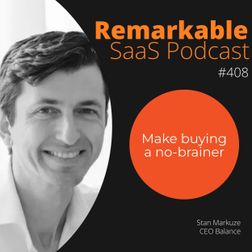
#408 – How Stan Markuze refused the me-too game and made buying a no-brainer
A story about choosing the one thing no competitor would copy. This episode is for sales-led SaaS founders stuck in a crowded category, wondering how to escape the price-and-features war In a crowded category, most founders just try to win it. Stan Markuze, CEO of Balance, did something else. Five companies in, with two auto-tech exits and a decade in real estate, he'd seen what a price war looks like. So when seven companies were selling the same treasury tool, he refused to be the seventh. And this inspired me to invite Stan to my podcast. We explore how refusing to compete on everyone else's terms creates an edge no rival can copy. Stan shares why he walked away from a feature-and-price war, and what turns a quiet user into a vocal one. You'll discover what happened to his sales cycle once buying his product stopped being a debate. We also zoom in on two of the 10 traits that define remarkable software companies: – Aim to be different, not just better – Turn customers into fans Stan's story proves remarkable companies don't fight harder inside the category—they change what they get measured on. Here's one of Stan's quotes that captures how he thinks about the standard SaaS model: "We turned the business model upside down. Usually, you pay an annual SaaS fee for a treasury management product. What we do is, if people sweep cash through our platform, for those who sweep a certain threshold, we would actually give them the treasury management system at no cost, because we're able to monetize the automatic sweeps." By listening to this episode, you'll learn: Why removing friction you can't see beats chasing growth you can What makes an ROI concrete enough to close on the first call Why the metric you stop tracking matters as much as the one you keep How a tight niche turns happy customers into a referral flywheel For more information about the guest from this week: Guest: Stan Markuze, CEO of Balance Website: balancecash.io
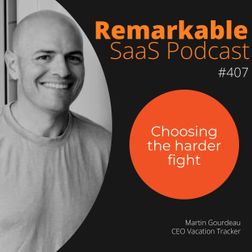
#407 – How Martin Gourdeau refused the commodity race and added $1M ARR in 9 months
A story about choosing the harder fight on purpose. This episode is for SaaS founders wondering why adding more features to their niche product isn't creating the edge it used to. Most niche SaaS races to add features—and wonders why margins shrink. Martin Gourdeau, CEO of Vacation Tracker, took a different path. After running Workleap as President and GM, he took a year off to study what's actually changing in software—then chose a 22-person bootstrapped company over another large stage. And he didn't pick Vacation Tracker by accident. He picked it because he believes the next wave of software will be won by a very different kind of company. And this inspired me to invite Martin to my podcast. We explore what he saw in that year off—and why it shaped a very different bet on what wins next. Martin shares why a small bootstrapped company now has an edge most large companies will never get back, why he changed the one number that decides when his whole team gets a raise, and what kind of SaaS he thinks AI will quietly destroy. We also zoom in on two of the 10 traits that define remarkable software companies: – Aim to be different, not just better – Create NEW value possibilities Martin's journey proves that the next wave of remarkable software companies won't look like the last. Here's something Martin observed that explains where he thinks the real opportunity sits: "High performers are notoriously bad at managing their energy levels because of this obsession to perform." By listening to this episode, you'll learn: Why most SaaS companies are competing in the wrong layer Why ARR-per-head changes the behavior of every employee What high performers get wrong about their own energy Why delegation to agents is the skill most leaders lack For more information about the guest from this week: Guest: Martin Gourdeau, CEO of Vacation Tracker Website: https://vacationtracker.io
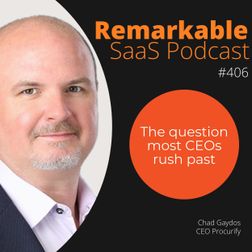
#406 – How Chad Gaydos chose fit over TAM and doubled deal sizes in 12 months
A story about asking the question many CEOs avoid—and finding real money. This episode is for SaaS CEOs with a nagging feeling that their growth isn't compounding the way it should. Most CEOs chase market size. And miss what actually matters. Chad Gaydos, CEO of Procurify, took a different path. With 30 years across SAP, Skillsoft, Talkdesk, and Total Expert, he's learned that growth isn't about how big the market is—it's about how well you fit it. When he took the CEO seat in January 2025, he asked a question most operators skip: Is there a real use case here—or just a big number? And this inspired me to invite Chad to my podcast. We explore why use-case fit—not market size—is what actually compounds growth. Chad shares why his first move was repositioning the entire company, why the product was being sold to the wrong customers, and why saying yes to the wrong customer is more expensive than saying no. We also zoom in on two of the 10 traits that define remarkable software companies: – Master the art of curiosity – Acknowledge you cannot please everyone Chad's journey proves that remarkable companies don't grow by chasing markets—they grow by reading them differently than everyone else. Here's one of Chad's quotes that captures how he reads markets: "What drew me wasn't procurement per se. It was really what was going on in this last category of the Office of the CFO. I felt like it hadn't been written yet." By listening to this episode, you'll learn: Why use-case fit beats TAM size What happens when pricing finally matches the value you deliver When the first 90 days demand subtraction, not addition How to make hard decisions without committee paralysis For more information about the guest from this week: Guest: Chad Gaydos, CEO of Procurify Website: https://www.procurify.com
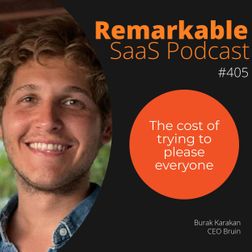
#405 – Burak Karakan, CEO of Bruin - On the cost of trying to please everyone
A story about an opinionated founder, the customers he turns away, and the ones who stay. This episode is for SaaS founders quietly wondering whether trying to be a fit for every buyer is what's slowing them down. Most founders think the goal is to be a fit for as many buyers as possible. Burak Karakan, Co-founder and CEO of Bruin, runs his company on the opposite belief. A former engineering manager at HelloFresh, he built an opinionated product — and he's at peace with the buyers who walk away because of it. And this inspired me to invite Burak to my podcast. We explore why being opinionated on purpose creates focus, speed, and the right kind of customer base. Burak shares his thinking on the question that qualifies a buyer in five minutes, why he hires juniors over seniors right now, and what happened when his team stopped tracking competitors altogether. You'll discover why he turns down deals that other founders would take. We also zoom in on three of the 10 traits that define remarkable software companies: – Acknowledge you cannot please everyone – Aim to be different, not just better – Master the art of curiosity Burak's journey proves that remarkable companies don't try to be a fit for everyone — they hold their position, and the right customers find them because of it. Here's one of Burak's quotes that captures his thinking: "It's unbelievable to me that engineers think they are there just to build stuff. No, you're there to solve problems, and sometimes solving that problem will especially require you to not build something." By listening to this episode, you'll learn: Why opinionated products attract better customers than agreeable ones What question reveals whether a buyer is a real fit in five minutes When ignoring your competitors becomes your sharpest strategic move Why hiring juniors right now beats hiring seniors For more information about the guest from this week: Guest: Burak Karakan, Co-founder & CEO of Bruin Website: https://getbruin.com
#404 – How Tim Barker proved the software org chart is now optional
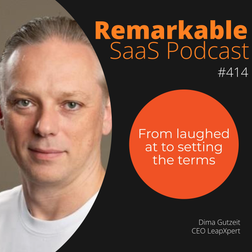
A story about rebuilding how a company runs from the ground up. This podcast is for SaaS founders wondering whether the playbook they've been running is still enough to keep their edge. Most software CEOs scale by hiring. Few question that. Tim Barker, CEO of Attain IP, walked away from the obvious next move. After scaling Salesforce in EMEA, leading DataSift through Twitter's data shutdown, and running a public mental health platform for five years, he turned down PE roles and board seats to start over. New company, new market — white-box AI for patent attorneys. But the real bet wasn't the market. It was the build: five people, no functional org, agents doing the work a department used to. That's the choice I wanted to understand. This inspired me to invite Tim to my podcast. We dig into how the operating model of a software company gets rebuilt when one person can run what used to take a department. Tim shares his thinking on why products should be bought not sold, why trust is now a measurable input, and why the obvious next move is rarely the remarkable one. We also zoom in on two of the 10 traits that define remarkable software companies: Sell the idea, not the product Master the art of curiosity Tim's story proves that remarkable companies don't follow the obvious playbook—they question the foundations everyone else takes for granted and build what works now. Here's one of Tim's quotes that captures how his definition of a winning product has shifted: "There's no MVP in our world, in our vocabulary. It's replaced by the minimum magical product. Magical products drive word of mouth, and our North Star is: once I've used it, I'm never going back." By listening to this episode, you'll learn: Why systems beat super prompts in any AI-first business What separates products people buy from products you have to sell Why trust is a measurable input, not just a brand value Why uncomfortable choices teach faster than comfortable ones For more information about the guest from this week: Guest: Tim Barker, CEO at Attain IP Website: attainip.ai
#403 – Why Amos Bar-Joseph rejected the playbook every unicorn ran
A story about questioning the play itself—not the execution. For SaaS founders quietly wondering whether their next round will fix what the last one didn't. Most founders who fail try harder the next time. Amos Bar-Joseph, co-founder and CEO of Swan, took a different path. Three-time founder. Two prior B2B startups built on the unicorn growth-at-all-costs playbook—both ended in failure. On the third one, he didn't tighten his execution. He rejected the play—and reached seven figures in ARR in just nine weeks. And this inspired me to invite Amos to my podcast. We explore why questioning the playbook creates a different kind of edge. Amos shares the thinking behind scaling talent first, not headcount—why mental capacity is the bottleneck, why knowledge has to become software, why meetings and alignment calls are the real cost of scale. We also zoom in on three of the 10 traits that define remarkable software companies: – Aim to be different, not just better – Master the art of curiosity – Focus on the essence Amos's journey proves that remarkable companies don't follow consensus—they question what everyone else accepts and walk away from it. Here's one of Amos's quotes that captures his philosophy on how a business should be built: "We're scaling our talent inside the company so we can discover what does it look like the 100x version of an engineer, the 100x product, the 100x seller, the 100x marketeer. [...] A business that is designed from the ground up to scale its employees, not a business that employees are designed to scale the business." By listening to this episode, you'll learn: Why convention is the fastest path to mediocrity in software What changes when revenue per employee becomes your North Star metric Why mental capacity is the real bottleneck, not headcount Why knowledge has to live in the system, not the team For more information about the guest from this week: Guest: Amos Bar-Joseph, Co-founder & CEO of Swan Website: https://www.getswan.com
#402 – How Joseph Lee refused to outspend his rivals — and outgrew them anyway
A story about advantages that capital cannot buy. This episode is for SaaS founders who are watching better-funded rivals raise round after round—and questioning whether outspending is really the only way to win. Most founders chase scale before they've earned the right. Joseph Lee, CEO of Supademo, took a different path. After six years and several pivots in his previous company, he started Supademo in early 2023 with a bootstrap mindset—even after raising. He did the gritty work that bigger competitors refused to do, and shared every harsh lesson in public from day one. The result: mid-seven-figure ARR — built by a team of 11. And this inspired me to invite Joseph to my podcast. We explore why founder-led grit beats capital when capital is everywhere. Joseph shares why he stopped tracking twenty metrics to focus on three, and why he believes 99% of a startup's momentum has nothing to do with the founder. You'll discover what happens when the smaller player chooses the work the bigger players won't touch. We also zoom in on two of the 10 traits that define remarkable software companies: Turn customers into fans Master creating momentum Joseph's journey proves that remarkable companies don't outspend competitors—they build flywheels competitors can't buy. Here's one of his quotes: "You need to build the right levers into your business where you're riding the momentum of the market or momentum of the product. We're not doing as much like hand-to-hand combat." By listening to this episode, you'll learn: Why structural market dynamics drive 99% of a startup's momentum What makes 100 early customers more valuable than 10,000 later ones Why measuring twenty metrics hides what three actually reveal Why trust compounds when founders share lessons publicly from day one For more information about the guest from this week: Guest: Joseph Lee, CEO of Supademo Website: https://supademo.com
1 de 42