In our May 2026 RSS.com training, Greg Wasserman, Head of Relationships for RSS.com, sat down with Rain Bennett, host of The Storytelling Lab, author of The Chief Storytelling Officer, keynote speaker, and filmmaker, to break down what storytelling actually means inside a podcast and how to use it to turn casual listeners into loyal fans.
Whether you record solo, run interviews, or script every word, the session covers practical ways to shape episodes your audience will finish and share.
Watch the full conversation here, or read our recap below:
Storytelling – Delivering Information Through Emotion
Rain’s working definition is that storytelling is a way to deliver information through emotion.
Every story has two sides, the intellectual layer (the facts, the plot) and the emotional layer (the real story). You need both, because emotion is how the information actually lands.
A story, in the simplest terms, is a sequence of events that creates change. No change, no story.
The “Storytelling Cocktail” Keeps Brains Hooked
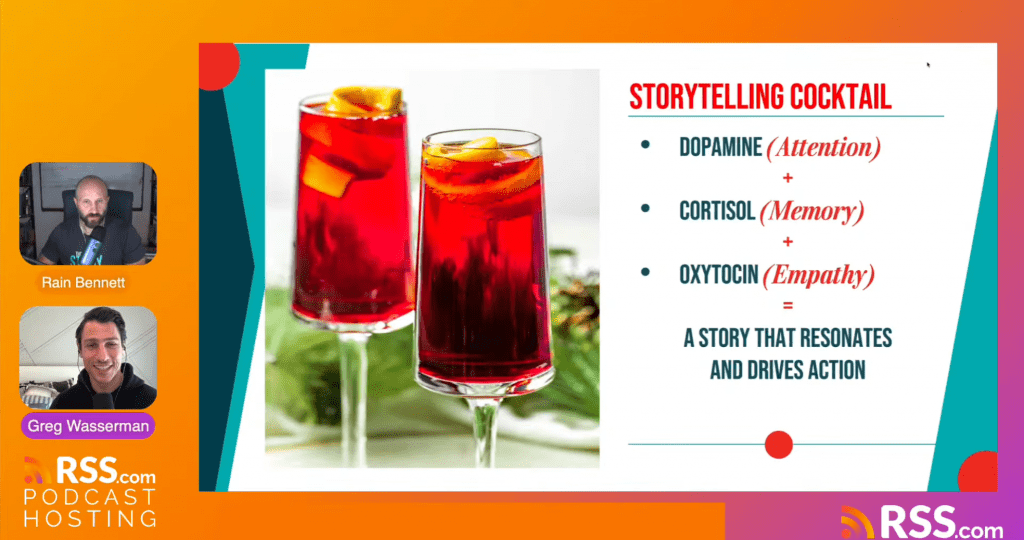
Three neurochemicals get elevated when someone hears a good story:
- Dopamine grabs attention. It fires when you open a loop (raise an unanswered question) and then close it.
- Cortisol helps them remember. It rises with tension and conflict, which is why every story needs an obstacle.
- Oxytocin builds trust and empathy. It elevates when the listener understands the lesson.
Attention alone won’t grow a show. The full cocktail is what creates the resonance that brings people back.
Know the Difference Between a Story and a Narrative
- A story is a single anecdote. A closed loop with a beginning, middle, and end.
- A narrative is the through line of your show. The belief, the perspective, the overall message that runs across every episode.
Rain’s analogy looks like this:
- The narrative is the trunk of a Christmas tree
- The stories are the ornaments
Without a clear narrative, listeners don’t know what your show stands for or what to expect when they hit play.
Use the Promise, Progress, Payoff Framework
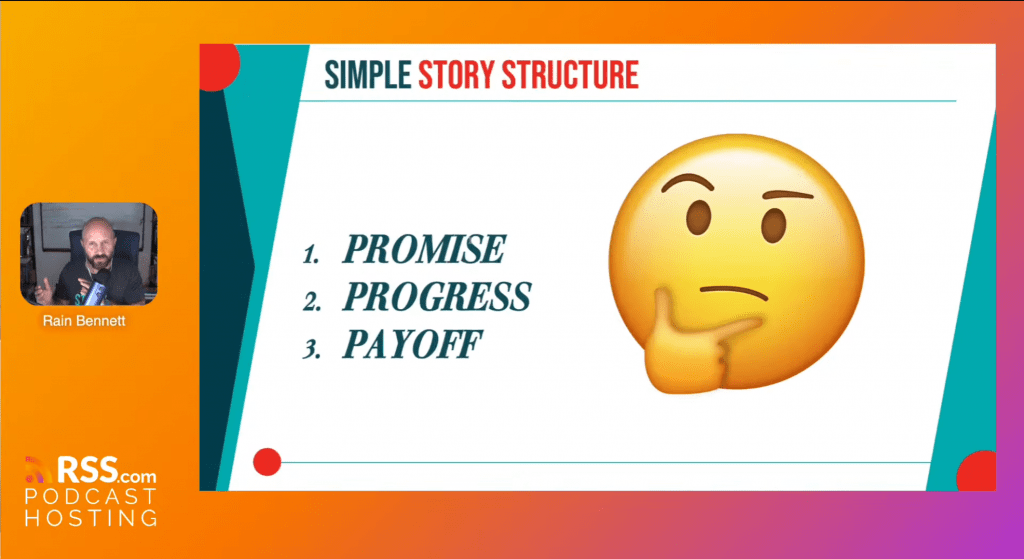
Skip the 17-step storytelling frameworks.
Rain’s three-part structure works for any episode format. Here’s what it looks like:
- Promise – Set up the hook. What will this episode give the listener?
- Progress – Build toward that promise. Open and close loops. Keep the ebb and flow going.
- Payoff – Stick the landing. Deliver what you promised.
The cardinal sin is breaking the promise. Over-promise and under-deliver, and trust erodes fast.
Your Perspective IS the Product
Your interpretation of the material is what makes your show worth listening to. As Rain put it, “I can read my Bible here. I don’t need to go to your show for that.”
That means doing the upfront work to figure out:
- What do you stand for?
- How do you see your industry?
- What angle only you can bring?
He also pushed back on “authenticity” as the goal. The better goal is consistency. Show up the same way, deliver on the same promise, over and over.
A useful exercise: write your voice as a “this, not that” list. “Excited, not hyper.” “Professional, not pretentious.” Those become guardrails for every episode.
Build the Show WITH Your Audience
The power of a story lives in the listener, not the storyteller.
- Listen to your audience. Watch for patterns in what they ask for.
- Rough rule from Rain: if 1 in 10 listeners ask for something, file it. If 7 in 10 are asking, act on it.
- Use shared language. Reference the things they care about.
When listeners feel like part of the show, they start telling other people about it. That’s how organic growth happens.
Consistency Beats Talent
Great podcasters got great by showing up, putting in reps, and refining their voice over time. There’s no superpower involved.
You won’t become a master storyteller in a day, week, month, or maybe not even a year. But if you keep using these frameworks, listening to your audience, and staying consistent to your narrative, you’ll build the kind of show people stick with and recommend.
Want to Go Deeper?
Rain’s book, The Chief Storytelling Officer, comes out August 25th and expands on everything covered in the session. You can connect with him here.
Click here for more RSS.com events!