WorldSnap – Geopolitics , Global Power Plays and International

WorldSnap – Geopolitics , Global Power Plays and International

by World Snap

Ukraine’s Secret Drone Factories: War Turns Into Export Business
AI
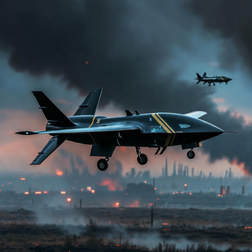
In this episode we uncover a surprising story from the Ukraine war: at least ten private Ukrainian companies secretly built drone factories in other countries and sold thousands of interceptor drones abroad — while Ukraine’s own military faced critical shortages on the front lines. President Zelenskyy publicly revealed the issue, highlighting how one company alone sold 1,000 drones for $3.5 million. We explore the reasons behind these secret overseas operations, the tension between private profit and national defense, the innovation that made Ukrainian drones attractive worldwide, and the risks of technology leakage. This story reveals how modern conflicts are quietly turning into export industries and raises tough questions about balancing business incentives with wartime survival. This episode uses AI-generated voice for narration.

Myanmar The War That Never Ends… Or Is It Just That No One Wants to Lose
AI
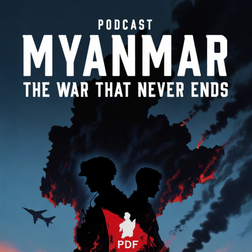
Myanmar: The War That Never Ends… Or Is It Just That No One Wants to Lose? Why has Myanmar been trapped in civil war for more than five years since the 2021 military coup — and why does this conflict actually stretch back nearly 80 years? In this episode, we take a calm, clear look at one of the world’s longest-running and most overlooked conflicts. From the ethnic tensions that began right after independence in 1948, through decades of rebellion and uneasy ceasefires, to the dramatic 2021 coup that turned peaceful protests into a full-scale civil war. We break down the current painful stalemate: • The military junta still controls the big cities and economic heartland • Resistance forces and ethnic armed groups dominate the borderlands and rural areas • Why neither side can achieve total victory You’ll also discover: • China’s clever two-sided strategy and how it keeps the war going • The role of Russia and Iran in supplying the junta • Why Western countries and ASEAN mostly stay on the sidelines • The devastating human cost — destroyed schools and hospitals, millions facing hunger, and a lost generation of young people • How this “forgotten war” directly affects Thailand and the rest of Southeast Asia through refugees, border instability, and the drug trade This is not just another news update. It’s a big-picture story about power, identity, geopolitics, and why some wars refuse to end. If you want to understand why Myanmar’s suffering continues in 2026 — and why the world should still care — this episode is for you.

Stalingrad: The City Battle That Turned the Tide of World War II

AI
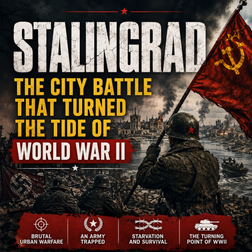
In 1942, Nazi Germany appeared close to dominating Europe. But on the banks of the Volga River, the German advance became trapped in one of the deadliest urban battles in history. This episode explores the Battle of Stalingrad, from Hitler’s campaign toward the Caucasus oil fields to the brutal street fighting inside the ruined city. Discover how Soviet defenders turned factories, basements, and apartment blocks into fortresses, why Germany’s exposed flanks became dangerously vulnerable, and how Operation Uranus surrounded the German Sixth Army. We also examine Hitler’s refusal to authorize a retreat, the failure of the Luftwaffe to supply the trapped troops, and the starvation, cold, and collapse that followed. Stalingrad did not end World War II, but it shattered the myth of German invincibility and gave the Soviet Union the momentum to begin pushing westward. This is the story of the city battle that changed the direction of the war.

Ukraine 2022: The Invasion That Changed Global Security Forever
AI
On February 24, 2022, Russia launched a full-scale invasion of Ukraine, shattering decades of assumptions about peace, deterrence, and security in Europe. In this episode, we explore how the war transformed NATO, accelerated European rearmament, weaponized energy and global finance, and revealed the growing importance of drones, satellites, technology companies, and industrial military production. We also examine the wider consequences for nuclear deterrence, global supply chains, China, Taiwan, the Global South, and the future balance of power. Ukraine became the battlefield, but the entire international security system was changed.

Chechnya: Russia’s Brutal Wars and the Making of Putin’s Security State
AI
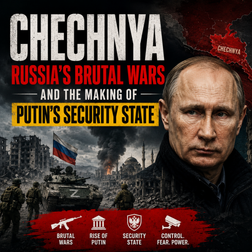
The Chechen wars were more than brutal conflicts on Russia’s southern frontier. They became a turning point in the history of post-Soviet Russia and played a major role in the rise of Vladimir Putin. In this episode, we explore the deep roots of Chechen resistance, the catastrophic Russian assault on Grozny, the collapse of the First Chechen War, and the fear that surrounded the renewed conflict in 1999. We examine how Putin used the Second Chechen War to present himself as the leader who would restore order, rebuild state power, and end the instability of the 1990s. We also look at how the conflict strengthened Russia’s security services, weakened independent media, centralized political authority, and created a system of rule based on loyalty, fear, and permanent national emergency. Chechnya was not simply conquered by Putin’s Russia. In many ways, Putin’s Russia was created through Chechnya.

The First World War: How Alliances Turned One Assassination Into Global Catastrophe
AI
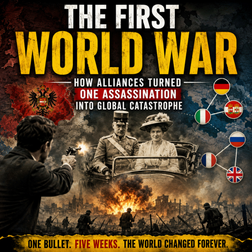
On June 28, 1914, two gunshots in Sarajevo killed Archduke Franz Ferdinand and his wife, Sophie. Just five weeks later, Europe’s great powers were at war. But one assassination did not cause the First World War by itself. In this episode, we explore how rival alliances, nationalism, imperial competition, military mobilization plans, and fear of national decline transformed a regional crisis into a global catastrophe. We examine Austria-Hungary’s confrontation with Serbia, Germany’s “blank cheque,” Russia’s decision to mobilize, the invasion of Belgium, Britain’s entry into the war, and the imperial networks that carried the conflict across continents. This is the story of how leaders who believed they were defending their nations created a war that destroyed empires, killed millions, redrew borders, and changed the modern world forever.

Kosovo: The Conflict That Changed the Rules of Humanitarian Intervention
AI
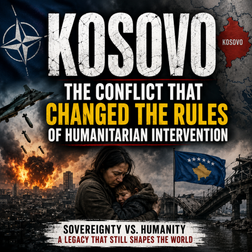
In 1999, NATO launched an air campaign against Yugoslavia without explicit authorization from the United Nations Security Council. The stated goal was to stop mass violence and forced displacement in Kosovo. But the intervention raised a question that still shapes international politics today: should powerful countries respect national sovereignty, or use military force when civilians are threatened by their own government? This episode explores the collapse of Yugoslavia, the rise of Serbian nationalism, Kosovo Albanian resistance, the Kosovo Liberation Army, the failure of diplomacy, NATO’s seventy-eight-day bombing campaign, and Kosovo’s path toward independence. It also examines the controversial idea that a military intervention can be legally questionable but morally legitimate, and how Kosovo influenced the later development of the Responsibility to Protect doctrine. Kosovo did not create a clear rule for humanitarian intervention. Instead, it created a debate that continues to influence wars, separatist movements, international law, and relations between major powers.

The Russo-Japanese War: The Asian Victory That Shocked Europe
AI
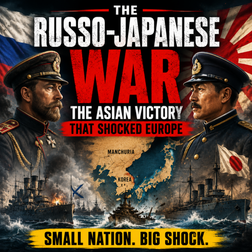
In 1904, Imperial Russia entered a war it expected to win. Its opponent was Japan, a nation that had transformed itself from a feudal society into a modern industrial and military power in just a few decades. This episode explores how competition over Korea and Manchuria pushed Russia and Japan toward war, why Russia’s enormous size became a logistical weakness, and how Japan used preparation, naval power, intelligence, and speed to gain the advantage. From the brutal siege of Port Arthur and the massive Battle of Mukden to the destruction of the Russian fleet at Tsushima, the conflict shocked Europe and changed global perceptions of power. Japan’s victory inspired anti-colonial movements across Asia, weakened the Russian Empire, and announced the arrival of a new great power. But the victory also strengthened Japan’s imperial ambitions and helped create the dangerous confidence that would shape its later expansion. This is the story of the Russo-Japanese War—the conflict that shattered the myth of permanent European military superiority and changed the balance of power in Asia.

India vs Pakistan: Why Kashmir Remains One of the World’s Most Dangerous Conflicts
AI
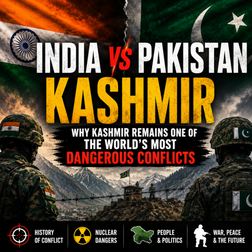
Why has Kashmir remained unresolved for nearly eight decades? In this episode, we explore the history, politics, and strategic dangers behind the conflict between India and Pakistan over Kashmir. From the Partition of British India in 1947 and the first Indo-Pakistani war to insurgency, nuclear deterrence, China’s role, water security, and the competing identities attached to the region, this episode explains why Kashmir is far more than a simple border dispute. We also examine the perspectives of India, Pakistan, and the diverse communities of Kashmir, while exploring how militant attacks, military retaliation, nationalism, and miscalculation could transform a local crisis into a wider war between nuclear-armed states. This is the story of a beautiful region divided by history, identity, and competing visions of justice—and why Kashmir remains one of the most dangerous pressure points in global geopolitics.

Pearl Harbor: The Attack That Pulled America Into World War II

AI
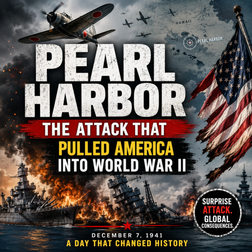
On December 7, 1941, Japanese aircraft launched a devastating surprise attack on the United States naval base at Pearl Harbor. Within hours, battleships were burning, thousands of Americans had been killed or wounded, and the United States stood on the edge of total war. In this episode, we explore the deeper story behind Pearl Harbor. Why did Japan decide to attack the United States? How did economic sanctions, the war in China, oil shortages, and imperial ambition push both countries toward conflict? Why were American forces caught unprepared, despite receiving several warnings? And how did one of the most successful surprise attacks in military history become a catastrophic strategic mistake? This is the story of the attack that united the American public, transformed World War II into a truly global conflict, and awakened an industrial power Japan could not defeat in a prolonged war.
1 of 9