
Episode notes
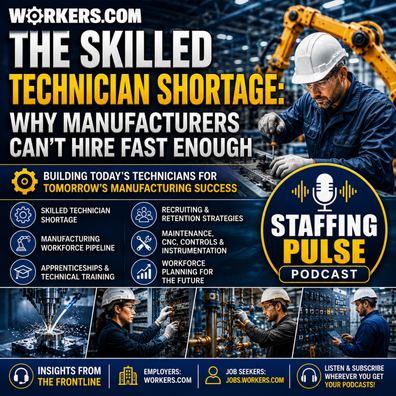
America's Manufacturing expansion is creating an urgent workforce challenge: Manufacturers need Skilled Technicians faster than the labor market is producing them.
As companies invest in new factories, expand domestic production, install automation, and bring advanced Manufacturing equipment online, demand is growing for CNC Technicians, Industrial Maintenance Technicians, Instrumentation Specialists, Controls Technicians, Mechatronics Technicians, and other skilled technical workers.
In this episode of WORKERS.COM Staffing Pulse: Insights From The Frontline, we examine the growing gap between Manufacturing investment and workforce-development timelines and how Employers can build stronger technical talent pipelines.
Experienced Technicians take years to develop through education, apprenticeships, mentoring, equipment experience, troubleshooting, and hands-on training. Yet Manufacturers expanding production often need skilled workers immediately while competing for a limited pool of experienced talent.
We explore strategies including workforce forecasting, apprenticeships, Community College and Technical School partnerships, internal training, Technician-Assistant roles, mentoring, cross-training, structured skills progression, and targeted recruiting.
The episode also examines skills-based hiring. Instead of requiring long lists of qualifications, Manufacturers can identify which skills are essential on day one and which can be developed after hire. This can expand the talent pool and create career pathways for workers with strong technical aptitude.
Cross-industry recruiting offers another opportunity. Automotive Technicians, Military Technical Occupations, Machine Operators, Production Employees, and Maintenance Workers may already have transferable Mechanical, Electrical, Diagnostic, Machining, Controls, and Troubleshooting experience.
For Semiconductor, Pharmaceutical, Defense, Automotive, Aerospace, Food Production, and other advanced Manufacturing sectors, Technician shortages can affect Equipment Uptime, Preventive Maintenance, Production Capacity, Quality, Expansion Schedules, and Operational Performance.
Manufacturers must also prepare for knowledge loss as experienced Technicians retire. Succession planning, mentoring, cross-training, skills inventories, and documented technical progression can help preserve institutional knowledge and develop the next generation of skilled workers.
For Job Seekers, Technician shortages are creating career opportunities in CNC Machining, Industrial Maintenance, Mechatronics, Instrumentation, Electrical Systems, PLCs, Robotics, Automation, Controls, and Troubleshooting.
This episode is for Manufacturing leaders, Plant Managers, Operations Teams, HR and Talent Acquisition Professionals, Skilled Trades Recruiters, Educators, Workforce-Development Organizations, and Job Seekers pursuing Technical Manufacturing careers.
🏢 Employers: Find workforce solutions at https://www.workers.com
👷 Job Seekers: Explore opportunities at https://jobs.workers.com
🌐 More Insights: https://www.workers.com/community