Whiskey and the Writings

Whiskey and the Writings

by Joe Oliver
Season 2
How to Read the Bible Like Jesus: Wisdom, Not Rules
Jesus didn't read Scripture like a rulebook. See how Matthew 5, the Sabbath, and the divorce texts teach us to read the Bible for wisdom.
Mark 9: The Hell Passage Jesus Borrowed From Isaiah
Was hell always a place of eternal torture, or did Jesus mean something else? In Mark 9:42 to 48, Jesus talks about cutting off your hand, an unquenchable fire, and a worm that never dies. He is quoting Isaiah 66:24, and the setting he has in mind is the Valley of Hinnom outside Jerusalem. Once you know what those words meant to his first listeners, this passage sounds very different. If you grew up hearing this passage as a threat, this breakdown is for you. We look at Gehenna in the Bible, what the Valley of Hinnom was, where Isaiah's image comes from, and why Jesus opens the whole passage with a warning about harming the vulnerable.
Revelation 21: The Bible Never Promised You're Going to Heaven
Everyone told you the goal is heaven when you die. Revelation 21 says something different, new heaven and new earth coming down, God moving in with us, not us evacuating to Him. In this video I walk through Revelation 21, trace it back to Ezekiel 37 and 47 (John is riffing on Ezekiel's temple vision the entire time), and land on what this means for bodily resurrection and how we live right now. If you grew up thinking this life is just a waiting room, this one's for you.
Acts 15: The First Church Fight Over What the Bible Even Means
Acts 15 records something most people never got told in church: the earliest Christians had a massive, unresolved fight over what following Jesus actually required. No unanimous doctrine handed down from heaven. A room full of apostles, arguing, until they reached a decision that even they framed as provisional ("it seemed good to the Holy Spirit and to us"). In this video we break down the Jerusalem Council: who was arguing, what was actually at stake (circumcision, Torah observance, Gentile inclusion), and why the outcome undercuts the idea that Christian doctrine has always been one clear, agreed-upon thing. If you grew up being told the Bible is simple and settled, this passage says otherwise, from the very first generation of the church.
What if the Rib was never a Rib?
Genesis 2:18-25 gets read as a surgery story. God knocks Adam out, pulls a rib, builds a woman. Case closed, right? Except the Hebrew word there, tsela, almost never means "rib" anywhere else it shows up in the Old Testament. It means side. And the text says God didn't just extract something, he took one whole side of the human and built the other half of creation out of it. That changes what this passage is actually doing. It's not explaining where women came from as an afterthought. It's saying humanity wasn't finished until both halves existed side by side. The man doesn't understand himself until he sees the half that was missing.
Did God Really Command Genocide? (Exodus 17 Explained)

Exodus 17 says God will "wipe out the remembrance of Amalek from under heaven." Two verses later it says the Lord will be at war with Amalek "from generation to generation." Which one is it? This isn't about explaining away the hard parts of the Old Testament. It's about asking a better question than "did this literally happen," and asking instead, "why am I being told this story, and what kind of story is it." Once you see this pattern in Exodus 17, you start noticing it everywhere else, including in the conquest of Jericho.
Decisional vs Emotional Forgiveness | What Jesus Actually Meant
Forgiveness sounds simple until you're the one carrying it. In this episode of Whiskey and the Writings, Joe sits down with Colby Stream to unpack what forgiveness actually looks like when the hurt runs deep — betrayal, abuse, years of unresolved pain. We dig into the difference between decisional forgiveness (the choice) and emotional forgiveness (the release), why the church often rushes people past both, and what Matthew 18 and Mark 11 actually teach about God's timeline versus ours. This isn't a "just forgive and move on" conversation — it's an honest look at what it means to say "I can't forgive yet, but I'm getting there," and why that's an okay place to be.
Why the Most Misunderstood Gospel Might Be the Best Place to Start
The Gospel of Mark doesn't end with the resurrected Jesus. It ends with three terrified women running from an empty tomb, saying nothing to anyone. That's not a scribal accident, it might be the most brilliant move in the entire New Testament. In this episode we go deep into the Gospel of Mark, the shortest and most overlooked of the four Gospels, and the one modern scholarship is only now catching up to.
Deconstructing Atonement: What Is Sin, Really?

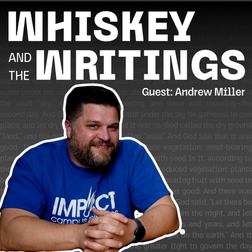
What if everything you were taught about sin was designed to keep you afraid instead of free? In this episode of Whiskey and the Writings, I sit down with my longtime friend Andrew Miller (Impact Campus Ministries) to dig into atonement theory, the doctrine that's supposed to explain how Jesus's death and resurrection actually fix our relationship with God. Except once you start looking, you realize there isn't just one answer. There are at least eight. We walk through three of the major atonement theories (recapitulation, Christus Victor, and penal substitutionary atonement), and why the "chasm between you and God, bridged by the cross" image most of us grew up with isn't the only lens Christians have used for 2,000 years. But before we can really talk atonement, we have to ask a harder question: what is sin, actually? Not the itemized list of "don't do this" we got in Sunday school, but what the Hebrew sages and Paul himself seem to be pointing at. Spoiler: it might have a lot less to do with a permanent stain on your soul than you think. This is Part 1 of a two-part conversation. Part 2 picks up where we left off and goes deeper into how a reframed understanding of sin changes everything about how we read the cross. Pour a glass, get curious, and let's wrestle with this one together.
Revelation as a Chiasm: Why Structure Changes Everything About End Times
Revelation isn't about predicting the future or identifying the Antichrist in today's politics. It's about who's on the throne right now. And a literary device called a chiasm reveals exactly how John structured that message. In this episode, Joe walks through how the entire Book of Revelation is organized as one giant chiasm—a mirror-structure used throughout ancient Hebrew and Greek literature to emphasize a central point. Understanding this changes everything about how you read apocalyptic literature.
1 of 10