Wealth Office

Wealth Office

by Michael Macfarlane
Season 1
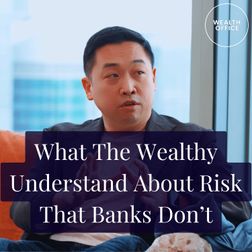
Marco Poon on Why Family Wealth Dies After Three Generations
Marco Poon joins Michael Macfarlane for a Wealth Office conversation exploring what family offices are really for, and whether the industry built around them has drifted too far from the families it is supposed to serve. With an estimated US$450 trillion held by private families globally, family offices are becoming an increasingly important part of the wealth landscape. But Marco argues that the incentives of large financial institutions can sit uneasily alongside the priorities of families thinking about governance, succession, philanthropy and wealth across generations. The conversation begins with a fundamental question: should a family office be structured around investment performance, or around the long-term objectives of the family itself? Marco draws on his own experience as a third-generation member of a Hong Kong business family, where his focus has shifted from the family’s original manufacturing interests towards investment, governance and preserving the entrepreneurial spirit for future generations. They examine why families with 100 or 200-year horizons may think about risk very differently from institutions operating around market cycles, and why stewardship, geopolitical change and experience can matter more than conventional definitions of “safe” assets. They also look at Hong Kong’s growing family office ecosystem, where families are increasingly learning directly from one another on governance, succession, education and the challenges of preparing the next generation. The discussion explores: • What a family office is really for • Why institutional incentives can conflict with family objectives • Stewardship versus short-term investment performance • How wealthy families define risk over 100 or 200 years • Why governance and succession matter as much as portfolios • The role of philanthropy in family identity and values • Why Hong Kong has become a hub for family-to-family learning • How next-generation family members should be prepared for responsibility • Why entrepreneurship can be part of succession planning • The role of private family capital in backing long-term innovation • Why China’s progress in AI, automation, new energy and EVs matters for investors • How fiduciary advice can create greater alignment between families and advisers The central question is what it actually means to preserve family wealth across generations. The answer is not simply protecting a portfolio. It is preparing people, building governance, preserving values and making sure each generation is capable of taking responsibility for what comes next. 🎥 Watch the full conversation to explore the private world of ultra-prime property and what it reveals about wealth, family and the future of global cities. Subscribe to Wealth Office for more conversations hosted by Michael Macfarlane with entrepreneurs, investors, family businesses and global thinkers exploring how wealth is shaping the future.
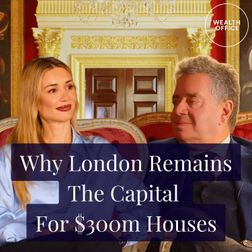
Gary Hersham & Irina Gamagina on Selling $400m Homes In London
Super-prime real estate experts Gary Hersham and Irina Gamagina join Michael Macfarlane ‪ @michaelmacfarlane-mma for a Wealth Office X conversation exploring what property means when money is no longer the primary constraint. At the very top of the market, real estate is about far more than housing. It can offer privacy, security, capital preservation and a place for internationally mobile families to build their lives. The conversation begins with a hypothetical question: if Michael had $100 million to spend on a home, where should he buy? Gary and Irina examine London’s position as a global safe haven, the growing appeal of Madrid, Milan, Zurich and Miami, and what the movement of wealthy families reveals about the changing geography of global capital. They also offer a rare look inside the ultra-prime market. Despite the mythology surrounding secret listings and dramatic bidding wars, transactions at this level remain grounded in trusted relationships, discretion and careful judgment. Emotion may begin the process, but valuation, taxation, ownership structures and long-term suitability still shape the final decision. The discussion explores: • What ultra-prime property is really for • Whether London remains a global safe haven • How wealthy families choose where to live • The reality of “off-market” property • Trust and reputation in private transactions • Emotion, status and price discipline • New wealth versus inherited wealth • The influence of technology, crypto and Asian capital • Why younger buyers increasingly prefer modern homes • The importance of family, schools, privacy and lifestyle • What an experienced property adviser truly provides The central question is what wealthy families are actually acquiring when they purchase an extraordinary home. The answer is rarely square footage alone. They are choosing where their children will grow up, where their capital may feel secure and how their family will live across generations. 🎥 Watch the full conversation to explore the private world of ultra-prime property and what it reveals about wealth, family and the future of global cities. Subscribe to Wealth Office for more conversations hosted by Michael Macfarlane with entrepreneurs, investors, family businesses and global thinkers exploring how wealth is shaping the future.
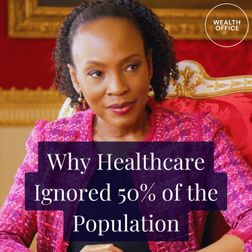
Maryann Selfe on the Billion Dollar Blindspot in Women’s Healthcare
Maryann Selfe is the author of The Billion Dollar Blindspot, a book about one of the most overlooked problems in modern healthcare: the historic failure of medicine to properly account for female biology. In this episode of Wealth Office, Maryann joins Michael Macfarlane @michaelmacfarlane-mma to discuss why women’s healthcare may be one of the most important investment themes of the coming decades. For much of modern medical history, male biology was treated as the default human model. Women were often underrepresented or excluded from clinical trials, medical research and drug development. The result was a major healthcare data gap affecting diagnosis, treatment, therapeutics, insurance, reimbursement and capital allocation. Maryann argues that this blindspot is now beginning to correct - and that the correction could create a major opportunity for healthcare investors, private capital, family offices and long-duration capital allocators. Michael and Maryann discuss why areas such as menopause, endometriosis, autoimmune disease, cardiovascular disease, fertility, diagnostics, therapeutics and preventive healthcare are becoming increasingly important investment categories. They also explore the role of private capital and family offices in funding the next generation of healthcare innovation. Many of the opportunities in women’s healthcare and personalised medicine sit in private markets, where long-duration capital may be better suited than traditional short-cycle venture capital or institutional funds. A major theme of the episode is the role of Asian capital. As family offices in Hong Kong, Singapore and across Asia become more global, there may be a significant opportunity for Asian private capital to back healthcare innovation emerging from Europe, the US and Asia itself. The conversation also connects women’s healthcare to wider trends in longevity, AI diagnostics, drug discovery, sex-specific therapeutics and preventive medicine. Maryann argues that understanding female biology better will not only improve healthcare for women, but could help build more personalised healthcare for everyone. Topics discussed include: The thesis behind The Billion Dollar Blindspot* Why male biology became the default model in medicine The history of women’s exclusion from clinical trials The female health data gap Why women’s healthcare has been underfunded How data gaps affect insurance, reimbursement and investment Why women’s health is becoming a serious healthcare investment theme The rise of personalised medicine and sex-specific healthcare Menopause, endometriosis, autoimmune disease and cardiovascular health Why women live longer but often spend more years in poor health The economic and productivity cost of poor female healthcare Why private capital and family offices may be well placed to invest The opportunity for Asian long-duration capital Healthcare innovation in Europe, the US and Asia AI diagnostics, therapeutics and longevity medicine Why women’s healthcare is not a niche market How better female health data could improve healthcare for all The central question of the episode is whether investors are beginning to reprice women’s healthcare in real time. If Maryann Selfe is right, the historic blindspot in women’s healthcare is not only a medical problem. It is a structural market inefficiency, a social challenge and a major investment opportunity.
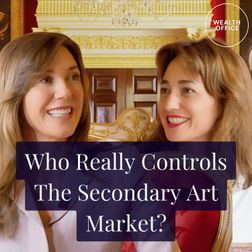
Catherine Freeman and Bigna Pfenninger on who really controls the art market
What is art really worth - and who really controls the secondary art market? In this episode of Wealth Office X, Michael Macfarlane ‪@michaelmacfarlane-mma‬ is joined by Catherine Freeman and Bigna Pfenninger, co-founders of FP13, for a conversation about art, power and the financialisation of culture. The secondary art market is often misunderstood. It is not simply a resale market for old works or dead artists. It is a living system in which value is shaped by belief, scarcity, institutional credibility, collectors, dealers, advisors, taste, timing and the stories that surround an artist’s work. In that sense, the art market reveals something quietly uncomfortable about value itself: that markets are never purely rational. They are also social systems, built on trust, legitimacy and collective belief. Together, Catherine and Bigna explore how artists develop secondary markets, why many never do, and how collectors, galleries, auction houses and institutions help determine which works become culturally and financially significant. They discuss blue-chip art, trophy works, private sales, freeports, art lending, fractional ownership, tokenisation and the growing role of art within family wealth, estate planning and long-term capital structures. The conversation also looks at a deeper shift in collecting itself. As Western next-generation wealth holders break up inherited collections, Asian collectors become more influential, and younger buyers demand participation, transparency and meaning, the secondary art market is entering a new phase. Topics include: • What the secondary art market actually is • Why living artists can already have secondary markets • How collectors and institutions create legitimacy • Why the primary market creates visibility, but the secondary market creates value • The Damien Hirst auction and what happens when hype outruns belief • Charles Saatchi, patronage and the making of cultural movements • Why sophisticated collectors behave differently from superficial collectors • How blue-chip art became a store of value • The rise of art-secured lending and financialised collections • Freeports, private sales and the hidden architecture of major art transactions • Tokenisation, fractional ownership and the future infrastructure of collecting • Why art remains an expression of civilisation, memory and human purpose At its core, this is a conversation about more than art as an asset class. It is about who gets to decide what culture is worth - and how beauty, belief, power and capital combine to shape the market for human expression. Wealth Office X explores the defining ideas, technologies and capital flows shaping the future of wealth. Each episode brings world-class experts into focused conversation around one major theme, helping long-term capital allocators understand complexity, test assumptions and form conviction in a changing world.
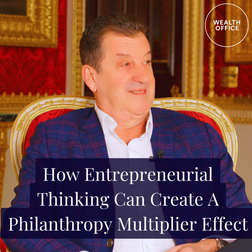
Howard Bilton on how entrepreneurial thinking can create a philanthropy multiplier effect
Howard Bilton, Founder and Chairman of The Sovereign Group and Founder of The Sovereign Art Foundation, joins Michael Macfarlane for a discussion on why some entrepreneurs believe philanthropy should be approached less like charitable spending and more like building systems capable of compounding impact across generations. For decades, philanthropy has largely been measured by how much money is given away. But Howard argues that this may be the wrong question. Drawing on his experience building both a global professional services business and an international charitable foundation, he explains why entrepreneurial thinking, long-term incentives and multiplier effects can often create far greater societal outcomes than traditional donation models alone. Rather than simply funding causes, the most effective philanthropy may increasingly resemble infrastructure, investment and systems design. The conversation explores: • Why entrepreneurs often approach philanthropy differently from institutions • How multiplier effects can dramatically increase social impact • Why building sustainable systems may matter more than writing larger cheques • The role of private capital in solving societal challenges • How the Sovereign Art Foundation uses art as a platform for charitable impact • Why art therapy has transformed the lives of vulnerable children across Asia • The rise of Asia and its growing influence on global wealth, philanthropy and long-term thinking • Why culture, creativity and artistic ecosystems are essential components of civilisation itself A major theme throughout the discussion is the role of art and culture in long-term civilisation building. Howard argues that some of the most important philanthropy is not simply about solving immediate problems, but about preserving cultural memory, supporting creative ecosystems and underwriting the institutions that shape how societies think, create and understand themselves across generations. In that sense, art may function not merely as aesthetic expression, but as legacy, identity and long-duration societal infrastructure. At its core, this episode is about a deeper idea: That the most effective forms of wealth creation are not always measured by what is accumulated, but by the systems, opportunities and multiplier effects left behind. 🎥 Watch the full conversation to explore how entrepreneurship, philanthropy, art and private capital intersect — and why building sustainable impact may become one of the defining challenges of the century. If you enjoy conversations like this, subscribe to Wealth Office for more discussions with entrepreneurs, investors, family businesses and global thinkers exploring how wealth shapes the future.

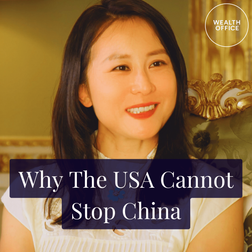
Keyu Jin on the Future of China and the Global Economy
Is the world still looking at China through the wrong lens? In this episode of Wealth Office, Michael Macfarlane sits down with economist, author and Professor at the Hong Kong University of Science and Technology, Keyu Jin, to explore how China's economy is changing and what that means for investors, entrepreneurs and family offices around the world. As geopolitical tensions continue to dominate headlines, conversations about China are often framed around decoupling and decline. But beneath the surface, a different story is unfolding. New industries are emerging, capital is finding new routes, supply chains are being reconfigured rather than dismantled, and Chinese entrepreneurs are increasingly looking beyond their domestic market. Drawing on her research and experience advising governments and global institutions, Keyu explains why understanding China's next phase requires looking beyond familiar narratives. The discussion explores how innovation, demographic change and shifting patterns of global investment are reshaping one of the world's most influential economies. Topics discussed include: Why China is entering a new phase of economic development How innovation is reshaping Chinese industry and entrepreneurship The reality behind deglobalisation and global supply chains Why Chinese businesses are increasingly expanding overseas How capital is moving across Asia and beyond What family offices and investors should understand about China's changing role in the global economy At its core, this conversation challenges conventional assumptions about China. Rather than a story of separation from the rest of the world, Keyu argues we are witnessing a more complex transformation, one where capital, innovation and opportunity continue to cross borders in new ways. If you enjoy conversations exploring the ideas shaping global wealth, business and investment, subscribe to Wealth Office for more discussions with entrepreneurs, economists, investors, family offices and global thinkers.
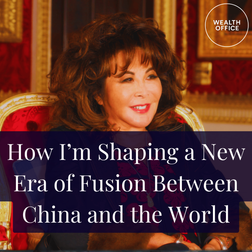
Lady Linda Wong Davies is shaping a new era of fusion between China and the world
In this episode of Wealth Office, Michael Macfarlane sits down with Lady Linda Wong Davies - a leading cultural patron working at the intersection of China, Africa and the West and Founder of the KT Wong Foundation - to explore one of the most important shifts shaping the modern world: the rise of cultural fusion. For centuries, global power has been accompanied by cultural dominance. From Renaissance Europe to modern America, wealth has historically shaped culture - and culture, in turn, has shaped how societies think, create and interact. But today, that model is changing. As China rises and the world moves toward a more multipolar global order, a new question emerges: can culture play a role in shaping a more connected future - rather than one defined by conflict? Drawing on nearly two decades of work through the KT Wong Foundation, Lady Linda shares how she has built cross-cultural platforms spanning theatre, music, film, photography and design - connecting China with Europe, Africa and beyond. From bringing Western opera into China, to introducing African artists to Chinese audiences, to creating entirely new forms of cultural collaboration, her work demonstrates how private capital and individual initiative can act as a catalyst for global understanding. This conversation explores: Why culture may be more powerful than “soft power” in shaping societies The evolution of China from cultural observer to cultural innovator The growing role of family wealth and private capital in shaping global culture Why Africa and Asia are becoming increasingly central to the cultural future How cross-cultural collaboration can unlock new creative and economic opportunities The role of individuals - not governments - in driving meaningful global change At its core, this episode is about a deeper idea: That beyond economics, beyond technology, and beyond geopolitics - culture is what ultimately shapes how humanity understands itself. And at a moment of historic global transition, that may matter more than ever.
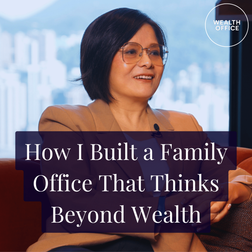
Elaine Chow built a Family Office that thinks beyond wealth
What is a family office actually for? In this episode of Wealth Office, Michael Macfarlane sits down with Elaine Chow, Managing Partner of Trinity Capital, her family’s Hong Kong–based single family office, to explore how she built an institution designed not merely to preserve wealth - but to steward it. Elaine’s journey began not with a textbook definition of a family office, but with a moment of transition. When her brother chose to exit the family business, she created a structure capable of managing capital with discipline, independence and long-term purpose. What emerged was more than an investment vehicle. It became a platform blending real estate, selective technology exposure, intergenerational education and philanthropy - anchored in a conviction that wealth is a responsibility, not an entitlement The conversation spans: Why family offices must balance steady cash-flow assets with selective risk How Trinity Capital approaches global real estate cycles, distress and value creation Why Hong Kong remains a strategic hub for family capital The evolving role of next-generation leaders in shaping impact and purpose Whether private family capital may become more influential than institutional capital How faith, stewardship and governance intersect in a modern single family office Elaine also offers a candid view on the transformation of Hong Kong as a financial centre - from IPO flows to art markets to cross-border capital - and why clarity of vision, both governmental and personal, matters in an era of shifting geopolitical gravity. At its core, this episode asks a deeper question: if wealth is temporary and capital is mobile, what does responsible stewardship actually look like? For family principals, next-generation members and advisors navigating the expanding ecosystem of Asian private capital, this conversation reframes the family office as something more than a balance sheet. It is a philosophy in action.
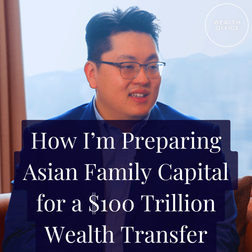
Marshall Jen is preparing Asian family capital for a $100 trillion wealth transfer
Over the next twenty years, more than $100 trillion in private wealth will transfer across generations. Nearly half of that capital will be in Asia. In this episode of Wealth Office, Michael Macfarlane is joined by Marshall Jen, a scholar and advisor deeply embedded in Asia’s evolving family office ecosystem. As Co-Director of one of the world’s few Master’s programmes dedicated to family wealth and governance, Marshall works directly with families navigating this historic shift in private capital. This conversation moves far beyond technical succession planning. It examines how Asian family offices are evolving from defensive wealth-preservation structures into entrepreneurial platforms capable of shaping global markets. As private capital becomes more internationally mobile and increasingly technology-driven, Marshall explains why family offices are no longer simply investment vehicles, but strategic institutions balancing three pillars: capital allocation, human capital development, and long-term societal contribution. The discussion explores: Why Asian family capital is becoming more outward-looking and globally influential The tension between patriarchal control and next-generation ambition How identity, culture and cross-border education are reshaping investment mandates Whether Asian and Western family office models will converge or diverge How Hong Kong, Singapore and the Greater Bay Area fit into the global capital ecosystem Why family capital - not institutional capital - may become the decisive force behind transformational industries such as AI and biotechnology At its core, this episode is about stewardship at scale. As technological acceleration and geopolitical complexity redefine markets, the choices made by family principals and next-generation leaders may influence far more than portfolio returns. They may shape the next era of global value creation. Watch the full conversation to understand how Asian family capital is preparing for the greatest wealth transfer in history - and what it means for the future of private wealth worldwide.
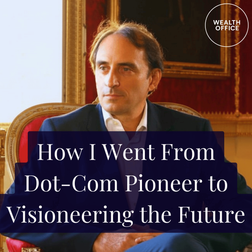
Nicolas De Santis went from dot-com pioneer to visioneering the future
What does it mean to build for a future you may never personally benefit from? In this episode of Wealth Office, Michael Macfarlane is joined by Nicolas De Santis - a dot-com pioneer who helped shape the early internet, co-founding Opodo, one of Europe’s first large-scale online travel platforms, and later creating one of the world’s earliest digital currencies - long before crypto entered the mainstream. After decades spent inside the machinery of technology, capital and growth, Nicolas’s focus has shifted from building companies to understanding something far bigger: how technology, entrepreneurship and private capital will determine the future of humanity itself. At the centre of this conversation is Nicolas’s concept of visioneering - the discipline of imagining possible futures and actively building towards them, rather than remaining trapped in short-term cycles of optimisation and profit. Drawing on philosophy, science fiction, systems thinking and real-world experience, he argues that the future is not something we predict, but something we choose to create. Together, Michael and Nicolas explore: What the dot-com era teaches us about today’s AI boom Why every major technological cycle produces both progress and bubbles The three possible planetary futures facing humanity — progress, stagnation, or self-destruction Why governance, not technology, is the decisive factor in which future emerges How private and family-controlled capital may be better positioned than governments or institutions to fund long-term human progress Why value creation, not capital accumulation, is the real responsibility of the next generation The growing role of Asia in shaping the technological and economic future of the world This is not a conversation about trends, markets or tactics. It is a deep, reflective discussion about purpose, responsibility and the long-term direction of civilisation - and what it means to build businesses, technologies and institutions that genuinely improve the human condition. For founders, investors, next-generation family members and anyone thinking seriously about the future, this episode offers a rare opportunity to step back from the noise and consider the bigger picture. Watch the full episode of Wealth Office to explore how the future is being imagined - and who is shaping it.
1 of 2