Untangling Web3

Untangling Web3

by Jack Davies & Alec Burns
Season 1

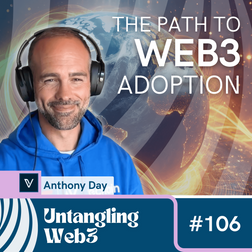
#106 Untangling: The Path to Web3 Adoption with Anthony Day

In this episode of Untangling Web3, we're joined by Anthony Day, Marketing Director at VeChain and creator of the Blockchain Won’t Save the World podcast. With a background in enterprise transformation and years of experience building real-world blockchain applications, Anthony brings deep insights into what’s blocking—and enabling—mainstream Web3 adoption. This conversation moves beyond hype to focus on value delivery, practical implementation, and what real users and businesses actually need from blockchain. Key highlights: Community incentives are underutilized by enterprises: Many traditional companies lack the mental model or experience to effectively use open token-based systems. Web3-native mechanisms like shared economics and community-driven reward structures remain foreign. Success stories like VeBetterDAO demonstrate that onboarding large user bases to sustainable, real-world actions is not only possible—it’s replicable. But it requires a shift from centralized control to collaborative growth. Enterprise integration requires meeting companies where they are: Web3 projects often frame their technology in ideological or overly technical terms. To resonate with business leaders, blockchain must be positioned as an enabler of clear business outcomes—cost savings, user engagement, compliance, loyalty, or sustainability. Decentralization is not a selling point by itself; it must be tied to tangible value. Narratives need translation, not evangelism: Terminology like “decentralized”, “non-fungible”, or “programmable privacy” often alienates outsiders. Mass adoption depends on framing products in accessible terms. Instead of leading with protocol jargon, builders should explain what the tool does in real-world language. This isn’t dumbing things down—it’s communicating value. Onboarding isn’t just technical—it’s cultural: Web3 isn’t failing because the tech doesn’t work. Failures are mostly due to poor planning, unclear value propositions, or incompatible mindsets. Success requires adapting growth strategies, messaging, and support systems to people who’ve never operated in open ecosystems before. Web3 adoption will not come from viral enlightenment or speculative hype. It will come from delivering measurable value to real users—through applications that are usable, rewards that matter, and infrastructure that scales. Clear regulation, practical incentives, and business-ready narratives are now within reach. For those building the next wave of Web3, the priority isn’t to convert the world to crypto—it’s to help the world do what it already does, better. -- This episode is sponsored by the VeChain foundation. Learn more about VeBetterDAO here: https://vebetterdao.org/ -- Learn more about Web3 at: https://untanglingweb3.com/ -- Untangling Web3 is brought to you by hosts Jack Davies and Alec Burns, with music by Daniel Paigge. Got a question or topic suggestion? Send us an email at theuntanglingweb3podcast@gmail.com. Love what you're hearing? Show your support by becoming a subscriber and don't forget to leave us a stellar review. The views we express here are our own, and do not represent the views of our employers. Nothing discussed or stated in the show should be considered advice.
#105 Untangling: Worldcoin

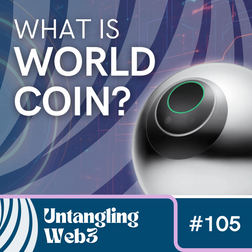
In this episode of the Untangling Web3 podcast, we dive headfirst into the controversial, ambitious, and wildly futuristic project known as Worldcoin. Created by Tools for Humanity and co-founded by OpenAI’s Sam Altman, Worldcoin combines digital identity, blockchain, and biometric scanning via the infamous “Orb” to tackle one of the most urgent problems of our AI age: proving you’re human in a world overrun by bots, agents, and deepfakes. But is this visionary solution as revolutionary as it sounds—or just dystopian science fiction? Key highlights: Worldcoin’s Vision for Digital Identity in a Post-AI World: With AI-generated content dominating the web, Worldcoin sets out to answer a crucial question—how do we prove someone online is a real human? At its core, the project offers a blockchain-based digital identity called World ID, anchored in biometric iris scans captured via the sci-fi-looking Orb. This proof-of-personhood system aims to separate bots from people while ensuring privacy through zero-knowledge proofs and decentralized protocols. The Role of the Orb and the Tokenomics Behind It: The Orb is the hardware gateway into Worldcoin's ecosystem. It scans users' irises to confirm uniqueness, creating a one-to-one digital credential tied to a real person. Once verified, users receive a World ID and are rewarded in the project’s native token, WORLD. This token not only incentivizes adoption but is positioned as a future vehicle for distributing universal basic income (UBI) in a world where AI displaces jobs. The podcast also covers the cryptographic privacy mechanisms involved, and the ethical dilemmas of onboarding users in developing countries through financial incentives. Criticism, Controversies, and the Future of Identity Systems: Worldcoin’s bold approach hasn’t come without backlash. The episode unpacks controversies including accusations of “bio-data colonialism,” the lack of hardware audit transparency, and compliance concerns with GDPR and consent revocation. Alec and Jack also explore alternative decentralized identity models from the Web3 space, such as Proof of Humanity and Gitcoin Passport, questioning whether Worldcoin’s centralized rollout aligns with Web3 ideals or undermines them. Worldcoin presents a radical approach to solving the digital identity problem in the age of AI. With its Orb, crypto incentives, and biometric-backed Web3 identity, it’s undeniably innovative—but also deeply polarizing. As the line between humans and AI blurs, projects like Worldcoin may shape the future of how we verify identity, distribute value, and govern online interactions. Whether it becomes the "login with Google" of Web3 or fades under regulatory pressure, it's a project worth watching. -- This episode is sponsored by the VeChain foundation. Learn more about VeBetterDAO here: https://vebetterdao.org/ -- Learn more about Web3 at: https://untanglingweb3.com/ -- Untangling Web3 is brought to you by hosts Jack Davies and Alec Burns, with music by Daniel Paigge. Got a question or topic suggestion? Send us an email at theuntanglingweb3podcast@gmail.com. Love what you're hearing? Show your support by becoming a subscriber and don't forget to leave us a stellar review. The views we express here are our own, and do not represent the views of our employers. Nothing discussed or stated in the show should be considered advice.
#104 Untangling: How Your Internet Really Works with Tim Creswick

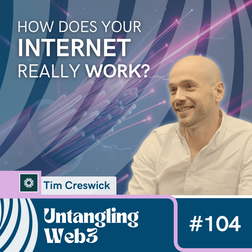
In this episode of Untangling Web3, Tim Creswick, founder and CEO of Vorboss, explains the physical and technical infrastructure behind the internet—what it is, how it moves data, and why fibre networks are the foundation of modern connectivity. With a focus on metro fibre, subsea cables, and security vulnerabilities, Tim provides a high-resolution breakdown of how the internet really functions beneath the surface, and what Web3, AI, and future technologies need to scale. Key highlights: Subsea Cables vs. Satellites: Most global internet traffic travels through undersea fibre optic cables, not satellites. While satellite systems like Starlink are impressive, they are capacity-limited and latency-prone compared to physical fibre. Deep sea cables—laid across oceans since the 1800s—enable ultra-high bandwidth and lower latency, critical for everything from global messaging to financial trading. Satellite systems are best used as edge solutions, not core infrastructure. Why Fibre is Still the Gold Standard: Fibre provides massive bandwidth, low latency, and physical isolation. Fibre strands the width of human hair can transmit signals over hundreds of kilometres with very low signal loss. Unlike wireless radio, which is shared and lossy, fibre is point-to-point and can be upgraded by simply improving transceivers and optical encoding. Innovations in amplitude and frequency modulation continue to increase the data throughput without replacing the cable itself. Security and Surveillance Risks: Bulk surveillance is a major vulnerability of existing infrastructure. State actors have intercepted fibre cables, tampered with hardware during shipping, and installed implants to siphon data. End-to-end encryption mitigates some of these risks, but metadata (who’s talking to whom and when) can still be weaponized. Even secure enclaves can be compromised if devices are intercepted before delivery. The weakest point is often not the cryptography, but the hardware or physical layer. The internet is not wireless magic—it is a massively coordinated physical system of cables, fibre, routers, and commercial agreements. As applications like Web3, AI, and real-time cloud computing grow, they place increasing strain on this infrastructure. Scalability, security, and sovereignty begin at the fibre level. To build a resilient digital future, developers, users, and policymakers must better understand the invisible systems that power our online world. -- This episode is sponsored by the VeChain foundation. Learn more about VeBetterDAO here: https://vebetterdao.org/ -- Learn more about Web3 at: https://untanglingweb3.com/ -- Untangling Web3 is brought to you by hosts Jack Davies and Alec Burns, with music by Daniel Paigge. Got a question or topic suggestion? Send us an email at theuntanglingweb3podcast@gmail.com. Love what you're hearing? Show your support by becoming a subscriber and don't forget to leave us a stellar review. The views we express here are our own, and do not represent the views of our employers. Nothing discussed or stated in the show should be considered advice.
#103 Untangling: AI Agents

In this episode of the Untangling Web3 podcast, we explore one of the most game-changing developments in modern Artificial Intelligence—the rise of AI agents. No longer just simple chatbots or assistants, these autonomous systems can reason, take action, and interact with tools and data in real-time. We also break down the buzz around Model Context Protocol (MCP), the newly emerging standard that’s revolutionizing how AI agents connect to the world. If you’re trying to understand where AI is headed next, this is the episode for you. Key highlights: What Are AI Agents and Why Do They Matter? AI agents are more than just advanced chatbots. They combine reasoning, memory, and tool usage to autonomously carry out complex tasks. From managing customer support workflows to making purchasing decisions on your behalf, agents represent the next evolution of AI—shifting from simple input-output systems to dynamic, goal-oriented intelligence. The hosts break down what sets agents apart and how they’re transforming industries ranging from e-commerce to healthcare. How Agents Work and the Role of MCP (Model Context Protocol): At the heart of every AI agent is a reasoning-and-action loop—taking an input, breaking it down into steps, and executing tasks using connected tools. The game-changer here is MCP, a new open protocol that acts like a universal USB-C for AI. Developed by Anthropic and quickly adopted by OpenAI, MCP enables seamless communication between agents, models, and external systems. This interoperability is critical for scaling AI use across businesses and consumer applications alike. The Future of AI Agents: Integration, Specialization, and Robotics: As foundational AI models stabilize, the real innovation lies in the tools and platforms built on top. Startups and big tech alike are racing to create flexible agent frameworks that can be tailored to specific jobs—from customer service bots to autonomous research assistants. The discussion also explores how agents might evolve into robotic systems, bringing AI from digital workspaces into the physical world. Combined with MCP and rapid improvements in model performance, we’re on the cusp of a world where AI doesn’t just suggest ideas—it acts on them. AI agents are the next major leap in Artificial Intelligence, offering businesses and individuals scalable, intelligent systems that can think and act autonomously. With Model Context Protocol setting the standard for integration, and global players like OpenAI and DeepSeek leading innovation, we’re entering a new era of digital autonomy. Whether you’re building with AI, working alongside it, or simply trying to understand what’s next, AI agents are a trend you can’t afford to ignore. -- This episode is sponsored by the VeChain foundation. Learn more about VeBetterDAO here: https://vebetterdao.org/ -- Learn more about Web3 at: https://untanglingweb3.com/ -- Untangling Web3 is brought to you by hosts Jack Davies and Alec Burns, with music by Daniel Paigge. Got a question or topic suggestion? Send us an email at theuntanglingweb3podcast@gmail.com. Love what you're hearing? Show your support by becoming a subscriber and don't forget to leave us a stellar review. The views we express here are our own, and do not represent the views of our employers. Nothing discussed or stated in the show should be considered advice.
#102 Untangling: X-2-Earn Apps with Piero Bassa

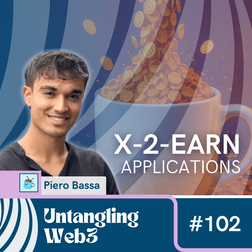
This episode of Untangling Web3 features Piero Bassa, senior software engineer at VeChain and founder of Mugshot, for an in-depth look at X-2-Earn models that use Web3 infrastructure to reward sustainable real-world behavior. With a background in building scalable decentralized systems, Piero outlines how DApps can enable new paradigms of user engagement by combining crypto incentives with everyday actions like choosing reusable items. Key highlights: What makes a DApp different from traditional apps? DApps operate on blockchain infrastructure instead of centralized servers, which decentralizes control and gives users true ownership of data and digital assets. Smart contracts replace opaque backend logic, allowing users to trust that rules, incentives, and governance are transparent and immutable. This model removes reliance on single points of failure, enables permissionless participation, and shifts power away from centralized platforms like Facebook and Google. The logic and value of X-2-Earn models X-2-Earn flips conventional engagement by turning user actions into valuable contributions. These models provide incentives for users to take actions like exercising, recycling, or drinking from reusable cups. By anchoring incentives to smart contracts and crypto rewards, X-2-Earn enables immediate, scalable compensation without intermediaries. It also ensures transparency in how and why rewards are distributed, building trust in the system’s fairness and intention. The Mugshot use case: Rewarding reuse with Web3 Mugshot incentivizes sustainable behavior by rewarding users for uploading photos of themselves using reusable mugs instead of disposable cups. Through AI validation and smart contract logic, users receive tokenized rewards that can be redeemed for products like sustainable coffee. In under a year, Mugshot has reached nearly a million users, showing that simplicity and fun UX, combined with meaningful incentives, can drive mass adoption—even without complex onboarding or referral systems. X-2-Earn models powered by blockchain offer a new path for rewarding socially and environmentally beneficial actions. By combining transparency, composability, and tokenized incentives, apps like Mugshot are proving that Web3 can deliver real-world impact at scale. Rather than chasing speculative hype, the future of decentralized apps lies in utility, habit formation, and trustless engagement—empowering users and aligning incentives for a more sustainable digital ecosystem. -- This episode is sponsored by the VeChain foundation. Learn more about VeBetterDAO here: https://vebetterdao.org/ -- Learn more about Web3 at: https://untanglingweb3.com/ -- Untangling Web3 is brought to you by hosts Jack Davies and Alec Burns, with music by Daniel Paigge. Got a question or topic suggestion? Send us an email at theuntanglingweb3podcast@gmail.com. Love what you're hearing? Show your support by becoming a subscriber and don't forget to leave us a stellar review. The views we express here are our own, and do not represent the views of our employers. Nothing discussed or stated in the show should be considered advice.
#101 Untangling: The AI Battle Royale

In this episode of the Untangling Web3 podcast, we break down the latest developments in the rapidly evolving world of AI, focusing on the rising competition between major players like OpenAI, Google's Gemini, and China's groundbreaking DeepSeek. With performance, cost, and openness on the line, this episode unpacks the global battle to dominate the future of artificial intelligence. Key highlights: Origins and Missions of the Major Players: The episode begins by tracing the roots of leading AI companies. From OpenAI's nonprofit beginnings to its dominance with GPT-4.1, and Google's Gemini suite developed from DeepMind and Brain, we compare their approaches to safety, openness, and commercialization. The team also discusses Anthropic’s Claude and the unique positioning of models like Mistral and Cohere’s Command R, each targeting different market segments and use cases—from transparency to enterprise knowledge management. The Rise of DeepSeek and the Global Shake-Up: The hosts unpack the massive impact of DeepSeek, China’s open-source AI contender that rocked global tech markets in early 2025. They explain why DeepSeek's performance-to-cost ratio, open accessibility, and groundbreaking efficiency innovations like batch tokenization sent shockwaves through Western tech stocks. With its free and highly capable models, DeepSeek challenges the dominance of U.S.-based platforms and marks a shift in global AI power dynamics. Performance, Pricing, and Future Trends: Diving into technical metrics, the hosts compare context windows, output limits, and per-token costs of today’s top models. They highlight how GPT-4.1, Claude, Gemini, and DeepSeek serve different user needs—from coding and storytelling to academic research and cost-efficient startups. The episode also explores how integration strategies like Model Context Protocol (MCP) and services like AWS Bedrock are reshaping how AI is deployed and scaled in real-world applications. As the AI battle heats up between OpenAI, Gemini, DeepSeek, and others, users are the real winners—gaining access to faster, cheaper, and more specialized tools. But with geopolitical dynamics, training data transparency, and business models evolving fast, staying informed is key. Whether you're an entrepreneur, developer, or tech enthusiast, this episode is your guide to navigating the increasingly competitive and globalized landscape of artificial intelligence. -- This episode is sponsored by the VeChain foundation. Learn more about VeBetterDAO here: https://vebetterdao.org/ -- Learn more about Web3 at: https://untanglingweb3.com/ -- Untangling Web3 is brought to you by hosts Jack Davies and Alec Burns, with music by Daniel Paigge. Got a question or topic suggestion? Send us an email at theuntanglingweb3podcast@gmail.com. Love what you're hearing? Show your support by becoming a subscriber and don't forget to leave us a stellar review. The views we express here are our own, and do not represent the views of our employers. Nothing discussed or stated in the show should be considered advice.
#100 Untangling: 100 Episodes of Web3

Welcome to a very special milestone of the Untangling Web3 podcast – our 100th episode! In this celebratory edition, we take a step back to reflect on how far the podcast has come, the incredible evolution of Web3 and emerging tech during this journey, and the community that has grown around us. From humble beginnings with scratchy audio and no video to live events, high-profile guests, and over 175,000 YouTube subscribers, this episode is both a nostalgic trip and an optimistic look forward. Key highlights: Podcast Growth and Milestones: Jack and Alec reflect on the early days of Untangling Web3 and how it grew from a side project into a thriving podcast with a global audience. They discuss significant moments including the first live event, guest highlights like Heather Flannery and King Willonius, and the podcast’s shift into broader tech conversations such as AI and quantum computing. From awkward first episodes to major speaking engagements and reaching 100K+ subscribers, it's been a wild and rewarding ride. Industry Shifts and Emerging Trends: The episode revisits the major changes in the tech space since episode one, with a focus on the rise of AI, the steady evolution of crypto and blockchain, and growing concerns over privacy, data ownership, and social media monopolies. The hosts highlight how these themes have shaped discussions across the last 100 episodes and point to AI misinformation, stablecoins, and decentralized social platforms like BlueSky as key areas of focus moving forward. The Future of the Podcast and Web3: Looking ahead, Alec and Jack share their excitement for the next 100 episodes, promising deeper dives into underexplored tech areas like robotics, drones, and self-sovereign identity. With the podcast now receiving inbound guest requests and growing industry recognition, they plan to continue building community, hosting live events, and pushing the boundaries of what a Web3-focused podcast can cover in an ever-changing tech world. Hitting 100 episodes is a major milestone, but for Alec and Jack, it's just the beginning. As the Web3, blockchain, and tech landscape continue to shift rapidly, Untangling Web3 remains committed to offering insightful, entertaining, and thought-provoking conversations. Whether you've been with them since episode one or just joined, thank you for being part of the journey. Here's to the next hundred—and beyond—as we continue to explore, review, and evolve with the tech shaping our future. -- This episode is sponsored by the VeChain foundation. Learn more about VeBetterDAO here: https://vebetterdao.org/ -- Learn more about Web3 at: https://untanglingweb3.com/ -- Untangling Web3 is brought to you by hosts Jack Davies and Alec Burns, with music by Daniel Paigge. Got a question or topic suggestion? Send us an email at theuntanglingweb3podcast@gmail.com. Love what you're hearing? Show your support by becoming a subscriber and don't forget to leave us a stellar review. The views we express here are our own, and do not represent the views of our employers. Nothing discussed or stated in the show should be considered advice.
#99 UW3 Live: Web3 for Social Good with Pankhuri Bansal and Sunny Lu

This special edition of Untangling Web3 features the first-ever live recording of the show, held in London and focused on the theme of Web3 for Social Good. Guest panelists Sunny Lu (CEO of VeChain) and Pankhuri Bansal (blockchain and AI expert with the UN and LTO Network) explore how decentralized technologies are driving impact in sustainability, social inclusion, and environmental action. Key highlights: Decentralization as a Tool for Inclusion Over 1.4 billion people remain unbanked globally, lacking access to basic financial services. Blockchain enables alternative financial systems through tokenized microloans and digitally verifiable identities. In regions like sub-Saharan Africa, tokenized lending models provide farmers with access to capital without the need for a formal bank account, unlocking economic participation for underserved communities. Green Incentives and Behavioral Change Micro-incentivization using blockchain tokens can change everyday behaviors at scale. Sustainability schemes—from plastic bottle deposit programs to plastic bag levies—prove that small financial nudges lead to measurable behavioral shifts. Web3 enables these incentives to be recorded transparently, scaled globally, and linked to real-world actions through smart contracts and on-chain proof systems. Tokenomics and the Future of ESG Crypto incentives create an auditable and efficient system for environmental, social, and governance (ESG) accountability. When individuals are rewarded for using recycled materials or companies track and tokenize their sustainability impact, ESG becomes measurable, verifiable, and incentivized. Applications like VeBetterDAO are building ecosystems where users earn rewards for provable social good actions—from recycling to reducing emissions. Web3 offers an unprecedented opportunity to coordinate global action at the individual level. From plastic waste collection to climate data verification, blockchain enables transparent and trustless systems that reward citizens for doing good. Rather than relying solely on governments or institutions, Web3 empowers individuals to contribute directly to sustainable outcomes—and be compensated in the process. As regulatory clarity emerges and enterprise interest grows, the alignment of social impact and tokenized value creation will become a powerful force for green transformation. -- This episode is sponsored by the VeChain foundation. Learn more about VeBetterDAO here: https://vebetterdao.org/ -- Learn more about Web3 at: https://untanglingweb3.com/ -- Untangling Web3 is brought to you by hosts Jack Davies and Alec Burns, with music by Daniel Paigge. Got a question or topic suggestion? Send us an email at theuntanglingweb3podcast@gmail.com. Love what you're hearing? Show your support by becoming a subscriber and don't forget to leave us a stellar review. The views we express here are our own, and do not represent the views of our employers. Nothing discussed or stated in the show should be considered advice.
#98 Untangling: Getting Deep Into DePIN with Tom Trowbridge

In this episode of Untangling Web3, co-founder of Fluence and host of the DePINed Podcast, Tom Trowbridge, breaks down the evolving world of DePIN—Decentralized Physical Infrastructure Networks. Drawing on his leadership at Fluence and his experience launching Hedera Hashgraph, Trowbridge provides a technical yet accessible overview of how DePIN offers an alternative model to centralized infrastructure, unlocking powerful new design patterns in blockchain-based networks. Key highlights: Definition and Criteria of DePIN: DePIN is defined as a crowdsourced physical infrastructure network delivering services through crypto-incentivized mechanisms. What differentiates DePIN from traditional infrastructure models is that the networks rely on community-owned hardware—whether dashcams, routers, drones, or browser extensions—rather than centralized corporate-owned systems. Participants contribute these resources and receive tokens, creating a more distributed and participatory infrastructure layer. Economic Models and Token Utility: The viability of DePIN depends on token-based crypto-economics that incentivize contribution and participation while allowing network effects to scale without centralized capital expenditure. Without tokens, projects would require upfront funding to bootstrap infrastructure and could not easily reward contributors with upside. Token rewards create both short-term participation incentives and long-term value alignment between users and the growth of the network. Fluence and the Cloudless Internet Fluence, the decentralized computing platform Tom co-founded, addresses the final missing piece in the decentralized internet stack: compute. While Filecoin and Arweave have decentralized storage, Fluence is focused on replacing centralized cloud compute providers like AWS and Azure. Fluence uses enterprise-grade infrastructure to deliver decentralized compute with service-level agreements (SLAs), competitive pricing (up to 70% cheaper than traditional cloud services), and an open architecture that supports dynamic scaling and migration. DePIN represents a fundamental rethinking of infrastructure—from centralized ownership to community-powered networks secured and incentivized by blockchain. From physical deployments like drone-based mapping to compute platforms like Fluence, this emerging paradigm offers the chance to outcompete traditional infrastructure on cost, resilience, and scalability. DePIN is now poised to evolve into one of the most impactful sectors in Web3. Read Tom's DePIN Tokenomics report in full here: https://depined.xyz/report#depin-token-economics-report -- This episode is sponsored by the VeChain foundation. Learn more about VeBetterDAO here: https://vebetterdao.org/ -- Learn more about Web3 at: https://untanglingweb3.com/ -- Untangling Web3 is brought to you by hosts Jack Davies and Alec Burns, with music by Daniel Paigge. Got a question or topic suggestion? Send us an email at theuntanglingweb3podcast@gmail.com. Love what you're hearing? Show your support by becoming a subscriber and don't forget to leave us a stellar review. The views we express here are our own, and do not represent the views of our employers. Nothing discussed or stated in the show should be considered advice.
#97 Untangling: AI & Creativity with King Willonius

This week on Untangling Web3, we're joined by artist, comedian, and AI innovator King Willonius to explore how artificial intelligence is reshaping creativity, comedy, music, and storytelling. Known best for his viral AI-generated track "BBL Drizzy," King breaks down the mechanics, ethics, and cultural implications of using AI as a creative collaborator—offering a first-hand look into how creators are using technology to expand the boundaries of art and expression. Key highlights: BBL Drizzy, Kendrick Lamar, and AI in Culture: The viral moment surrounding the Drake and Kendrick Lamar feud was deeply intertwined with AI. King Willonius used Udio to generate "BBL Drizzy," a satirical, soul-inflected track that responded to the online drama. The song’s meteoric rise—created in under 30 minutes—became a cultural flashpoint, blurring the line between parody, artistry, and AI commentary. This moment demonstrated AI’s power to remix and engage with real-time culture, while raising urgent ethical questions about voice cloning and artistic ownership. Ethics, Voice Cloning, and Artist Rights: The accessibility of voice cloning and image generation raises complex issues about consent, ownership, and cultural legacy. When prominent artists like Drake use AI-generated voices of deceased icons like Tupac, it creates a normalization of practices that many consider ethically gray. The absence of clear frameworks invites both innovation and abuse. For creators, the challenge is balancing the freedom to remix with the responsibility to respect identity and provenance. Creative Empowerment vs. Creative Replacement: AI’s primary impact is in lowering barriers to entry and compressing timelines. Instead of needing a studio, a team, and weeks of iteration, a solo artist can now produce music, video, and design in a fraction of the time. While some fear AI will replace creatives, King frames it as a class-leveling force—one that empowers marginalized voices and expands access to professional-grade tools. Artificial intelligence is not just a tool for productivity—it is becoming a medium of cultural expression, satire, and commentary. The future of creativity involves hybrid workflows, where human originality is amplified by synthetic intelligence. Artists who embrace AI without abandoning ethics or intention will be at the forefront of a new era in music, comedy, and culture. Whether remixing internet moments, shaping virtual identities, or training AI agents to rap, creators like King Willonius are rewriting what it means to be an artist in the age of artificial intelligence. Learn more about King Willonius' work here: https://www.kingwillonius.com/ -- This episode is sponsored by the VeChain foundation. Learn more about VeBetterDAO here: https://vebetterdao.org/ -- Learn more about Web3 at: https://untanglingweb3.com/ -- Untangling Web3 is brought to you by hosts Jack Davies and Alec Burns, with music by Daniel Paigge. Got a question or topic suggestion? Send us an email at theuntanglingweb3podcast@gmail.com. Love what you're hearing? Show your support by becoming a subscriber and don't forget to leave us a stellar review. The views we express here are our own, and do not represent the views of our employers. Nothing discussed or stated in the show should be considered advice.
4 of 14