
Episode notes
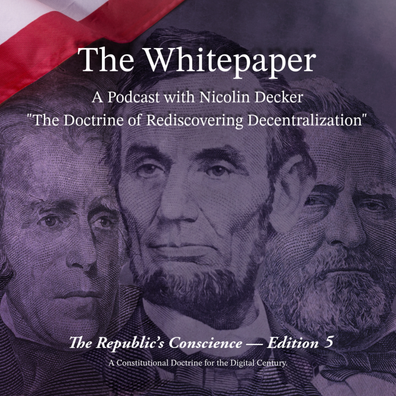
In this Constitutional Architecture Edition of The Whitepaper, Nicolin Decker presents The Republic’s Conscience — Edition 5: The Doctrine of Rediscovering Decentralization: a doctrinal brief demonstrating that decentralization is not a 21st-century invention — it is the original design of the United States Constitution.
This episode is crafted for Members of Congress, federal regulators, Article III judiciary, digital-governance architects, Treasury and central-bank leadership, and national-security officials seeking clarity in a domain long defined by confusion:
Everyone is talking about decentralization — but no one agrees on what it means.
🔹 Core Thesis
RDC argues:
The U.S. already operates the world’s first decentralized governance model — not through technology, but through constitutional structure.
Separation of powers, federalism, judicial review, and democratic consent function as the original decentralized protocol — long predating blockchain, distributed computation, or cryptographic consensus.
🔹 Structural Findings
1. The Historical Lineage
RDC traces decentralization through national-security architecture, not cryptocurrency culture:
- RAND (1964): networks must survive the loss of a center
- DARPA / ARPANET (1969): distributed resilience
- Chaum (1982): verifiable systems among “mutually suspicious actors”
- Haber & Stornetta (1991–1995): the first operational blockchain
- Nakamoto (2008): convergence — not invention
The conclusion:
Decentralization began as a constitutional defense strategy — not an anti-government ideology.
2. The Misalignment: “DeFi” vs. Constitutional Decentralization
RDC provides the bright-line distinction missing from policy debate:
- Constitutional decentralization: distributed authority with accountability
- Most digital asset systems: distributed execution without accountability
Or in policy language:
Code without checks and balances is not decentralization — it is unregulated centralization expressed through automation.
Bitcoin qualifies as an immutable digital commodity; most upgradeable, governance-managed digital assets do not.
3. The Post-Chevron Turning Point
In today’s legal era, authority must trace to statute — not infrastructure or market adoption.
RDC applies that same standard to digital systems:
A system may automate execution — but it may not originate power.
4. The Forward Model
Instead of speculation, RDC offers a constitutional pathway:
- The Federal Trust Layer™
- Asset-Backed Digital Currencies (ABDCs)
- Autonomous Commodity Primitives (ACPs)
- SingularVote™ — the first architected constitutional decentralized electoral system
These are not alternatives to constitutional authority — they are its digital expression.
🔻 The Closing Principle
RDC reframes the modern narrative:
- The issue is not technological capability.
- The issue is constitutional memory.
Decentralization without shared meaning becomes anarchy. Shared meaning without decentralization becomes tyranny.
The Constitution already solved this balance.
What remains is alignment — not reinvention.
📄 Rediscovering Decentralization — The United States Constitution as the Foundational Governance Protocol in the Digital Age. [Click Here]
This is Edition Five of The Republic’s Conscience.