
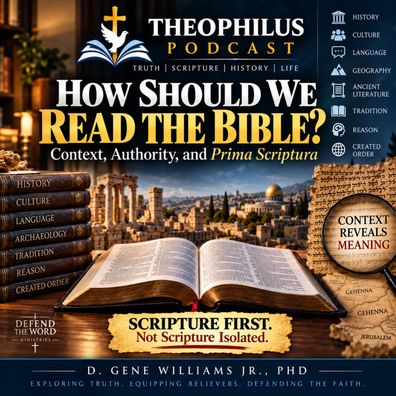
Episode notes
How should Christians actually read the Bible?
In this teaching, we examine biblical interpretation, historical and cultural context, the limits of a purely plain reading, and the relationship between Sola Scriptura, Prima Scriptura, and the use of sources outside the biblical text.
We begin with a simple but important distinction: the Bible was written for us, but it was not originally written to us. The biblical authors wrote within real historical settings, using languages, customs, idioms, literary forms, and cultural assumptions that their original audiences often understood without explanation.
From there, we consider the question of authority. What does Sola Scriptura actually mean? How is it different from Solo Scriptura or Nuda Scriptura? And why do I use the term Prima Scriptura?
Prima Scriptura does not diminish ...