The Forgotten ECE

The Forgotten ECE

by Jamie-Lee Wagler
Season 3

Capable Learners Day Home: Kayla's 57 Sensory Bin Ideas for Engaging Play

On today's episode, we welcome Kayla Snidal, the founder of Capable Learners and an experienced early childhood educator with over 15 years in the field. Main topics: Creating adaptable and inclusive sensory bins for all ages The benefits of sensory play for regulation, creativity, and leadership Tips for managing the mess and making sensory activities low-stress How to incorporate community resources and recycled materials Building an emergent curriculum based on children's interests Timestamps: 00:00 - Introduction to Kayla Snidal and her background in early childhood education 00:45 - Inspiration behind her new ebook, '57 Sensory Bin Ideas' 02:19 - The importance of adaptable sensory activities for different materials and budgets 04:01 - Finding sensory materials through thrift stores, community groups, and reuse stores 07:43 - Addressing the gap in family day home sensory opportunities 10:24 - How older children can support and lead during sensory activities 12:24 - The role of sensory play in fostering autonomy, leadership, and fun 13:29 - Favourite sensory bins for school-aged children and their messy, creative appeal 14:59 - Embracing messy, builder-style sensory play to develop problem-solving 20:36 - Strategies for managing mess and stress when introducing sensory bins 22:01 - Adapting sensory play for different age groups and classroom settings 23:14 - Encouraging children to try new sensory activities without stigma 24:08 - School-age expectations for sensory play and their creative uses 25:28 - Introducing sensory bins in out-of-school care to boost engagement 29:56 - Personal story: A memorable sensory bin experience with coffee beans 33:44 - The importance of advocating for the role of sensory play for school-aged children 34:14 - How to access Kayla’s ebook, resources, and exclusive discount code 35:16 - Final thoughts and encouragement for educators to embrace sensory play in their craft Resources & Links Beyond the Bin - Virtual Workshop Wesbite 57 Sensory Bin Ideas ebook (use code: bins5 for $5 off) Connect with Kayla: Instagram Website

The Hidden Cost of Holding it Together

Have you ever noticed how a child who was “fine” at school completely unravels in your program at 3:30? The tears. The shutdown. The explosive reaction over something small. It’s not random. And it’s not because your program is the problem. In this episode, we unpack the hidden emotional cost of “holding it together” all day at school — and why before and after school programs often become the place where everything spills out. We explore: What masking looks like in school-age children Why behavior escalates after dismissal The neurological toll of constant self-regulation The added pressures kids are carrying today — technology, peer dynamics, bullying, academic workload, unrealistic expectations Why your program often becomes the safe landing zone But this conversation doesn’t stop at understanding. We go deeper into what actually helps. You’ll walk away with practical strategies for: Co-regulation with 6–12 year olds (without treating them like preschoolers) Adjusting your emotional stance so you don’t escalate the situation Creating decompression rituals after school Supporting nervous system resets through the environment and programming Recognizing when behaviour is communication, not defiance We also talk about the impact of your regulation — how your tone, posture, pacing, and response style directly influence whether a child stabilizes or spirals. School-age children are navigating more complexity than ever before. They are managing social media exposure, peer comparison, academic demands, and social pressure — often without the emotional scaffolding to process it all. Before and after school programs have a powerful opportunity: not just to supervise time, but to provide nervous system safety. If you’ve ever felt overwhelmed by the intensity of after-school behaviour, this episode will help you see it differently — and respond in ways that build resilience instead of resistance. Because sometimes the meltdown isn’t misbehaviour. It’s a relief. NEVER MISS AN EPISODE: https://miss-jamie-consulting.kit.com/2d1b0877c0

But They Don't Need Me

Moving from early years to school age can feel like an identity crisis. In preschool, you’re needed constantly — tying shoes, regulating emotions, leading the room. Then suddenly you’re in a school-age program, and no one wants your planned activity. They’re building forts, forming friend groups, and asking, “Is it mandatory?” What happened? In this episode, we unpack the “independence shock” educators experience when transitioning to ages 4–12. We break down why autonomy isn’t rejection — it’s development. Grounded in Self-Determination Theory and school-age research, we explore the shift from directing to offering, from compliance to choice-based programming, and from being the center of the room to becoming the architect of the environment. You’ll walk away with: A clear understanding of why school-age children resist adult-led control The difference between offering invitations and directing participation Practical strategies for planning without micromanaging A new way to measure success in before and after-school programs If you’ve ever thought, “They don’t need me like preschoolers did,” this episode is your reset. They don’t need you the same way. And that’s exactly the point. Your ticket to elevated school-age PD is one click away! Join me at Camp North of Ordinary for a Summer Camp Leadership Retreat, designed for educators who work with School Agers! Whether that is before and after-school programs or summer camp! More information here: missjamieconsulting.com/campnorth

The Space Between: Partnering with Families Beyond Pickup and Drop-Off

Families may only see us at the edges of the day — at drop-off and pickup — but trust is built in everything that happens in between. In this episode, Jamie explores the often-invisible work of family partnership beyond face-to-face moments. From emails and newsletters to documentation, tone, and transparency, this conversation reframes communication as one of the most powerful tools educators have to build trust, advocate for their profession, and create a true sense of community. Rooted in How Does Learning Happen?, the CECE Code of Ethics, and relationship-based practice, this episode challenges educators to see communication not as an extra task — but as intentional professional practice. Because when families aren’t in the room, our words, documentation, and tone become the program.
Season 2

Mini-Series: Families at the Edges - Morning Drop-Off Energy: Setting the Tone for the Day”
Morning drop-off is more than a transition — it’s a threshold moment. It’s where children transition from home to community, where parents entrust them, and where educators subtly establish the emotional tone for the entire day. In this episode, Jamie explores the professional, emotional, and developmental importance of morning drop-off in before- and after-school programs. Drawing on attachment theory, co-regulation, and reflective practice, she reframes drop-off as one of the most powerful — and underestimated — moments in school-age care. Rather than focusing on perfection or routines alone, this episode centres presence, tone, and intentional connection — and how educators’ responses in the first minutes of the day shape children’s sense of safety, belonging, and readiness to engage.

Mini-Series: Families at the Edges - Connections Between Bells: Guardian Pickup Conversations: Navigating the 3-Minute Window
Pickup time. Three minutes. Twenty backpacks. One educator is trying to hold connection, information, safety, and emotion all at once. In this episode, Jamie dives into one of the most universal — and underestimated — moments in before- and after-school care: the guardian pickup conversation. With genuine candour, warmth, and the wisdom of a seasoned school-age educator, Jamie explores what’s truly happening in that chaotic, sacred window at the end of the day. It’s not just signing children out or handing over reminders — it’s relationship-building in real time. Jamie breaks down: Why pickup feels so chaotic — and why it matters How micro-moments shape family trust and confidence The emotional labour educators quietly carry in those last minutes What guardians are actually hearing between the lines How to share concerns with compassion and professionalism The small communication shifts that turn chaos into connection This episode reminds educators that those quick end-of-day conversations are more than routine — they are the heartbeat of family engagement. Whether you’re a new educator learning the “pickup dance,” a seasoned supervisor supporting your team, or someone who’s ever ended a day absolutely spent, this episode will leave you feeling seen, grounded, and proud of the work you do. Because the truth is: Before- and after-school educators don’t just manage time — they build bridges between home and program, one 3-minute conversation at a time.

Holding Space, Not Just Time: Emotional Labour in Split-Shift Work
Split shifts are more than early mornings and late afternoons — they are emotional marathons. In Episode 12, Jamie brings voice to the invisible work of school-age educators who live in the “in-between” hours: the early starts, the long breaks no one understands, and the emotional balancing act required to show up twice a day with presence, patience, and heart. With honesty, humour, and a whole lot of compassion, Jamie explores the emotional labour behind split-shift work — the self-regulation, the empathy, the attunement, and the quiet resilience that never makes it onto a schedule. She unpacks what research says about co-regulation and attachment during transitions, reflects on the realities of caregiver fatigue, and validates the educators who feel overstretched yet continue to hold space for children with incredible care. This episode is a grounding reminder that school-age educators don’t just “cover hours” — they hold space, build belonging, and create emotional safety in the margins of the day. Whether you’re an educator, a supervisor, or someone who has ever felt unseen in your split-shift role, this episode will make you feel understood, valued, and profoundly proud of the work you do.

The Human Side of Compliance in School-Age Programs
Compliance. Just hearing the word can make an educator’s shoulders tense — especially in the fast-paced, ever-changing world of before- and after-school care. In this episode, Jamie gets real about the emotional labour, pressure, and pride behind keeping programs compliant under the CCEYA — and why compliance isn’t just about checklists or binders. It’s about people. From navigating borrowed spaces and unpredictable transitions to leading teams with compassion instead of fear, Jamie reframes compliance as something deeply human — a reflection of care, not control. She reminds us that every policy has a heartbeat: ✅ Attendance means safety. ✅ Documentation means trust. ✅ Inspections mean accountability — and opportunity. This episode is a powerful reminder that we can meet every regulation and still keep our hearts in the work. Whether you’re an educator feeling the weight of expectations or a supervisor leading your team through licensing season, this one will leave you feeling seen, grounded, and proud of the professionalism that lives in every detail of your day.

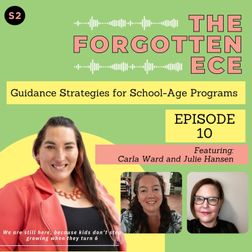
Guidance Strategies for School Age Children Featuring Carla Ward and Julie Hansen
In this special episode of The Forgotten ECE Podcast, I’m joined by two inspiring leaders in the early childhood education field: Carla Ward, host of The Everything ECE Podcast, and Julie Hansen, founder of The Inspired ECE. We dive deep into practical and respectful guidance strategies for school-age children, exploring: Common challenges and how to reframe them Tools for building meaningful connections with kids Realistic approaches to structure and expectations A sneak peek into Carla and Julie’s exciting upcoming workshop on August 16th Whether you're an educator, program leader, or advocate, this conversation is packed with powerful takeaways you can use right away. ✨ Connect with the Guests: 🔗 Carla Ward on Instagram: @elfoundations 🎧 Listen to Carla’s podcast: The Everything ECE Podcast 📸 Julie Hansen on Instagram: @inspired_ece 🗓️ Register for the August 16th workshop: 👉 elfoundations.thrivecart.com/guidance-strategies 🎧 Let’s keep showing up—because kids don’t stop growing when they turn six.

No Time, No Budget, Low Prep Experiences that Matter

Time is short. Budgets are tight. But that doesn’t mean your programming has to feel flat or uninspired. In this episode, we dive into realistic, meaningful, and low-prep ideas that bring connection, joy, and purpose into your before and after school programs—without extra stress or spending. From spontaneous games and open-ended materials to quick-win transitions and group reflections, this episode is packed with practical takeaways you can use tomorrow, even if your day is already jammed. Because sometimes, the most magical moments happen when we do less—with intention. Perfect for: ✔️ Educators stretched thin ✔️ Teams working with limited resources ✔️ Anyone who wants to make a difference without burning out You’ll walk away with: Easy go-to experiences that require zero prep Ways to shift mindset from “more stuff” to “more meaning” A challenge to reflect on what really makes an impact
2 of 5