The Early American Brass Band Podcast

The Early American Brass Band Podcast

by Chris Troiano, Stephen Cannistraci
Season 2

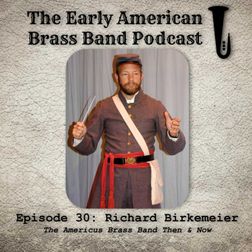
30 - Interview with Richard Birkemeier: The Americus Brass Band Then and Now

Episode 30 is our conversation with Dr. Richard Birkemeier of the Americus Brass Band. We discuss the historical Americus band from Georgia as well as the current Americus Brass band, their past recording projects, movies and tv shows, and touring shows. You can now support the show on Patreon and Teespring! No obligation, but we greatly appreciate any support you're willing to give. For show notes and resources, visit our website at www.eabbpodcast.com. You can get in touch with us on social media, and by emailing eabb.podcast@gmail.com Music in this episode comes from Our Musical Past from the Library of Congress. Episode Structure: 2:00 - Richard's musical background and how he got involved with early American brass bands 5:52 - The beginnings of The Americus Brass Band at Cal State Long Beach, acquiring instruments 9:24 - The Historical Americus Brass Band from the 19th century 18:25 - African American brass bands after the American Civil War 22:14 - Why the present day Americus Brass Band chose to model themselves after the historic band 25:30 - Movie and TV projects the Americus Band was involved in: Gettysburg, Glory, North and South 30:49 - Specific stories about North and South and Glory. Recording Dr. Quinn, Medicine Woman and Disney's Hidalgo 37:18 - Recording Music of the Civil War, the album's reach and impact 43:29 - Americus' touring shows 48:49 - Response to the touring shows 58:05 - Where you can find more about the Americus Brass Band 59:01 - Closing thoughts 1:00:45 - Featured Album: Americus Brass Band, Music of the Civil War

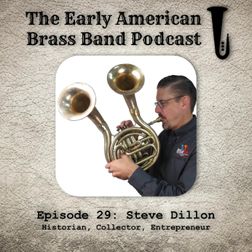
29 - Interview with Steve Dillon: Historian, Collector, Entrepreneur

Episode 29 is our conversation with Steve Dillon, instrument collector and owner of Dillon Music in Woodbridge NJ. We loved having him on the show and can’t wait to have him on again to get into more topics. In this episode, we talk mainly about his collecting, historical brass instruments, Arthur Pryor, and brass and concert bands in the 29th century. You can now support the show on Patreon and Teespring! No obligation, but we greatly appreciate any support you're willing to give. For show notes and resources, visit our website at www.eabbpodcast.com. You can get in touch with us on social media, and by emailing eabb.podcast@gmail.com Music in this episode comes from Our Musical Past from the Library of Congress. Episode Structure: 2:13 - Interview with Steve Dillon - Steve's musical background 4:11 - Early days of Steve buying/selling/trading instruments, how that evolved into owning and operating Dillon Music in Woodbridge, NJ. 6:50 - Steve's personal instrument collecting 8:30 - How Steve got interested in collecting fifes 10:42 - How to date fifes, general conversation about instrument production in the United States 12:19 - Reenacting as a fifer 15:30 - Background on Arthur Pryor, and how Steve came to own Pryor's trombone 21:50 - The path Pryor's trombone took from the time he passed to Steve purchasing it 23:20 - Some of the brass instrument collections Steve has sold to museums over the years 26:00 - Restoring the Harvard Tuba at Dillon Music 34:57 - Instruments being recycled as shell casings during WWII 35:51 - Instruments Steve has on display at Dillon Music 36:57 - 2-bell instrument possibly made by Conn for Simone Mantia 46:09 - Accessibility of historical instruments, historical instrument quality, recording Slide Partners with Joe Alessi 52:45 - Simone Mantia and instrument maintenance 56:06 - Period vs. modern mouthpieces 57:40 - Brass and concert bands in the 19th century 1:04:21 - Where you can find more about Steve's store and research 1:06:35 - Featured Album: Slide Partners

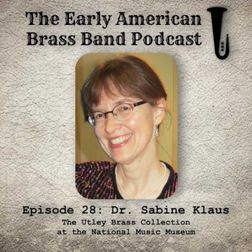
28 - Interview with Dr. Sabine Klaus: The Utley Brass Collection at the National Music Museum

Episode 28 is our great conversation with Dr. Sabine Klaus, the Joe R. and Joella F. Utley Curator of Brass Instruments and Professor of Music at the National Music Museum, and University of South Dakota. We talk about her experience in the museum field, the history and development of the National Music Museum, the Utley Collection of brass instruments at the museum, and her books Trumpets and Other High Brass. You can now support the show on Patreon and Teespring! No obligation, but we greatly appreciate any support you're willing to give. For show notes and resources, visit our website at www.eabbpodcast.com. You can get in touch with us on social media, and by emailing eabb.podcast@gmail.com Music in this episode comes from Our Musical Past from the Library of Congress. Episode Structure: 2:29 - Dr. Klaus' background 14:19 - History of the National Music Museum 20:06 - How the museum grew and changed over time 22:27 - History of The Joe R. & Joella F. Utley Collection 32:48 - How cataloguing this collection led to Dr. Klaus' books and the online resources associated with the collection 35:19 - Moving the collection from South Carolina to South Dakota 37:51 - How the Utley collection is stored and displayed at the National Music Museum 45:20 - Highlights of The Utley Collection 50:19 - How the museum determines what instruments get displayed and what instruments get stored, new displays at the museum 53:28 - How the instruments in the museum are maintained 56:40 - Thoughts on restoring instruments vs. preserving them as physical objects, playing instruments in the collection 1:02:25 - Using an acoustic measuring device to predict how an instrument may sound if played to help determine the quality of an instrument 1:05:31 - Dr. Klaus' books Trumpets and Other High Brass 1:17:44 - Featured Album: Trumpets and Other High Brass DVD and audio examples

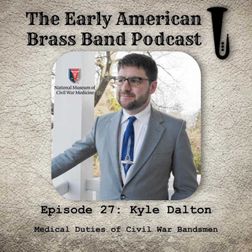
27 - Interview with Kyle Dalton: Medical Duties of Civil War Bandsmen

Episode 27 is a great conversation with Kyle Dalton of the National Museum of Civil War Medicine about the medical duties Civil War bandsmen carried out during the war, and all things Civil War medical history. We’re very grateful to Kyle for coming on the show and sharing his knowledge and research with us! You can find more about Kyle and the museum here: www.civilwarmed.org You can now support the show on Patreon and Teespring! For more details, visit www.patreon.com/eabbpodcast or www.teespring.com/stores/eabbpodcast. No obligation, but we greatly appreciate any support you're willing to give. For show notes and resources, visit our website at www.eabbpodcast.com. You can get in touch with us on social media, and by emailing eabb.podcast@gmail.com Music in this episode comes from Our Musical Past from the Library of Congress, and features perhaps the only recording of Our Lady of the Hospital, sung by soprano Kaley Harman, accompanied by collaborative pianist Matt Warfield-May. Episode Structure: 4:04 - Interview with Kyle Dalton Interview: Kyle's background 6:46 - History of The National Museum of Civil War Medicine 11:27 - Thoughts on how the historiography of the Civil War has changed recently, medical aspects of Civil War History 15:07 - Brief history of medical evacuation before and during the beginning of the American Civil War, the Band's medical duties 19:38 - Ethics of medical treatment during the American Civil War 23:19 - What life was like for a stretcher bearer in the American Civil War 25:21 - Bandsmen's medical duties beyond stretcher bearing 29:50 - Layout of hospitals in relation to battlefields, chain of survival during the American Civil War 33:39 - History of the Union Ambulance Corps 39:59 - Civil War medical developments and setbacks 45:53 - Final thoughts on the bandsmen's medical contributions 55:29 - How you can get in touch with Kyle and the National Museum of Civil War Medicine 59:00 - Featured Recording: Our Lady of The Hospital

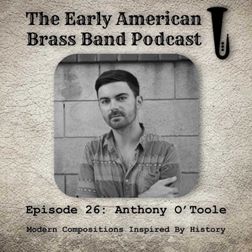
26 - Interview with Anthony O'Toole: Modern Compositions Inspired By History

Episode 26 is our conversation with composer Anthony O’Toole. We primarily focus on three of Anthony’s pieces: A New Birth of Freedom, The Battle Cry of Freedom, and Butler’s Blunders. All three of these pieces were inspired by or in some way connected to 19th century brass bands and Anthony’s love of history. Along the way, we talk about many other general aspects of music making and composing, and we really enjoyed Anthony’s insights and thoughts on music in a general sense. You can now support the show on Patreon and Teespring! For more details, visit www.patreon.com/eabbpodcast or https://teespring.com/stores/eabbpodcast. No obligation, but we greatly appreciate any support you're willing to give. For show notes and resources, visit our website at www.eabbpodcast.com. You can get in touch with us on social media, and by emailing eabb.podcast@gmail.com Music in this episode comes from Anthony O’Toole, “The President’s Own” United States Marine Band, Our Musical Past from the Library of Congress, and The 8th GM Regiment Band. Episode Structure: 4:09 - Anthony's musical background, how his composition projects get started 9:17 - Anthony's interest in history 12:14 - Background on A New Birth of Freedom 22:17 - Recording: A New Birth of Freedom 26:44 - Background on Anthony's setting of The Battle Cry of Freedom 42:58 - Recording: Battle Cry of Freedom, performed by “The President’s Own” United States Marine Band 47:21 - Experience composing that piece as part of an audition for the Marine Band 49:43 - Background on Butler's Blunders 55:01 - Month of Miniatures 1:01:45 - Recording: Butler's Blunders 1:03:28 - Composing in the style of the 19th century, studying other composers 1:10:56 - Being adaptable as a composer 1:24:02 - How you can get in touch with Anthony 1:26:47 - Show wrap-up, Featured Album: Anthony's SoundCloud page

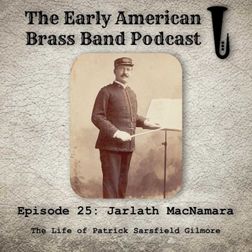
25 - Interview with Jarlath MacNamara: The Life of Patrick Sarsfield Gilmore

Episode 25 is our introduction to the life and career of Patrick Gilmore with historian Jarlath MacNamara. Jarlath has been researching Patrick Gilmore for years, and we were so thankful that he took the time to share what he’s learned with us, and now you. You can now support the show on Patreon and Teespring! For more details, visit www.patreon.com/eabbpodcast or https://teespring.com/stores/eabbpodcast. No obligation, but we greatly appreciate any support you're willing to give. For show notes and resources, visit our website at www.eabbpodcast.com. You can get in touch with us on social media, and by emailing eabb.podcast@gmail.com Music in this episode comes from Our Musical Past from the Library of Congress, and The 8th GM Regiment Band. Episode Structure: 3:33 - Interview Start, Jarlath's background and how he got interested in researching Patrick Gilmore 11:56 - Patrick Gilmore's early life, how the Irish were treated in the 1820's 15:42 - Patrick Keating's influence on Gilmore 19:26 - Gilmore's travel to America in 1849 24:49 - Gilmore's time in Boston 27:13 - Prevalence and importance of militias in this time, the bands Gilmore was leading before the American Civil War 33:55 - How Gilmore became involved in political movements of the time 36:45 - How Gilmore came to be in the Union Army 39:03 - "When Johnny Comes Marching Home" - The West Point Band 41:11 - Gilmore's band's activities during the war 44:50 - Gilmore's band organizing activities in MA and LA after his service in the Army 57:20 - Gilmore at the Grand Review and the National Peace Jubilee 1:09:33 - 2nd National Peace Jubilee 1:13:30 - Gilmore's tours to Europe and throughout the United States 1:17:53 - Gilmore Memorial Concert after his death 1:23:46 - Some concluding thoughts 1:28:07 - Where you can find more about Jarlath and his research 1:32:32 - Conclusion, Featured Album: “A Tribute to Patrick Sarsfield Gilmore” The Allentown Band

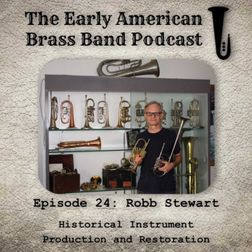
24 - Interview with Robb Stewart: Historical Instrument Production and Restoration

Episode 24 features our conversation with brass instrument repairman, restorer, and reproducer Robb Stewart. Robb is widely regarded as one of the best brass instrument repairmen and specializes in repairing and reproducing vintage instruments. In our interview, we talk about how Robb got started, what some of the biggest challenges are in this line of work, and reflect on his career thus far. You can now support the show on Patreon and Teespring! For more details, visit www.patreon.com/eabbpodcast or https://teespring.com/stores/eabbpodcast. No obligation, but we greatly appreciate any support you're willing to give. For show notes and resources, visit our website at www.eabbpodcast.com. You can get in touch with us on social media, and by emailing eabb.podcast@gmail.com Music in this episode comes from Our Musical Past from the Library of Congress, and The 8th GM Regiment Band. Episode Structure: 2:19 - Robb's musical background 4:44 - How Robb got into musical instrument repair 6:22 - Where Robb's interest in historical instruments began 7:12 - How Robb's career as an instrument repairman unfolded 10:09 - Early days of collecting and repairing historical instruments 17:23 - Philosophy on restoring historically important instruments 22:00 - Fabricating parts with modern materials 27:54 - Robb's personal collection of instruments 30:31 - Instrument makers Richardson and Sibley 33:58 - Thoughts on reasons for the scarcity of b flat 19th century instruments today 38:10 - Robb's instrument reproductions 49:22 - Playing with the California Gold Rush Band 51:21 - Robb's favorite instrument makers 58:47 - More notable instruments from Robb's collection 1:01:56 - Graves reproduction mouthpiece (referencing the mouthpiece mentioned in Jeff Stockham's episode) 1:03:47 - The instrument maker Thomas Payne 1:05:11 - General thoughts on instrument reproduction 1:10:18 - Where you can find more on Robb and his work 1:12:21 - Show wrap-up 1:13:38 - Featured Album: The California Gold Rush Band: Brass Mounted Army: Music of the Old Horse Cavalry

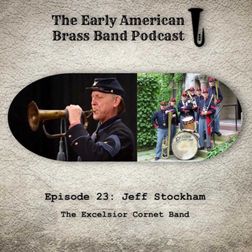
23 - Interview with Jeff Stockham: The Excelsior Cornet Band

Episode 23 features leader of the Excelsior Cornet Band, freelance musician, and instrument collector Jeff Stockham. It was great to get a legend in the field on the show, and we hope you enjoy the conversation! You can now support the show on Patreon! For more details and to sign up, please visit www.patreon.com/eabbpodcast. No obligation, but we greatly appreciate any support you're willing to give. For show notes and resources, visit our website at www.eabbpodcast.com. You can get in touch with us on social media, and by emailing eabb.podcast@gmail.com Music in this episode comes from Our Musical Past from the Library of Congress, and The 8th GM Regiment Band. Episode Structure: 1:54 - Jeff's musical background 9:05 - How Jeff got into 19th century brass performance 17:10 - Frederick Fennell's influence on the field of 19th century brass bands 20:59 - How Jeff got into collecting instruments, the "Cornet Conspiracy" group of collectors 27:31 - Jeff's collection, philosophy on using antique horns 36:54 - Thoughts on reproduction instruments 38:48 - Reenacting with the Federal City Brass Band and the Coates Brass Band 40:40 - The Excelsior Cornet Band 46:07 - Memorable gigs the Excelsior Band has played 52:22 - Recording with the Excelsior Cornet Band 59:01 - Jeff's "Music and Musket" presentations 1:12:09 - Where you can find more about Jeff and the Excelsior Cornet Band 1:14:59 - Featured Album: Cheer, Boys, Cheer!, the Excelsior Cornet Band

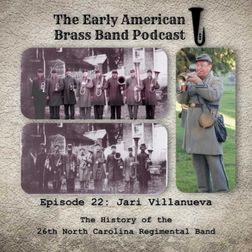
22 - Interview with Jari Villanueva: The History of the 26th North Carolina Regimental Band

Episode 22 features Jari Villanueva, back for round 2! In the episode, we talk all about the history of the 26th North Carolina Regiment Band. The Federal City Brass Band, which Jari founded and directs, re-creates the 26th NC Regiment Band in performance and they have done extensive research into the music, uniforms, and history of the men who were in the 26th NC Band during the American Civil War. In this episode, we discuss the band's history, their service during the war, activities after the war, and the Federal City Brass Bands's reenactment activities. You can now support the show on Patreon! For more details and to sign up, please visit www.patreon.com/eabbpodcast. No obligation, but we greatly appreciate any support you're willing to give. For show notes and resources, visit our website at www.eabbpodcast.com. You can get in touch with us on social media, and by emailing eabb.podcast@gmail.com Music in this episode comes from Our Musical Past from the Library of Congress, and The Federal City Brass Band Better than Rations or Medicine. Episode Structure: 3:16 - How Jari found out about the 26th NC Regimental Band and decided to incorporate them into the Federal City Brass Band organization. 11:21 - History of 26th NC Regimental Band Reenactments 13:38 - The history of the 26th NC Regimental Band, and the Moravian music traditions 17:59 - How the Salem Band turned into the the 26th NC Regimental Band 22:34 - How the band grew and changed once enlisted 25:23 - The band's activities throughout 1862 27:55 - Other duties of the band during their service 31:33 - Moving north in the Spring of 1863 36:42 - 26th NC Regiment at Gettysburg 40:07 - The 26th NC Regimental Band after Gettysburg 43:50 - Story about a 26th NC Regimental Band member who got called to bugle 48:22 - Moravian musical traditions 49:51 - The Band near the end of the war 51:55 - Capture of the 26th NC Regimental Band 54:32 - The band after the war 57:45 - North Carolina's as a part of the Confederacy 59:53 - Concluding thoughts on the men of the 26th NC Band 1:07:31 - How the Federal City Brass Band structures their performances as the 26th NC Regimental Band 1:09:03 - The Uniforms of the 26th NC Regimental Band 1:14:29 - Music the Federal City Brass Band plays when performing as the 26th NC Regimental Band 1:15:58 - Notable performances as the 26th NC Regimental Band 1:22:35 - Using drums and cymbal when performing 26th NC Regimental Band music 1:25:07 - Where people can find more about the 26th NC Regimental Band, and Jari

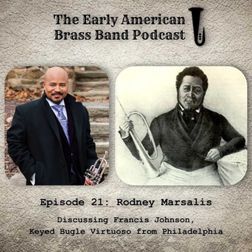
21 - Interview with Rodney Marsalis: Discussing Francis Johnson, Keyed Bugle Virtuoso

Welcome back for Season 2 of the Early American Brass Band Podcast! Episode 21 is our conversation with Rodney Marsalis - trumpet soloist and leader of the Rodney Marsalis Philadelphia Big Brass. We talk about his musical background, how he got interested in researching Francis Johnson, Johnson's life and musical career, and the RMPBB's "Francis Johnson Project" concerts. More on Rodney here: https://www.rmpbb.com/artist.php?view=prog&rid=3365 You can now support the show on Patreon! For more details and to sign up, please visit www.patreon.com/eabbpodcast. No obligation, but we greatly appreciate any support you're willing to give. For show notes and resources, visit our website at www.eabbpodcast.com. You can get in touch with us on social media, and by emailing eabb.podcast@gmail.com Music in this episode comes from Our Musical Past from the Library of Congress. Episode Structure: 2:34 - Patreon announcement! 3:45 - Interview with Rodney Marsalis - musical background 7:44 - How Rodney learned of Francis Johnson 11:04 - Francis Johnson's life and musical career 13:23 - The music scene in Philadelphia during Francis Johnson's time 16:35 - Francis Johnson's travels and musical ensembles 22:12 - Francis Johnson's contributions to the development of American music 26:23 - Publication of Francis Johnson's music 29:15 - Other tours within the United States, audience reception 35:18 - Sidebar about teaching early American music in schools 40:28 - The Francis Johnson Project 51:06 - Thoughts on performing on period instruments 55:03 - Where you can find out more about Francis Johnson and Rodney Marsalis 1:01:41 - Wrap-up, Feature Album: Chestnut Brass, The Music of Francis Johnson
3 of 6