The Transformation Observatory Podcast

The Transformation Observatory Podcast

by The Transformation Observatory
Season 2
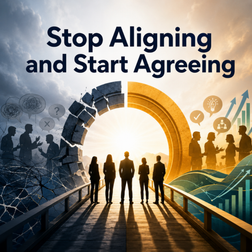
Stop Aligning and Start Agreeing
AI
Welcome to The Transformation Observatory Podcast. This episode explores the critical insights of Julia Dhar and Kristy Ellmer, Partners at Boston Consulting Group (BCG), and Philip Jameson, Associate Director at BCG. They are the authors of the recently published best-seller, How Change Really Works. Please note that we are not associated with BCG, nor are we promoting or advertising BCG’s products or services. In this deep dive, we examine the "false alignment trap," a behavioral phenomenon that explains why approximately 70% of organizational transformations fail. Leadership teams often fall into this trap when they appear to agree on the "why," "what," and "how" of a change effort, while their actual interpretations remain deeply divided. The podcast explores the psychological drivers behind this failure, such as the false consensus effect—the tendency to overestimate how much others share our beliefs—and the affective forecasting error, which leads leaders to avoid necessary conflict because they overestimate how unpleasant it will be. The episode further outlines a five-step process for reaching "true agreement," moving beyond superficial alignment to ensure change actually sticks. This includes: Setting clear parameters for decision-making. Provoking early exchange to surface dissent. Conducting quality debates to explore trade-offs. Coming to a formal verdict through documented commitments. Sending a unified message to the entire organization. By following this framework, leaders can avoid common pitfalls like organizational paralysis, hyperactivity without progress, or tunnel vision on the wrong goals.
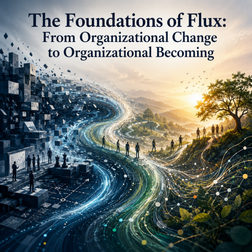
The Foundations of Flux: From Organizational Change to Organizational Becoming
AI
Welcome to The Transformation Observatory Podcast. In this episode, we conduct a deep-dive review into a collection of seminal scholarly works that have served as the bedrock of organizational theory for decades. While these canonic articles were often written in principle unrelated to one another, they collectively form the theoretical foundations of how we perceive organizational transformation today. This podcast explores a fundamental shift in the management paradigm: moving away from viewing transformation as a finite, episodic effort and toward seeing it as a continuous continuum. Drawing on the core concepts found in your sources, we discuss: Organizational Becoming: We examine the radical perspective of Tsoukas and Chia, who argue that change is the normal condition of organizational life. Rather than seeing change as an exceptional event that happens to a stable organization, this view suggests that "organization" is merely a secondary pattern that emerges from an ever-present flux of human action. Episodic vs. Continuous Change: We break down Weick and Quinn’s essential distinction between episodic change (infrequent, intentional, and discontinuous) and continuous change (ongoing, evolving, and cumulative). The podcast highlights why modern leaders must shift their vocabulary from "change" to "changing" to remain attentive to the dynamic character of work. The Planned vs. Emergent Tension: We explore the research of Liebhart and Garcia-Lorenzo, which investigates the struggle decision-makers face when trying to find stability through planned methods while simultaneously needing the agility to leverage emergent, unpredictable change. The 70% Failure Rate: We address the sobering reality that 70% of organizational transformations fail. This episode analyzes why "one-size-fits-all" master models often collapse and why successful firms instead focus on building their own change architectures through rapid-cycle, results-focused experimentation. By the end of this episode, listeners will understand how these classic scholarly insights provide the lens through which we view transformation today—not as a destination to be reached, but as a perpetual state of becoming.
Digital Dexterity is a People Problem
AI
Welcome to The Transformation Observatory Podcast. In this deep dive, we explore why many digital transformations fail despite massive investments in technology: the "people problem". Drawing on extensive research from the Leadership Initiative at Harvard Business School, this episode examines how successful leaders are shifting their focus from digital literacy to digital dexterity—creating a workforce that is both willing and able to leverage tools like generative AI for innovation. The podcast details the four essential practices leaders must adopt to build this capability: Reframing the Challenge: Moving beyond a "technology-first" mindset to prioritize cultural transformation and new ways of working. Engaging From the Top: Why digital dexterity cannot be delegated and requires the C-suite to actively model tech-savviness and data-informed decision-making. Bridging People and Perspectives: The role of the leader as a "bridger" who uses empathy to navigate employee anxieties and translates priorities across organizational silos. Sustaining Long-Term Commitment: Recognizing that building a digitally dexterous workforce is a "marathon, not a sprint" that requires years of persistent effort and integration into talent strategy. Listeners will also learn about the five critical characteristics of a digitally agile organization: data-informed decision-making, cross-functional collaboration, customer focus, continuous learning, and comfort with change. Join us as we deconstruct traditional leadership to make room for the future of work.
The AI Transformation Manifesto: Twelve Themes for Rewired Companies
AI
Welcome back to The Transformation Observatory Podcast! After a refreshing vacation, we are back to continue our analysis of the most critical insights in business evolution. In this episode, we dive deep into the strategic framework required for companies to become truly "rewired" for the AI era. The discussion centers on the twelve themes that separate leaders from laggards, emphasizing that technology alone is not a competitive advantage; instead, the advantage lies in building enduring organizational capabilities to harness that technology. We explore how successful companies focus on their specific economic leverage points—such as process yield in mining or supply chain integration in automotive—to drive deep transformation. Key highlights of this deep dive include: Leadership and Talent: Why senior business leaders must be in the "driver's seat" of the tech agenda and how the "30–70 shifts" in talent density create high-performing, in-house engineering teams. Operational Speed: The necessity of increasing an organization's "metabolic rate" by embedding AI talent directly into business units and treating tech platforms as strategic assets. Execution at Scale: Strategies for making data easy to consume, designing for adoption, and navigating the emerging frontier of agentic engineering. The AI Antidote: A closing reflection on the human element of transformation, exploring how practices like meditation can help leaders maintain perspective and resilience in a rapidly changing workplace. Please note: The Transformation Observatory Podcast is not affiliated in any way with McKinsey & Company, and we are not promoting their services or products. This analysis is intended for educational and insight-sharing purposes.
Season 1
Always-On Transformation. Is it Just Another Buzzword?
AI
This episode explores the radical shift from episodic, time-bounded change programs to the modern imperative of continuous and "always-on" transformation. Drawing from a comprehensive knowledge base, the discussion moves beyond the traditional "unfreeze-transition-refreeze" model to examine organizations that treat change as a baseline operating condition rather than an interruption. Key themes include: The Intellectual Foundations: How academic streams like dynamic capabilities and organizational ambidexterity—the ability to simultaneously exploit current strengths while exploring new ones—now provide the essential scaffolding for modern corporate strategy. The "Always-On" Landscape: A breakdown of how major consultancies like McKinsey, BCG, Deloitte, and Accenture are reframing transformation as a permanent institutional capability, using concepts like "Total Enterprise Reinvention" and "Perpetual Upheaval". Technology as a Driver: An analysis of why Generative AI is no longer just a context for change but an active driver, creating a faster cadence that makes traditional, discrete programs obsolete before they are even completed. The Human Constraint: A critical look at change fatigue, noting that employee willingness to support organizational change collapsed from 74% in 2016 to just 43% in 2022. The discussion highlights the necessity of engineering for change-absorption capacity and human sustainability. Institutional Architecture: The transition from temporary project teams to the permanent Transformation Office as the primary engine for planning, governing, and sustaining a continuous portfolio of change. The conversation provides a necessary reality check on transformation success rates, which have remained stubbornly stable at approximately 30% for two decades, challenging leaders to invest in long-term capability over short-term content
The Paradox of Coordination in Organizational Transformation
AI
This episode explores the counterintuitive research of Adolfo M. Carreno, specifically his theories on Alignment Saturation and the Transformation Immunity Model. The discussion challenges the standard assumption that alignment and learning are always beneficial, revealing instead how sustained success can generate internal defenses that protect an organization's stability at the expense of its ability to renew. Listeners will discover the mechanics of Alignment Saturation, a system-level condition where coordination becomes so dense and self-reinforcing that it actually narrows the organization's capacity to reassess its direction. The episode breaks down the four reinforcing dimensions of this phenomenon—structural, strategic, interpretive, and operational—and explains why misalignment is actually a "downstream signal" of deeper saturation rather than the root cause of failure. The conversation further examines the Transformation Immunity Model, which explains how accumulated learning becomes sedimented across structural, cultural, cognitive, and behavioral layers. A central highlight is the concept of "autoimmune misclassification," a process where an organization's interpretive filters "learn too well," causing them to misidentify novel, disruptive signals as familiar variations that don't require fundamental change. Ultimately, this deep dive reframes resistance and volatility not as leadership deficits or execution failures, but as the paradoxical outcomes of organizational coherence that has become self-protective. It offers a new perspective on how high-performing organizations can restore interpretive openness to navigate environmental shifts that their existing systems were designed to filter out.
Special Episode - Leading Through Ungovernable Change
AI
This episode explores how to lead effectively in an era of “ungovernable change”—where disruption is no longer an occasional event but a continuous, stacked, and unpredictable reality. Drawing from expert insights on leadership and trust, the discussion provides a strategic roadmap for navigating today’s volatile landscape. Key topics covered include: The Adaptability Differentiator: Why simply being adaptable is no longer enough for senior-level advancement. The conversation breaks down the three essential pillars—Agility, Resilience, and Foresight—and explains how to demonstrate these qualities visibly in meetings, communications, and relationships. Creating "Certainty Bubbles": How to build and maintain stakeholder trust when the external world feels out of control. We examine how successful leaders become sources of predictability, certitude, and stability for their employees, customers, and suppliers by making concrete commitments and providing transparent information. Converting Fear into Focus: Practical tactics for managing the "three engines of fear"—AI saturation, policy volatility, and geopolitical fragmentation. Learn how to build policy intelligence systems and use "real options"—small, staged investments—to replace panicked reactions with structured strategic bets. Routinizing Change: Moving away from trying to build temporary enthusiasm for individual events toward developing permanent "change reflexes". The discussion highlights how to empower your team with the habitual skills and mindset needed to embrace ongoing transformation as a core capability rather than a threat. This episode is designed for leaders who want to stop "sprinting through the fog" and start building the coherence, courage, and vision required to thrive in uncertain times. If you would like me to generate this audio deep dive for you, please let me know! I can also create other artifacts like a tailored report or a quiz based on these leadership concepts.
From change fatigue to radical reinvention
AI
This episode explores the evolving landscape of organizational leadership as detailed in the article "Change Is Changing: How to Meet the Challenge of Radical Reinvention" by Aaron De Smet, Arne Gast, Erik Mandersloot, Richard Steele, and Carmen James. In a world where employees are increasingly exhausted by a fivefold increase in change initiatives over the last decade, traditional management tools are no longer sufficient. The conversation highlights five fundamental questions for leaders to navigate this radical reinvention, emphasizing the need for strategic clarity, ecosystem mapping, and organizational rewiring. Ultimately, the sources suggest that successful reinvention requires leaders to transition from traditional "command and control" styles to serving as stewards, coaches, and catalysts who lead with a rare combination of humanity and humility. I can also create a tailored report summarizing these leadership strategies or a quiz to test your knowledge of the four levels of change—would you like me to do that?
How the elite twelve percent transform
AI
In this episode, we explore the core insights from the article "Transformations That Work," authored by Michael Mankins and Patrick Litre, Partners at Bain & Company. While most large organizations have transformation programs underway, research shows that only 12% of these major change efforts produce lasting results. This discussion examines why so many ambitious initiatives settle for mediocrity and outlines the six critical practices that allow leading companies to defy the odds. Drawing on real-world examples from companies like Dell, Ford, and Adobe, we break down how successful leaders treat transformation as a continuous process, build it into the operating rhythm, and drive change from the middle out. You will also learn the importance of managing organizational energy as a scarce resource and securing substantial external capital to fuel breakthrough aspirations.
Six Pitfalls Of Operating Model Transformations
AI
This episode explores the McKinsey Quarterly article "How to Get Your Operating Model Transformation Back on Track," authored by Ákos Légrádi, Deepak Mahadevan, Olli Salo, and Tom Welchman. While over half of large companies have attempted to modernize their operating models through agile, digitization, or other "new ways of working," many find that the promised gains in speed, efficiency, and customer centricity remain elusive. This episode breaks down the six common pitfalls identified in the sources—such as failing to link goals to strategy or pursuing technology changes in a silo—that prevent organizations from achieving their full value potential. Listeners will learn how to move beyond "inspirational posters" to create a holistic system that transforms strategic potential into market-beating results.
1 of 2