
The Security Nexus Deep Dive

The Security Nexus Deep Dive

by The Security Nexus
Season 2
The Threshold Trap: Reading Russia's Hybrid Campaign Correctly
Europe is counting incidents. The number that actually matters is the one Moscow still hasn't crossed. https://www.thesecuritynexus.net
The Chekist Craft, Part VI: A Service Measures Its Success by the Other Side's Losses
The SVR's final volume covers détente through the Soviet collapse and its own 1991 rebirth — and reveals its own tell: an institution that judges its Cold War record by counting Aldrich Ames, Robert Hanssen, and the Walker family rather than by the state it was actually protecting. https://www.thesecuritynexus.net
The Chekist Craft, Part V: The Cold War Turns the Legends Into Liabilities
Volume V of the SVR's official history covers 1945–1965 as a story of institutional whiplash — four service reorganizations, a self-inflicted purge under Beria, and a run of marquee human assets whose Cold War careers ended the same way: betrayed from within, not out-spied from without. https://www.thesecuritynexus.net
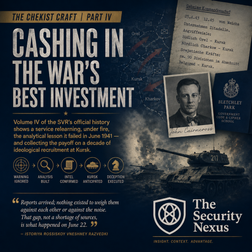
The Chekist Craft, Part IV: Cashing In the War's Best Investment
Volume IV of the SVR's official history shows a service relearning, under fire, the analytical lesson it failed in June 1941 — and collecting the payoff on a decade of ideological recruitment at Kursk. https://www.thesecuritynexus.net/
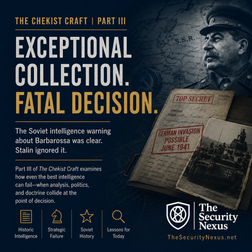
The Chekist Craft, Part III: What Moscow Knew Before Barbarossa: The SVR's own official history of 1933–1941 documents a service that recruited well, collected precisely, and still failed to stop the surprise it foresaw.
Volume III of Istoriya rossiyskoy vneshney razvedki, the SVR's official multivolume history, covers 1933 to 1941 — the years Soviet foreign intelligence built some of the most productive ideological networks in its history and then watched its own leadership discount the one report that mattered most. The volume's throughline is not collection failure. It is the gap between what a service knows and what a state does with the knowledge, and the 1,100-plus pages the SVR devoted to this period read as an unusually candid admission that the second problem, not the first, cost the Soviet Union its strategic surprise on June 22, 1941. This is the third installment in Security Nexus's series on Soviet intelligence tradecraft, following our reading of Volume I's institutional arc and Volume II's account of INO's founding and the deception operations of the 1920s (see our prior posts on the Chekist Craft). Volume III covers the recruitment methodology that produced the Cambridge Five and the "Red Orchestra" networks in Germany, the human cost the Great Terror inflicted on the service's own operational bench, and the documentary record — Moscow's own cables and marginalia — of the warnings that preceded the German invasion. https://www.thesecuritynexus.net/
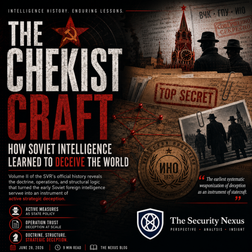
The Chekist Craft: How Soviet Intelligence Learned to Deceive the World
How Soviet intelligence transformed deception into statecraft. Explore the origins of active measures, Operation Trust, and the enduring doctrine behind modern Russian influence operations. https://www.thesecuritynexus.net/
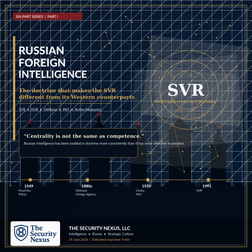
Why Russia Treats Intelligence as a Pillar of State, Not a Support Function
This is the first installment of a six-part series tracing the institutional and doctrinal history of Russian foreign intelligence, drawn from the Sluzhba Vneshney Razvedki's own commissioned history, Ocherki istorii rossiyskoy vneshney razvedki (Essays on the History of Russian Foreign Intelligence), edited by former SVR director and Foreign Minister Yevgeny Primakov. Each installment will pair the SVR's official narrative, read critically, against independent scholarship. This post covers Volume 1: the period from Muscovite Russia through the eve of the Bolshevik Revolution. https://www.thesecuritynexus.net/
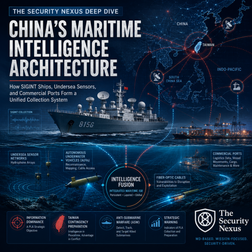
Eyes Beneath the Surface: China's Maritime Intelligence Architecture Deck
China's spy ships, undersea sensor networks & port data aren't parallel programs — they're one integrated collection system aimed at a Taiwan contingency. Western strategy needs to catch up. thesecuritynexus.net
The Watcher State: North Korea's Intelligence Architecture as a Survival Machine
Kim Jong-un's overlapping intelligence agencies are not redundant bureaucracies — they are a deliberately engineered system for preventing coups, disciplining elites, and bankrolling a sanctions-strangled regime. https://www.thesecuritynexus.net/
The Defector Dilemma: How Western Intelligence Mishandles Its Most Valuable Sources
Between paranoid skepticism and reckless credulity, Western agencies have repeatedly failed to extract full value from defectors—and the structural causes remain unreformed. https://www.thesecuritynexus.net
1 of 5