The Deep Dive

The Deep Dive

by FlyingFree

The Younger Dryas Impact Hypothesis

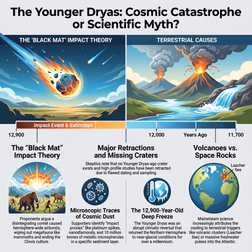
Exploring the Younger Dryas Impact Hypothesis, a controversial theory suggesting that a cometary collision or airburst approximately 12,900 years ago caused sudden global cooling, megafaunal extinctions, and the collapse of early human cultures. While proponents point to markers like magnetic microspherules, nanodiamonds, and platinum spikes as evidence of a cosmic event, the sources highlight a growing scientific consensus that refutes these claims. Critics argue that the physical evidence is often non-reproducible, misidentified, or better explained by terrestrial processes such as volcanic activity and standard wildfires. Geochronological data has further weakened the theory by showing that potential "smoking guns," like the Hiawatha Crater, actually date back millions of years rather than to the late Pleistocene. Furthermore, the academic credibility of the hypothesis has been severely damaged by high-profile retractions of foundational studies due to flawed methodologies and data manipulation. Consequently, most researchers now favor Earth-system mechanisms, such as shifting ocean currents or volcanic clusters, to explain the abrupt climatic shift.

Is String Theory Really Science?

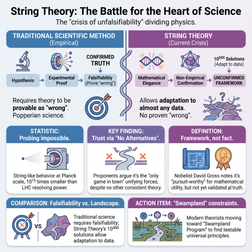
Addressing a modern methodological crisis in fundamental physics, where dominant frameworks like string theory and the multiverse hypothesis have become nearly impossible to test empirically. Critics argue that this departure from Popperian falsifiability—the principle that a theory must be capable of being proven wrong—threatens the integrity of the scientific method. In response, some scholars propose a post-empirical framework using Bayesian inference and non-empirical virtues, such as mathematical elegance and a lack of viable alternatives, to establish theoretical trust. However, skeptics contend that an overreliance on aesthetic beauty and institutional groupthink has led the field into a speculative "no-man's-land" detached from physical reality. Highlighting a historic 2015 meeting in Munich where physicists and philosophers debated whether science should evolve its definition of proof or return to a more foundational, experiment-driven approach. Ultimately, the collection examines the tension between the pursuit of a "theory of everything" and the traditional requirement that science remains grounded in observable evidence.

Overthrowing a Scientific Dogma: Clovis First

Examining the revolutionary impact of the Cactus Hill and Monte Verde archaeological sites on our understanding of human migration to the Americas. These locations offer compelling evidence of human activity dating back 14,500 to 20,000 years, directly challenging the long-held "Clovis First" theory that suggested a much later arrival via an ice-free inland corridor. Researchers such as Tom Dillehay and Michael Waters have utilized advanced radiocarbon dating and interdisciplinary studies to prove that early populations likely traveled along the Pacific or Atlantic coasts long before previously assumed. Beyond merely dating artifacts, exploring how these ancient groups transitioned from nomadic foragers into complex, settled societies with rich ceremonial traditions. Sites like Huaca Prieta in Peru and the Mapuche mounds in Chile illustrate the enduring social structures and cultural resilience of these indigenous populations over millennia. Ultimately, these records document a shift in the scientific community toward a more nuanced and ancient timeline for the peopling of the Western Hemisphere.
6 of 6