The Conservation Conversation (TCC)

The Conservation Conversation (TCC)

by Rumbidzai Takawira
Season 3

BIODIVERSITY BEYOND ALARMISM with Dr Stuart Pimm & Dr Tanyaradzwa Mundoga (A CBD COP17 Conversation)

ARE WE TELLING THE FULL STORY ABOUT BIODIVERSITY LOSS? Just days after the conclusion of CBD COP17 in Yerevan, Armenia, where the first global assessment confirmed that the world remains off track to meet the 2030 biodiversity targets, we take a step back from the negotiations, declarations and global commitments to ask a fundamental question: Biodiversity Beyond Alarmism: Are We Telling the Full Story About Nature’s Decline and Recovery? Rumbie Takawira speaks with Dr Tanyaradzwa Mundoga, Director of Wildlife and Forestry Resources in Zimbabwe’s Ministry of Environment, Climate and Wildlife and the country’s Focal Point to the Convention on Biological Diversity and Dr Stuart Pimm, Doris Duke Distinguished Professor of Conservation Ecology at Duke University, and one of the most influential figures in modern conservation biology Dr Pimm has spent decades studying species extinction, habitat loss and the science behind conservation. He challenges us to look beyond headlines and alarmism.

Professor Patience Gandiwa : BEYOND THE NUMBERS: Rethinking Conservation in Africa (From Global Commitments to Local Action )

The Conservation Conversation presents a CBD COP17 Series. “Nature won’t thrive on good intentions.” That was the sobering message from UN Secretary-General António Guterres as he launched the State of Biodiversity Action report on 15 October 2026 ahead of the 17th Conference of Parties to the Convention of Biological Diversity (CBD COP17). The report warns that the world is not on track to meet its 2030 biodiversity targets. So, we must ask: Are we truly protecting nature, or are we simply counting species and measuring hectares while communities continue to bear the costs of conservation? As CBD COP17 (Biodiversity) unfolds in Armenia and the world looks ahead to UNFCCC COP31 (Climate Change), Rumbidzai Takawira speaks to Professor Patience Gandiwa, (Chairperson of the African Group of Negotiators on Wildlife) about Africa’s conservation priorities, wildlife economics, community benefits and turning global commitments into meaningful action. Tune in. Let’s go Beyond the Numbers and rethink conservation in Africa. #TheConservationConversation #CBDCOP17 #COP31 #Biodiversity #AfricanConservation

THE OTHER SIDE OF COEXISTENCE: Human–wildlife conflict, community realities, research and the contradictions of conservation.
This week on The Conservation Conversation What does it really mean to live alongside wildlife? From crocodiles and hippos in Kariba to elephants, baboons and the daily realities of human–wildlife conflict, we’re going beyond the headlines to hear the stories of the people living on the frontline of conservation. Rumbie Takawira sits down with PHD Researcher, Yolanda Mutinhima, to unpack the realities of coexistence, the human cost of conflict, and how research can translate into action. Face to face with living with wildlife. The beauty, the danger, the contradictions, and the people behind the stories.

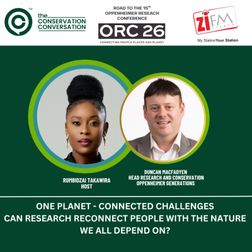
Road to the Oppenheimer Research Conference: CAN RESEARCH RECONNECT PEOPLE WITH THE NATURE WE ALL DEPEND ON?

This week on The Conservation Conversation… What happens when we become disconnected from the very nature we’re trying to protect? As Africa faces a rapidly changing climate, biodiversity loss, pressure on land and water, and growing demands for conservation that works for both people and planet, research has never mattered more. Tonight, as we count down to the 15th Oppenheimer Research Conference, we ask a bigger question: Can we conserve what we no longer feel connected to? Rumbi speaks to Duncan MacFadyen - Head Research and Conservation at Oppenheimer Generations- about people, nature, research, and the future of conservation.
Season 2

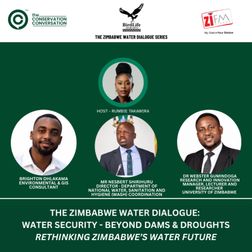
The Zimbabwe water dialogue: WATER SECURITY - BEYOND DAMS & DROUGHTS ‘Rethinking Zimbabwe’s Water Future’
As we geared up for the Zimbabwe Water Indaba in Bulawayo, we’re looking beyond today’s water challenges and asking: What does Zimbabwe’s water future really look like? From climate change and governance to infrastructure, technology and our shared river basins, are we prepared for what’s ahead? We rethink Zimbabwe’s water future with: MR NESBERT SHIRIHURU DIRECTOR DEPARTMENT OF NATIONAL WATER, SANITATION AND HYGIENE (WASH) COORDINATION DR WEBSTER GUMINDOGA- RESEARCH AND INNOVATION MANAGER, LECTURER AND RESEARCHER - UNIVERSITY OF ZIMBABWE BRIGHTON DHLAKAMA - ENVIRONMENTAL & GIS CONSULTANT

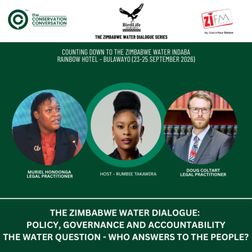
The Zimbabwe Water Dialogue: Policy, Governance and Accountability
THE WATER QUESTION: WHO ANSWERS TO THE PEOPLE? This week on The Conservation Conversation - Zimbabwe Water Dialogue, we put water, law, policy, governance and accountability under the spotlight. With legal practitioners, Muriel Hondonga and Doug Coltart, we ask the difficult questions: Are our laws strong enough? Are they being enforced? Who is responsible when water systems fail, resources are polluted, or communities are left without adequate access? And we’re counting down to the Zimbabwe Water Indaba, taking place 23–25 September in Bulawayo, bringing together experts and stakeholders to tackle water security, climate resilience, WASH, wastewater, water for livelihoods, governance and the water–food–energy nexus.

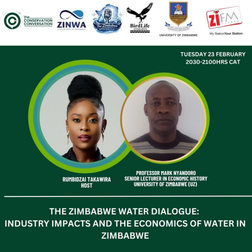
THE ZIMBABWE WATER DIALOGUE : Industry Impacts and the Economics of Water
Every industry, from mining to agriculture to manufacturing, depends on water, yet, many of the same industries pollute, over-abstract, or degrade the very water systems they rely on. This is not just an environmental issue, it is an economic one. Join host Rumbidzai Takawira as she speaks to Professor Mark Nyandoro, Senior Lecturer in Economic History at the University of Zimbabwe, specialising in water, climate, and development. His work connects water governance to economic growth, inequality, and long-term development , helping us understand how history continues to shape today’s industrial choices. We ask difficult but necessary questions: Can Zimbabwe industrialise without collapsing its water systems? And is pollution cheaper than compliance?

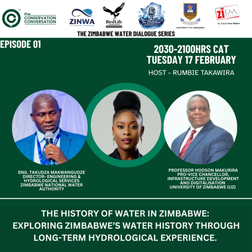
THE HISTORY OF WATER IN ZIMBABWE: EXPLORING ZIMBABWE'S WATER HISTORY THROUGH LONG-TERM HYDROLOGICAL EXPERIENCE.
Today on The Conservation Conversation (Tuesday 17 February 2026), we dive into the history and foundations of Zimbabwe’s water story in Episode 01 of the Zimbabwe Water Dialogue Series. Before we talk about shortages, pollution, or the future, we must understand where it all began. How was Zimbabwe’s water system designed?What did we inherit at independence? Was Zimbabwe ever truly water-scarce, or did management failures shape today’s crisis? Join Host Rumbie Takawira in conversation with: Eng. Takudza Makwangudze – Director, Engineering & Hydrological Services, Zimbabwe National Water Authority (ZINWA) And Professor Hodson Makurira - Pro Vice Chancellor, Infrastructure Development & Digitalisation, University of Zimbabwe

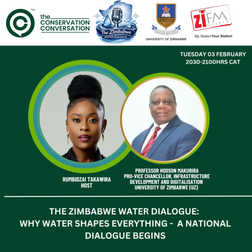
THE ZIMBABWE WATER DIALOGUE: WHY WATER SHAPES EVERYTHING - A NATIONAL DIALOGUE BEGINS

Bonus
This week on The Conservation Conversation We officially launch The Zimbabwe Water Dialogue, in partnership with the University of Zimbabwe. Rumbidzai Takawira sets the scene for a national conversation on water, why this dialogue matters, what it hopes to achieve, and how water touches every part of Zimbabwe’s future, from communities and industry to policy and climate resilience. 🎙️ Featuring Professor Hodson Makurira, Pro Vice Chancellor (Infrastructure Development & Digitalisation), University of Zimbabwe. Water is life. The conversation begins tonight. #WaterDialogue #ZimWaterDialogue #ZimWater #water #conservation
Season 1

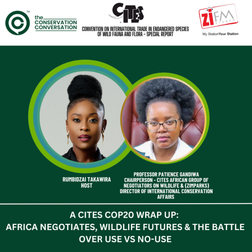
CITES CoP20 WRAP UP: Africa Negotiates, Wildlife Futures & The Battle Over Use vs No-Use

In this episode of The Conservation Conversation, (9 December 2025) Rumbidzai Takawira sits down with Professor Patience Gandiwa, Director of International Conservation Affairs at ZimParks, Chairperson of the African Group of Negotiators on Wildlife and Vice-Chair of CITES CoP20, for an unfiltered breakdown of everything that went down in Samarkand, Uzbekistan. From stockpile wars to Africa’s historic united front, from Namibia’s rejected ivory and rhino horn proposals to Zimbabwe’s breakthrough on value-added elephant products… this episode pulls back the curtain on the politics, science and power struggles that shaped the 50th anniversary of CITES. We unpack: • Consumptive vs non-consumptive conservation, the ideological battle dividing Africa • Why Proposal 14 is a game-changer for Zimbabwean youth and industry • What Africa achieved, and what still lies ahead in intersessional negotiations Featuring supporting voices from CITES SG Ivonne Higuero, Namibia (Horn Nam) and Senegal.
1 of 2