
Episode notes
Episode Focus
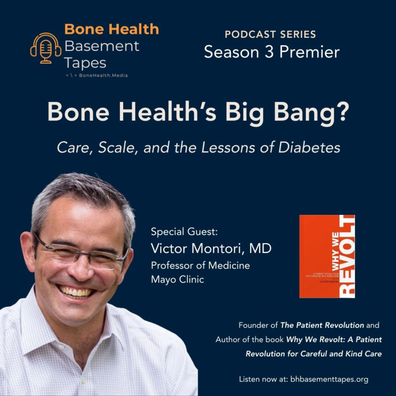
This season-opening episode examines whether bone health is approaching a “Big Bang” moment similar to diabetes 15 years ago—and, critically, how to ensure that the scaling of bone health care does not repeat the moral and practical mistakes that accompanied diabetes’ transformation.
The episode is anchored by a conversation with Victor Montori, MD, Professor of Medicine and endocrinologist the Mayo Clinic, author of Why We Revolt, and founder of the Patient Revolution, followed by a panel discussion with bone health clinicians.
Why This Conversation Matters Now
Diabetes care transformed rapidly once previously fragmented forces—screening, therapeutics, reimbursement, and technology—converged. That transformation improved outcomes, but it also introduced new burdens: over-reliance on metrics, protocol-driven care, administrative overload, and erosion of patient and clinician agency.
Bone health today shows many of the same pre-transformation conditions:
- A large, mostly undiagnosed at-risk population
- Fragmented ownership of care
- Reliance on single metrics (e.g., T-scores) to make complex decisions
- Growing technological capability without fully formed care models
- Increasing economic pressure from preventable fractures
This episode explores whether bone health is on the verge of a similar inflection point—and what lessons from diabetes must guide its evolution.
Core Conceptual Comparisons
- HbA1c <> T-score: Both are population-level summary metrics that became over-empowered as individual care decision-makers.
- CGM <> bone health monitoring: Diabetes advanced not by finding a better number, but by capturing lived, dynamic risk. Bone health has not yet had an equivalent “continuous risk” moment.
- Fragmented care ownership: Just as diabetes once belonged to “everyone and no one,” bone health risk today lacks clear longitudinal accountability.
- Undiagnosed disease burden: In both conditions, risk is widespread, silent, and often only recognized after harm occurs.
The Patient Revolution Lens
Dr. Montori’s work frames healthcare reform as a moral project, not merely a technical one. Key principles guiding the episode include:
- Care must fit into patients’ lives, not the reverse
- Metrics should inform conversation, not replace it
- Scale without humility risks industrializing fragility
- Clinician and patient burden are ethical concerns, not side effects
These principles serve as a safeguard as bone health care begins to scale.
Panelists:
Bryan Huber, MD, Orthopedic Surgeon
Dudley Phipps, PA-C, CEO/Executive Director, American Society of Osteoporosis Providers
Peter T. Bianco, MBA, Moderator, The Bone Health Basement Tapes