TechnoViews

TechnoViews

by Sci-Tech Asia International Research Network
Season 1

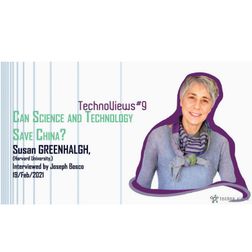
TechnoViews #9 'Can Science and Technology Save China?' | Susan Greenhalgh (Harvard University)

Susan GREENHALGH, interviewed by Joseph BOSCO on 19 February 2021. FEATURED AUTHOR Susan Greenhalgh is the John King and Wilma Cannon Fairbank Research Professor of Chinese Society in the Department of Anthropology at Harvard University, and the co-editor of the recently published volume, Can Science and Technology Save China? (Cornell University Press, 2020). Her two most recent books are Fat-Talk Nation: The Human Costs of America’s War on Fat (2017) and Cultivating Global Citizens: Population in the Rise of China (2010). In this podcast, she discusses how in China, “state-market-science/[and] technology are tangled tightly together to form a knot of governing logics, practices, and institutions.” She discusses China’s scientism, and why people continue to have faith in science even though it has not lived up to the promise. She explains what she means with the statement that “science is contextual,” and gives examples of how “Chinese science is distinctly Chinese.” She also has some interesting thoughts on the recent concern in the US press over the competition with China in science and technology. AUTHOR’S PERSONAL WEBSITE http://susan-greenhalgh.com/ BOOK'S OFFICIAL WEBPAGE https://www.cornellpress.cornell.edu/book/9781501747021/can-science-and-technology-save-china/

TechnoViews #8 'Anxious China: Inner Revolution and Politics of Psychotherapy' | Li ZHANG (University of California—Davis)

Li ZHANG, interviewed by Joseph BOSCO on February 5, 2021. FEATURED AUTHOR Li ZHANG is a professor in the Dept. of Anthropology at the University of California—Davis, and the author of the new book Anxious China: Inner Revolution and Politics of Psychotherapy (2020, University of California Press). Her two previous single-author books are Strangers in the City: Reconfigurations of Space, Power, and Social Networks within China's Floating Population (2001), and In Search of Paradise: Middle Class Living in a Chinese Metropolis (2010). She is also the co-editor of the recently published edited volume, Can Science and Technology Save China? (2020).This podcast discusses the rise of psychotherapy in Kunming, and how part of the appeal of psychotherapy in China is that it comes from the West and claims to be scientific, but the therapeutic techniques don’t always fit Chinese notions of personhood, sociability and efficacy in healing, so have to be adapted and localized. We also discuss the scientism and blind faith in science that makes psychotherapy such a popular fad in China today, though psychotherapy nevertheless appears to be helpful to clients. AUTHOR'S PERSONAL WEBSITE https://anthropology.ucdavis.edu/people/lizhang BOOK'S OFFICIAL WEBPAGE https://www.ucpress.edu/book/9780520344198/anxious-china

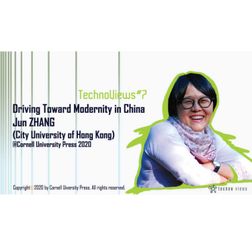
TechnoViews #7 'Driving Toward Modernity in China' | Jun ZHANG (City University of Hong Kong)

Jun Zhang (City University of Hong Kong), Interviewed by Cornell University Press in March 2020. FEATURED AUTHOR Jun Zhang is Assistant Professor of Asian and International Studies at City University of Hong Kong. This episode is about her new book Driving toward Modernity: Cars and the Lives of the Middle Class in Contemporary China. In the interview, Jun talks about what it is like to be the first person in your family to ever own a car, the massive increase of cars, and car owners, within China over the past two decades, and how the Chinese, particularly the middle class, have thrived as well as struggled with this unprecedented influx of new automobiles into the country. For more details on the book, please visit the Cornell Press website: www.cornellpress.cornell.edu/book/97815…bookTabs=1 AUTHOR'S PERSONAL WEBSITE https://cityu-hk.academia.edu/JunZhang Copyright ©️ 2020 by Cornell University Press. All rights reserved.

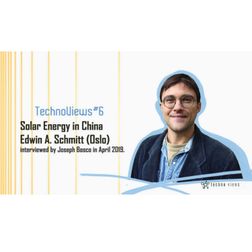
TechnoViews #6 'Solar Energy in China' | Edwin A. SCHMITT (Oslo University)

Edwin A. Schmitt (Olso University), Interviewed by Joseph Bosco in April 2019. FEATURED AUTHOR Edwin A. Schmitt is a postdoctoral fellow at the Department of Cultural Studies and Oriental Languages at the University of Oslo in Norway. He has a PhD in Anthropology from The Chinese University of Hong Kong, where he wrote a thesis on environmental consciousness, which included examining the issue of air pollution in Chengdu, China. He is currently a member of the interdisciplinary project – Airborne: Pollution, Climate Change, and Visions of Sustainability in China – at the University of Oslo. This team has collaborated with scholars at Tsinghua University, Zhejiang University, and Oregon State University to examine air pollution in China from multiple perspectives. Prof. Schmitt’s most recent research focuses primarily on the historical role of energy institutions in China and what that means for air pollution. Links to articles mentioned in the podcast: https://www.nature.com/articles/d41586-019-00629-5 https://oilprice.com/Alternative-Energy/Solar-Energy/Rumors-Of-Chinese-Subsidy-Cuts-Sends-Shockwaves-Through-Solar-Markets.html AUTHOR WEBSITE https://www.hf.uio.no/ikos/english/people/aca/chinese-studies/temporary/edwinsc/ CORRECTING NOTE FROM THE AUTHOR After the interview, Edwin realized he had made a mistake at minute 13:20. He said that coal-fired power plants produce 4 million GW of electricity for the grid, but the correct number should be about 930 GW. Please see the following website for details: https://www.iea.org/weo/china/

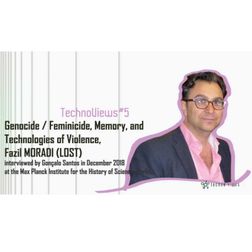
TechnoViews #5 'Genocide/Feminicide, Memory, and Technologies of Violence' | Fazil Moradi (LOST)

Fazil Moradi (LOST), Interviewed by Gonçalo Santos in December 2018 at the Max Planck Institute for the History of Science in Berlin. FEATURED AUTHOR Fazil Moradi is a postdoctoral researcher, member of the Law, Organization, Science and Technology (LOST) Research Network and an Associate at the Max Planck Institute for Social Anthropology. He received his PhD in Social Anthropology from the University of Halle-Wittenberg and the Max Planck Institute for Social Anthropology with a dissertation on the translations of al-Anfāl genocide in Kurdistan-Iraq. His ethnographic inquiries are located in the Middle East, Africa and Europe, covering modernity’s infrastructures of violence – genocide-feminicide, effects of chemical weapons, ecological harm, global drones –, technoscience of evidence & testimony, aesthetics of violence, translation and hospitality. He teaches at the University of Halle-Wittenberg and is completing a monograph entitled, Hosting Genocide-Feminicide: On the Living On of the Un Translatable in Kurdistan, Iraq. AUTHOR'S PERSONAL WEBSITE https://lost-research-group.org/staff/fazil-moradi/ RECENT PUBLICATIONS Moradi, Fazil and Richard Rottenburg. (2019). “Introduction: Evidence – On the Translatability of Modernity’s Violence.” Critical Studies (Special Issue, “Evidence: On the Translatability of Modernity’s Violence.” Edited by F. Moradi and R. Rottenburg). Moradi, Fazil (2019). “Un Translatable Death, Evidentiary Bodies: After – Auschwitz and Murambi – in Translation.” Critical Studies. Moradi, Fazil (2018) “Love and Feminicide in Kurdistan,” tr. into Sorani Kurdish by Nabz Samad, Culture Magazine 3: 21-27. Moradi, Fazil (2017) “Genocide in Translation: On Memory, Justice, and Future Remembrance.” in Memory and Genocide: On What Remains and the Possibility of Representation , edited by F. Moradi, R. Buchenhorst, and M. Six-Hohenbalken. London and New York: Routledge. Moradi, Fazil (2016). “The Force of Writing in Genocide: On Sexual Violence in the al-Anfāl Operations and Beyond,” In Gender Violence in Peace and War: States of Complicity. Edited by V. Sanford et al. New Brunswick, NJ and London: Rutgers University Press, pp.102-115.
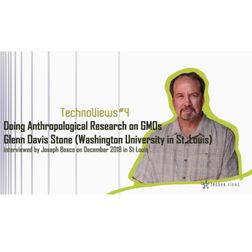
TechnoViews #4 'Doing Anthropological Research on GMOs' | Glenn Stone (Washington University)

Glenn Davis Stone (Washington University), Interviewed by Joseph Bosco in December 2018, St. Louis, Missouri. FEATURED AUTHOR Glenn Davis Stone is a Professor of Anthropology and Environmental Studies at Washington University in St Louis. Professor Stone’s research focuses on environmental anthropology, political ecology, food studies and science & technology studies. He has conducted fieldwork among nonindustrial farmers in West Africa, India, the Philippines and North America, and he has been researching and writing on Genetically Modified crops since 2002, and was the author of a major review article on The Anthropology of Genetically Modified Crops” in the Annual Review of Anthropology in 2010. In this podcast, Prof. Stone discusses how he came to research GMOs, why he opposes both the praising and condemning of GM crops, why he thinks GMOs are so polarizing, and what he thinks anthropologists can contribute to the debates about GMOs. He also explains why he has done research on “heirloom rice” among the Ifugao in the Philippines. At the end of the podcast, Dr. Stone discusses the controversy over the use of CRISPR technology on humans. AUTHOR'S PERSONAL WEBSITE https://pages.wustl.edu/stone SELECTED PUBLICATIONS Agriculture as Spectacle. (Journal of Political Ecology, 2018) Farmer Knowledge Across the Commodification Spectrum. (Journal of Agrarian Change; with A. Flachs, 2018) Dreading CRISPR: GMO’s, Honest Brokers, and Mertonian Transgressions. (Geographical Review, 2017) The Ox Fall Down: Path Breaking and Technology Treadmills in Indian Cotton Agriculture. (Journal of Peasant Studies; with A. Flachs, 2017) Heirloom Rice in Ifugao: An Anti-commodity in the Process of Commodification (Journal of Peasant Studies; with D. Glover, 2017) Towards a General Theory of Agricultural Knowledge Production: Environmental, Social and Didactic Learning (Culture, Agriculture, Food and Environment, 2016) Disembedding Grain: Golden Rice, the Green Revolution, and Heirloom Seeds in the Philippines (Agriculture & Human Values; with D. Glover, 2016) CRISPR and the Monsanto problem (Fieldquestions, 2016) Biotechnology, Schismogenesis, and the Demise of Uncertainty (Journal of Law & Policy, 2015) The FoxNewsization of GMO’s (EnviroSociety, 2015) Biosecurity in the Age of Genetic Engineering (Bioinsecurity and Human Vulnerability, 2014) Trials of Genetically Modified Food (Food Culture & Society; with C. Kudlu, 2013) GM Crops: From St Louis to India (Anthropology News, 2012) Contradictions in the Last Mile: Suicide, Culture & E-Agriculture (Science, Technology & Human Values, 2011) Anthropology of Genetically Modified Crops (Annual Review of Anthropology, 2010)

TechnoViews #3 'Environmental Crisis in China' | Stevan Harrell (University of Washington)

Stevan Harrell (University of Washington), Interviewed by Gonçalo Santos in June 2018, Whatcom County, WA. FEATURED AUTHOR Stevan Harrell is Professor Emeritus of Anthropology at the University of Washington. Steve is one of the most well known anthropologists of China. He has been doing empirical research in China and Taiwan for more than four decades. He has published a large number of books and journal articles on diverse topics such as family, kinship, fertility, aging, and gender, as well as religion and ethnicity. In the late 1980s and 1990s, Steve started doing fieldwork with ethnic minority communities in Sichuan province. Work in Liangshan, Sichuan, led Steve to develop a strong interest in environmental sustainability and community development. He is currently writing a new book on the history of modern and contemporary china from an ecological perspective. In this podcast, Steve shares his insights on China’s environmental crisis, its historical roots, as well as some of the future challenges faced by the country in the age of the Anthropocene. AUTHOR’S PERSONAL WEBSITE http://faculty.washington.edu/stevehar/index.html SELECTED PUBLICATIONS Greening East Asia. The Rise of the Eco-developmental State (University of Washington Press, 2020, co-edited with Ashley Esarey, Mary Alice Haddad, and Joanna I. Lewis) Transforming Patriarchy. Chinese Families in the 21st Century (University of Washington Press, 2017, co-edited with Gonçalo Santos) Ways of Being Ethnic in Southwest China (University of Washington Press, 2001) Human Families (Westview Press, 1997) Chinese Historical Micro-Demography (University of California Press, 1996) Cultural Encounters on China’s Ethnic Frontiers (University of Washington Press, 1995) Chinese Families in the Post-Mao Era (University of California Press, 1993) Ploughshare Village. Culture and Context in Taiwan (University of Washington Press, 1982)

TechnoViews #2 'The Crafting of the 10.000 Things. Shifting Frameworks of Knowledge and Technology in Imperial China' | Dagmar Schäfer (MPI for the History of Science)

Dagmar Schäfer (Max Planck Institute for the History of Science), Interviewed by Gonçalo D. Santos on March 22, 2018, Hong Kong. FEATURED AUTHOR Dagmar Schäfer is the Director of Department III, Artifacts, Action, Knowledge at the Max Planck Institute for the History of Science in Berlin. She is Honorary Professor in History of Technology at Technische Universität, Berlin; Adjunct Professor at the Institute of Sinology, Freie Universität, Berlin; and Guest Professor at Tianjin University (2018–2021). She received her doctorate and habilitation from the University of Würzburg and has worked and studied at Zhejiang University, Peking University, National Tsing Hua University, the University of Pennsylvania, and the University of Manchester, among others. She was previously a Guest Professor at the School of History and Culture of Science, Shanghai Jiao Tong University. Dagmar Schäfer's interest is the history and sociology of technology of China, focusing on the paradigms configuring the discourse on technological development, past and present. She has published widely on the Premodern history of China (Song-Ming) and technology, materiality, the processes and structures that lead to varying knowledge systems, and the changing role of artifacts—texts, objects, and spaces—in the creation, diffusion, and use of scientific and technological knowledge. Her current research focus is the historical dynamics of concept formation, situations, and experiences of action through which actors have explored, handled and explained their physical, social, and individual worlds. Her monograph The Crafting of the 10,000 Things (University of Chicago Press, 2011) won the History of Science Society: Pfizer Award in 2012 and the Association for Asian Studies: Joseph Levenson Prize (Pre-1900) in 2013. Dagmar Schäfer was awarded the Gottfried Wilhelm Leibniz Prize 2020—the most prestigious research award in Germany, it is given to “exceptional scientists and academics for their outstanding achievements in the field of research.” FURTHER READING Schäfer, Dagmar. 2011. The Crafting of the 10,000 Things: Knowledge and Technology in Seventeenth-Century China. University of Chicago Press. AUTHOR WEBSITE https://www.mpiwg-berlin.mpg.de/users/dschaefer

TechnoViews #1 'The Craft of Anthropology. Doing Fieldwork with Artisans in Thailand and Greece in Times of Change' | Michael Herzfeld (Harvard)

Michael HERZFELD, interviewed by Gonçalo SANTOS on March 6, 2018, Hong Kong. FEATURED AUTHOR Michael Herzfeld is Ernest E. Monrad Research Professor of the Social Sciences in the Department of Anthropology at Harvard University. He is also the former and founding Director (2014-18) of the Thai Studies Program, Asia Center, Harvard University; Senior Advisor on Critical Heritage Studies to the International Institute for Asian Studies, Leiden, and Visiting Professor at Leiden University. He is also Chiang Jang Scholar and Visiting Professor at Shanghai International University, and Honorary Professorial Fellow in the Faculty of Arts, Melbourne University. His research interests cover social theory, history of anthropology, social poetics, knowledge politics, politics of history and heritage, crypto-colonialism, artisanship, and the practice of comparison, and is ethnographically focused on Europe (especially Greece & Italy) and Southeast Asia (specifically Thailand). He is the author of eleven books (most recently Siege of the Spirits: Community and Polity in Bangkok, 2016) and Cultural Intimacy: Social Poetics and the Real Life of States, Institutions, and Societies, 2016), and is the producer of two films about Rome and currently working on two films about Bangkok. Herzfeld was Lewis Henry Morgan Lecturer for 2018 with a topic focusing on “subversive archaism” in Greece and Thailand; the book version will appear in 2021 as Subversive Archaism: Troubling Traditionalists and the Politics of National Heritage (Duke University Press). A former editor of American Ethnologist, editor at large (responsible for “Polyglot Perspectives”) for Anthropological Quarterly, co-editor of the “New Anthropologies of Europe: Perspectives and Provocations” series at Berghahn Books and of the IIAS Asian Heritages series at Amsterdam University Press, he holds honorary degrees from the Université Libre de Bruxelles, the University of Macedonia (Thessaloniki), and the University of Crete, and is a past winner of the J.I. Staley Prize, the J.B. Donne Prize in the Anthropology of Art, and the Rivers Memorial Medal. FURTHER READING Herzfeld, Michael. 2004. The Body Impolitic: Artisans and Artifice in the Global Hierarchy of Value. University of Chicago Press. Herzfeld, Michael. 2016. Siege of the Spirits: Community and Polity in Bangkok. University of Chicago Press. AUTHOR WEBSITE https://anthropology.fas.harvard.edu/people/michael-herzfeld
2 of 2