The STEM Lab

The STEM Lab

by The Stem Lab

Children's STEM Toys: Complete Skill-Building Guide for Future Engineers and Scientists
AI
Every STEM toy purchase is a bet on your child's future—but most products marketed as educational dead-end after twenty minutes of guided play. This episode breaks down what separates genuine skill-building tools from flashy edutainment, walking you through the layered learning architecture that develops real technical competencies. Whether you're choosing a first coding robot for a preschooler or an Arduino kit for a ten-year-old, you'll learn exactly what to look for and what to avoid. Real STEM toys offer progressive complexity, technical transparency, and open-ended application—if you can't see how the mechanism works, modify it, and expand it as skills develop, it's edutainment, not education. Effective learning happens in layers: tactile manipulation first, then conceptual pattern recognition, then generalized problem-solving—skipping the physical experimentation stage undermines a child's ability to abstract those relationships into code later. Screen-free coding tools like physical command tiles force children to plan entire sequences before execution, building more durable cognitive skills than jumping straight to screen-based block coding. The Arduino platform isn't just a toy with a shelf life—it's the same microcontroller used in university engineering programs and commercial prototyping, offering infinite expandability from blinking LEDs to building weather stations with multiple sensors. Solar and wind energy kits teach energy conversion, storage, and load calculation—skills directly applicable to future climate solutions work and real-world engineering careers. When evaluating any STEM toy, look for concrete skill milestones: a five-year-old mastering sequential instruction logic with a coding robot is learning prerequisites for every programming language they'll encounter later. Read the full article: https://stemlabguide.com/children-s-stem-toys

How to Teach Python and Block Coding Using LEGO Robotics Platforms

AI
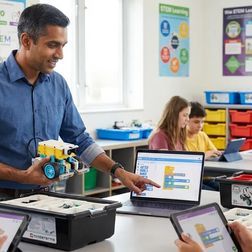
How to Teach Python and Block Coding Using LEGO Robotics Platforms LEGO programming education delivers measurable skill progression from visual block coding to production Python—the same language running enterprise automation workflows. This guide establishes a structured curriculum using LEGO Education platforms that transitions learners from icon-based programming at age 7 to industry-standard text-based development by age 12. You'll implement a three-tier progression (WeDo 2.0 → SPIKE Prime → MINDSTORMS Robot Inventor) that maps directly to professional software development milestones while maintaining the tactile feedback and immediate debugging visibility that makes LEGO robotics superior to screen-only coding platforms. Skill level: Parent or educator with basic computer literacy. No prior programming experience required. Time commitment: 12-18 months for complete progression; individual lessons run 45-90 minutes. Measurable outcomes: Block-based logic structures (6-8 weeks), Scratch-equivalent programming (12-16 weeks), Python syntax and OOP fundamentals (24-32 weeks). What You'll Need Hardware platforms (progressive sequence): - LEGO Education WeDo 2.0 (ages 7-9): Blu…

LEGO STEM Lab Setup Checklist: Software, Space, Expansion Packs & Consumables

AI
Most families who invest in LEGO robotics kits hit a wall after just a few projects — not because kids lose interest, but because the setup itself falls apart. Software won't install, the workspace is too small for testing, expensive expansion packs create clutter, and hidden costs drain budgets. This episode walks through a complete infrastructure checklist covering software compatibility, physical space requirements, expansion timing, and long-term consumable costs so your LEGO STEM lab actually works from day one. Different LEGO platforms speak different languages and don't mix well. SPIKE Prime, Mindstorms, Boost, and WeDo each use their own software and programming styles. Buying one doesn't mean your parts or skills transfer to another — it's like assuming your Xbox games will work on a PlayStation. Check your device compatibility before opening the box. Each platform needs specific operating systems and app versions to function. SPIKE Prime works on tablets, computers, and Chromebooks, while Boost only works on tablets. Getting this wrong means frustration before your kid writes a single line of code. You need more physical space than you think. A workspace roughly the size of a large desk is the minimum for building, coding, and letting robots actually move around. Think of it like needing room to spread out a big puzzle and still have space to see what you built in action. Plan your power setup like a charging station. Between rechargeable batteries, USB cables, and device chargers, you'll want a surge-protected power strip nearby. Budget around ten dollars monthly for quality rechargeable batteries if your platform runs on AAs. Parts multiply fast, so organize from the start. A single SPIKE Prime kit has over 500 pieces, and that number grows quickly with expansions. Using labeled transparent drawers — like a tackle box for LEGO — keeps everything findable and prevents the chaos that makes kids quit. Show Links Affiliate Disclosure: As an Amazon Associate I earn from qualifying purchases. Full article: https://stemlabguide.com/lego-stem-lab-setup-checklist-software-space-expansion-packs-consumables Related Articles How to Choose a Citizen Science Kit for Your Child's Skill Level - https://stemlabguide.com/how-to-choose-a-citizen-science-kit-for-your-child-s-skill-level STEM Toys for 10 Year Olds That Teach Real Skills: Skill-Building Guide - https://stemlabguide.com/stem-toys-for-10-year-olds-that-teach-real-skills Best 3D Printers for Kids and Teens: Complete Buyer's Guide for Educational STEM Learning - https://stemlabguide.com/best-3d-printers-for-kids-and-teens Best Robotics Kits for Kids: Complete Guide to Building Real Engineering Skills - https://stemlabguide.com/best-robotics-kits-for-kids How to Build Your First Machine Learning Model with Kids: Step-by-Step Guide - https://stemlabguide.com/how-to-build-your-first-machine-learning-model-with-kids

What Skills Do LEGO STEM Programs Actually Teach? Capability Milestones Explained
AI
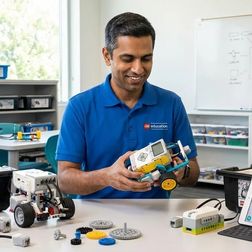
Most parents watching their kid's LEGO robot roll across the living room floor have no clue what's actually being learned. Is it real engineering skill or just expensive playtime? This episode breaks down the specific, measurable abilities kids develop through LEGO STEM platforms like WeDo 2.0, SPIKE Prime, and MINDSTORMS. Whether you're a parent evaluating programs or an educator designing curriculum, you'll finally understand what capability milestones to look for at each age level. LEGO STEM programs teach real engineering concepts through physical failure. When a robot tips over during a turn, kids learn about center of gravity the hard way. This hands-on trial and error builds understanding that sticks better than reading about it in a textbook. The programming progression mirrors how professionals actually learn to code. Kids start with simple picture-based commands around age 6, move to drag-and-drop blocks by age 10, and graduate to real Python programming in their teens. Each step adds complexity like stacking building blocks. Physical feedback speeds up problem-solving skills faster than screen-only coding. When your code says move 50 centimeters but the robot only goes 30, you can see the mistake immediately. It's like learning to cook by tasting your food instead of just reading recipes. Kids learn to deal with real-world messiness that professional engineers face daily. Motors have limits, sensors pick up interference, and there's always a tiny delay between giving a command and seeing it happen. These frustrations teach patience and troubleshooting that transfer to real jobs. The mechanical building skills translate directly to professional engineering work. Understanding gear ratios, structural bracing, and load distribution through LEGO bricks creates mental models that engineers use when designing everything from factory robots to spacecraft. It's learning the grammar before writing the novel. Show Links Affiliate Disclosure: As an Amazon Associate I earn from qualifying purchases. Full article: https://stemlabguide.com/what-skills-do-lego-stem-programs-actually-teach-capability-milestones-explained LEGO Education SPIKE Prime Set - https://www.amazon.com/s?k=LEGO%20Education%20SPIKE%20Prime%20Set&tag=stemlab-20 Related Articles How to Choose a Citizen Science Kit for Your Child's Skill Level - https://stemlabguide.com/how-to-choose-a-citizen-science-kit-for-your-child-s-skill-level STEM Toys for 10 Year Olds That Teach Real Skills: Skill-Building Guide - https://stemlabguide.com/stem-toys-for-10-year-olds-that-teach-real-skills Best 3D Printers for Kids and Teens: Complete Buyer's Guide for Educational STEM Learning - https://stemlabguide.com/best-3d-printers-for-kids-and-teens Best Robotics Kits for Kids: Complete Guide to Building Real Engineering Skills - https://stemlabguide.com/best-robotics-kits-for-kids How to Build Your First Machine Learning Model with Kids: Step-by-Step Guide - https://stemlabguide.com/how-to-build-your-first-machine-learning-model-with-kids

Top LEGO Robotics Kits for Progressive STEM Learning: EV3, SPIKE Prime & WeDo Breakdown
AI
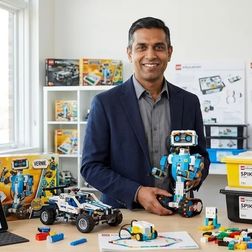
Top LEGO Robotics Kits for Progressive STEM Learning: EV3, SPIKE Prime & WeDo Breakdown LEGO robotics kits represent the most widely deployed educational platform for transitioning children from block-based play to industry-relevant programming and mechanical engineering concepts. This analysis evaluates eight current-generation platforms based on skill progression alignment, software compatibility, hardware expandability, and career-preparation value—not entertainment factor. LEGO Education SPIKE Prime Set The delivers the most complete middle-school robotics curriculum in LEGO's current lineup. This 528-piece system combines Scratch-based block programming with Python text coding through the same SPIKE App interface, creating a genuine bridge between visual and production-level languages. Lab Specs: Rechargeable Hub with six I/O ports, Bluetooth 4.2 connectivity, 25-hour battery life. Runs on Windows 10+, macOS 10.14+, ChromeOS, iOS 10+, Android 5+, and Amazon Fire tablets. Fully offline-capable after initial app download—no cloud dependency for core functions. Skill Progression: Designed for ages 11-14, but the actual capability range extends from basic sensor logic (achie…

LEGO Education vs. LEGO Technic vs. LEGO Boost: STEM Learning Platform Comparison
AI
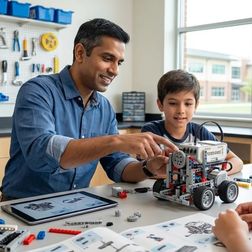
Parents often spend big money on LEGO robotics kits hoping their children will learn valuable coding skills, only to watch interest fade after a few weeks of building preset models. This episode breaks down three popular LEGO STEM platforms—SPIKE Prime, Technic, and Boost—to help families understand which one actually teaches skills that matter for future careers. Rajiv Patel draws on 15 years of hardware and software experience to explain what each platform does well, where it falls short, and which type of learner benefits most from each option. LEGO Education SPIKE Prime teaches real programming that transfers to jobs. It starts with drag-and-drop coding blocks, then moves to Python—the same coding language used in actual workplaces. Think of it like learning to ride a bike with training wheels before taking them off. LEGO Technic builds engineering thinking without any electronics at all. Kids learn how gears, levers, and mechanical parts work together, which helps them understand why things break and how to fix them—skills that even experienced engineers say make them better at their jobs. LEGO Boost is a dead-end platform for serious learning. While it introduces basic coding concepts for younger kids, it stops before teaching the building blocks needed to move to real programming. It's like learning to count but never getting to multiplication. The programming language matters more than the toy. SPIKE Prime uses MicroPython, which is the same code running in industrial machines and smart devices. When kids write programs for SPIKE, they're practicing the exact same logic they would use in college robotics classes. Subscription costs and internet requirements can make or break a platform's value. SPIKE Prime software is free with one-time hardware purchase and works offline. Boost requires internet access for updates and certain features, creating problems when WiFi is spotty or unavailable. Show Links Affiliate Disclosure: As an Amazon Associate I earn from qualifying purchases. Full article: https://stemlabguide.com/lego-education-vs-lego-technic-vs-lego-boost-stem-learning-platform-comparison LEGO Education SPIKE Prime Set - https://www.amazon.com/s?k=LEGO%20Education%20SPIKE%20Prime%20Set&tag=stemlab-20 LEGO Boost Creative Toolbox - https://www.amazon.com/s?k=LEGO%20Boost%20Creative%20Toolbox&tag=stemlab-20 Related Articles How to Choose a Citizen Science Kit for Your Child's Skill Level - https://stemlabguide.com/how-to-choose-a-citizen-science-kit-for-your-child-s-skill-level STEM Toys for 10 Year Olds That Teach Real Skills: Skill-Building Guide - https://stemlabguide.com/stem-toys-for-10-year-olds-that-teach-real-skills Best 3D Printers for Kids and Teens: Complete Buyer's Guide for Educational STEM Learning - https://stemlabguide.com/best-3d-printers-for-kids-and-teens Best Robotics Kits for Kids: Complete Guide to Building Real Engineering Skills - https://stemlabguide.com/best-robotics-kits-for-kids How to Build Your First Machine Learning Model with Kids: Step-by-Step Guide - https://stemlabguide.com/how-to-build-your-first-machine-learning-model-with-kids

Lego Stem Sets

AI
You've probably bought STEM toys that your kid built once and never touched again. This episode digs into why most educational building sets fail to develop real skills and which Lego products actually prepare kids for future engineering careers. Rajiv Patel breaks down the specific product lines worth investing in, what software features matter most, and how to avoid expensive toys that are basically just fancy puzzles. Three Lego lines actually build career-ready skills. Spike Prime, Mindstorms Robot Inventor, and certain Technic sets connect to coding platforms. Other Lego sets might be fun to build, but without software integration, they're like learning to drive using a toy car instead of the real thing. The best sets let kids graduate from easy coding to professional coding. Spike Prime uses simple drag-and-drop blocks that work like puzzle pieces, then lets kids switch to Python, the same coding language used in real jobs. It's like training wheels that actually come off. Check if the software works on your devices before buying. Spike Prime works on almost everything including Chromebooks and tablets, but older Mindstorms systems need outdated computers most families don't have anymore. Nothing's worse than opening a gift that won't run. Sets that make kids solve problems beat sets with perfect instructions. The best Lego STEM kits force kids to figure out how to make something work, not just follow pictures step by step. Building a custom robot arm teaches more than snapping together a pre-designed spaceship. Messy storage kills learning time. A full Spike Prime setup needs about as much sorted storage space as two shoe boxes. When pieces are jumbled together, kids waste almost half their building time just hunting for parts instead of actually learning. Show Links Affiliate Disclosure: As an Amazon Associate I earn from qualifying purchases. Full article: https://stemlabguide.com/lego-stem-sets LEGO Education Spike Prime Set - https://www.amazon.com/s?k=LEGO%20Education%20Spike%20Prime%20Set&tag=stemlab-20 LEGO Mindstorms Robot Inventor - https://www.amazon.com/s?k=LEGO%20Mindstorms%20Robot%20Inventor&tag=stemlab-20 LEGO Technic Liebherr R 9800 Excavator - https://www.amazon.com/s?k=LEGO%20Technic%20Liebherr%20R%209800%20Excavator&tag=stemlab-20 LEGO Education WeDo 2.0 Core Set - https://www.amazon.com/s?k=LEGO%20Education%20WeDo%202.0%20Core%20Set&tag=stemlab-20 LEGO Technic 4x4 Mercedes-Benz Zetros Trial Truck - https://www.amazon.com/s?k=LEGO%20Technic%204x4%20Mercedes-Benz%20Zetros%20Trial%20Truck&tag=stemlab-20 LEGO Technic Control+ App-Controlled Transformation Vehicle - https://www.amazon.com/s?k=LEGO%20Technic%20Control%2B%20App-Controlled%20Transformation%20Vehicle&tag=stemlab-20 Related Articles How to Choose a Citizen Science Kit for Your Child's Skill Level - https://stemlabguide.com/how-to-choose-a-citizen-science-kit-for-your-child-s-skill-level STEM Toys for 10 Year Olds That Teach Real Skills: Skill-Building Guide - https://stemlabguide.com/stem-toys-for-10-year-olds-that-teach-real-skills Best 3D Printers for Kids and Teens: Complete Buyer's Guide for Educational STEM Learning - https://stemlabguide.com/best-3d-printers-for-kids-and-teens Best Robotics Kits for Kids: Complete Guide to Building Real Engineering Skills - https://stemlabguide.com/best-robotics-kits-for-kids How to Build Your First Machine Learning Model with Kids: Step-by-Step Guide - https://stemlabguide.com/how-to-build-your-first-machine-learning-model-with-kids

How to Integrate LEGO STEM Kits Into a Progressive Engineering Curriculum
AI
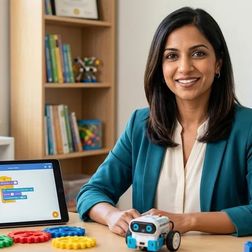
Most schools hand kids a bucket of LEGO bricks and call it engineering education, but there's a massive gap between playtime and actual skill development. In this episode, Rajiv Patel draws on fifteen years of enterprise hardware-software integration experience to reveal how LEGO platforms can teach real engineering competencies when structured correctly. If you're a parent, educator, or curriculum designer wondering how to transform colorful bricks into a legitimate pathway for CAD literacy, Python programming, and systems thinking, this episode lays out the complete eighteen to twenty-four month roadmap. LEGO STEM kits work best in a three-tier system organized by age. Think of it like learning to swim—you start in the shallow end with simple builds for ages six to nine, move to the middle depths with multiple sensors for ages ten to thirteen, and finally dive into real programming languages for ages fourteen and up. Mechanical fundamentals must come before coding. Students should spend their first eight to twelve weeks building gear trains and pulleys without any motors or sensors, like learning to ride a bike before adding training wheels backwards—you need to understand how the parts work together first. Measuring and documenting matters as much as building. Just like scientists keep lab notebooks, young engineers need to record their gear ratios and test results with stopwatches and rulers, proving their designs actually work the way they predicted. Sensor fusion is the bridge to professional robotics. Around ages ten to thirteen, students learn to combine multiple sensors—distance, force, and color—into one system, similar to how your phone uses its camera, microphone, and touchscreen together to do useful things. Python programming enters naturally after block-based coding. The SPIKE Prime platform lets students graduate from drag-and-drop coding blocks to writing real Python code, making the jump feel like moving from training wheels to a regular bike rather than starting over completely. Show Links Affiliate Disclosure: As an Amazon Associate I earn from qualifying purchases. Full article: https://stemlabguide.com/how-to-integrate-lego-stem-kits-into-a-progressive-engineering-curriculum LEGO Education SPIKE Prime Set - https://www.amazon.com/s?k=LEGO%20Education%20SPIKE%20Prime%20Set&tag=stemlab-20 LEGO MINDSTORMS Robot Inventor - https://www.amazon.com/s?k=LEGO%20MINDSTORMS%20Robot%20Inventor&tag=stemlab-20 Related Articles STEM Toys for 10 Year Olds That Teach Real Skills: Skill-Building Guide - https://stemlabguide.com/stem-toys-for-10-year-olds-that-teach-real-skills How to Choose a Citizen Science Kit for Your Child's Skill Level - https://stemlabguide.com/how-to-choose-a-citizen-science-kit-for-your-child-s-skill-level Best 3D Printers for Kids and Teens: Complete Buyer's Guide for Educational STEM Learning - https://stemlabguide.com/best-3d-printers-for-kids-and-teens Best Robotics Kits for Kids: Complete Guide to Building Real Engineering Skills - https://stemlabguide.com/best-robotics-kits-for-kids How to Build Your First Machine Learning Model with Kids: Step-by-Step Guide - https://stemlabguide.com/how-to-build-your-first-machine-learning-model-with-kids

Understanding Skill Milestones: What 10 Year Olds Can Master in STEM

AI
If you've ever wondered whether your 10-year-old is where they should be in STEM—or what "where they should be" even means—this episode breaks it down with refreshing clarity. Host Lakshmi Venkataraman, a National Board Certified science educator, moves past vague notions of "exposure" to outline the concrete, measurable skills kids this age can actually master. Whether you're evaluating a coding kit, choosing a robotics program, or just trying to understand your child's readiness for harder challenges, this conversation gives you the specific benchmarks to look for. STEM skill milestones for 10-year-olds aren't arbitrary—they're grounded in cognitive development research, Next Generation Science Standards, and observable competencies from hundreds of real students. At this age, children develop "formal operational thinking," meaning they can juggle multiple variables, follow multi-step cause-and-effect chains, and reason hypothetically about outcomes they haven't witnessed. The four core milestone areas are computational thinking, engineering design practices, quantitative reasoning, and scientific modeling—each with specific, observable benchmarks parents can actually assess. In coding, the milestone isn't just using block-based tools but achieving "syntax awareness"—debugging 40-50 line programs, explaining what loops and conditionals do, and beginning to recognize text-based code structures like Python. Engineering milestones shift from following instructions to constraint-based problem-solving: kids should identify how design variables affect performance, test iteratively, and articulate trade-offs between competing goals. The critical leap in scientific thinking is mechanistic explanation—moving from describing what happens to explaining why through underlying mechanisms, controlling variables, and distinguishing correlation from causation. Read the full article: https://stemlabguide.com/understanding-skill-milestones

How to Choose STEM Toys That Build Career-Ready Skills

AI
Parents pour hundreds of dollars into products labeled "STEM" only to watch their kids lose interest without gaining a single employable skill. This episode delivers a proven framework for cutting through the marketing noise and identifying which toys actually build career-ready capabilities. Host Rajiv Patel draws on fifteen years of hiring experience to show you exactly how to evaluate STEM products based on technical compatibility, progressive skill development, and alignment with real job requirements. If you're tired of expensive plastic collecting dust in your garage, this systematic approach will transform how you make every future purchasing decision. Before buying any STEM product, reverse-engineer from professional toolchains—if a coding toy doesn't transition from block-based programming to text-based languages like Python within six to twelve months, it fails the employability test. Products teaching "coding" through narrative games without exposing actual syntax, logic structures, or debugging tools are entertainment purchases, not skill development investments. Career-ready skills require progressive learning architecture with documented paths connecting foundational concepts (sensors, conditional logic, variables) to advanced applications like hardware-software integration. Vendor lock-in and proprietary languages with zero external application teach the wrong lessons about real-world engineering, which demands tool interoperability across platforms. Prepare for evaluation by auditing your child's current skill level, documenting your household's technical infrastructure, and referencing actual entry-level job postings rather than marketing materials. Systems like VEX Robotics V5 demonstrate ideal progressive architecture, supporting learners from age ten through high school without requiring platform abandonment and skill restarts. Read the full article: https://stemlabguide.com/how-to-choose-stem-toys-that-build-career-ready-skills
7 of 15