Signal, Noise & Nonsense

Signal, Noise & Nonsense

by Kristen Hansen
Season 1

Minisode 7.5 - Kristen's Causal Inference Workshop

Bonus
Wading past the shallow waters of simple correlation and straight into the statistical deep end. If your workflow relies on a naive linear regression, you aren't doing causal inference—you're just admiring your own residual error. In this 15-minute technical workshop, we break down the Neyman-Rubin counterfactual framework, unpack how standardization and G-computation simulate a randomized trial, and explore how inverse probability weighting (IPW) uses propensity scores to sever backdoor confounding paths. Essential listening for anyone trying to extract real causal signal from messy observational data.

Why Are We Treating the Shadow Instead of the Patient?

Why do lifestyle headlines and blockbuster drugs keep celebrating chemical wins while patients get worse? In this episode of Signal, Noise & Nonsense, we expose The Proxy Illusion and the dangerous Surrogate Endpoint Fallacy. We break down the biostatistical nitty-gritty of Directed Acyclic Graphs (DAGs) and model misspecification, then put two major medical disasters on the autopsy table: the 1980s CAST trial (where drugs successfully eliminated surrogate heart rhythms while increasing mortality by 2.5 times) and the misleading shadow metrics of oncology and biomarker research. Tune in as we teach you how to spot a proxy scam, prove why treating the smoke detector doesn't put out the fire, and show you why nature doesn't hand out cheat codes disguised as biomarkers.

Why are we drawing vertical cliffs in a Continuous World

Human biology doesn't operate like a light switch—it’s a dynamic, continuous gradient. Yet clinical medicine, epidemiology, and health tech are obsessed with drawing arbitrary lines across living tissue to divide us into neat, binary categories: Sick vs. Healthy, Normal vs. Hypertensive, High-Risk vs. Low-Risk. In this episode, we step away from playful research anomalies and confront the structural, architectural flaws in how modern medicine models the world. We inspect the crime scene of the cliff effect—the statistical violence committed when rich, continuous biological data is chopped into primitive binary buckets for the sake of software dashboards and clinical convenience.
Does Mozart Make your Baby Einstein?

Can playing a classical sonata to a newborn instantly boost their brainpower and turn them into a genius? In 1993, a modest study on 36 college students got completely mangled by the media, sparking a multi-million-dollar industry of baby headphones, interactive CDs, and panicking parents desperate to outsource their toddler's education. In this episode, we unpack the rise and fall of the Mozart effect. We break down how a temporary, fifteen-minute spatial task bump in college students got transformed into an infant miracle myth, examine the core statistical and methodological limits of small-sample psychology, and look at the real data behind human cognitive development.

Is Drinking Red Wine Equivalent to the Gym?

Drinking red wine is just like going to the gym, or so the internet claimed back in 2012. We look at the actual rodent research behind the headlines, the dose mismatch that makes the human equivalent impossible, and how university press offices mangle science for a viral moment.

Does Posing Like Wonder Woman Make You Super?

In 2012, a viral TED Talk promised that standing like a superhero for just two minutes would alter your hormones, boost risk tolerance, and turn you into an executive power player. The catch? The study behind it had a tiny sample of 42 undergraduates, a menu of post-hoc decisions, and an effect size that vanished the second independent researchers tried to replicate it. This week, we dive into the rise and dramatic fall of "Power Posing," unpacking p-hacking, researcher degrees of freedom, and how the Open Science movement brought down one of pop psychology’s biggest fads.

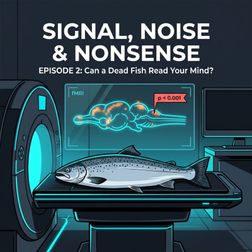
Can a Dead Fish Read Your Mind?

According to the uncorrected output of an fMRI scanner, a dead, ice-packed Atlantic salmon was actively reading human emotions. This week, we dive into Craig Bennett’s legendary 2009 Ig Nobel-winning study to explore how running 140,000 simultaneous statistical tests on pure thermal background noise can manufacture phantom brain activity out of thin air. We break down the Multiple Comparisons Problem, spatial autocorrelation, and why modern high-dimensional data analytics needs a lot more than a prayer to separate true signals from dead fish.

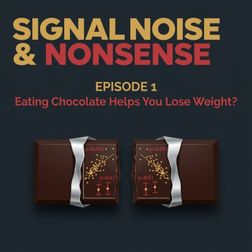
Eating Chocolate Helps You Lose Weight?

Can eating a bar of dark chocolate every day actually accelerate weight loss by 10%? In 2015, global news headlines proclaimed it as a breakthrough scientific fact. But behind the viral media storm was a deliberate honey-pot experiment designed by a scientist-turned-journalist to expose how easily health media and pay-to-play journals can be fooled by textbook statistical tricks. In this inaugural episode, we perform a complete autopsy on the "Chocolate Weight Loss Study," dissecting the subtle mathematical trap that guaranteed a "statistically significant" false positive before a single participant was even recruited.