Rooted Wisdom

Rooted Wisdom

by Beech Works
15. The Banneker-Douglass-Tubman Museum: Charity’s Annapolis
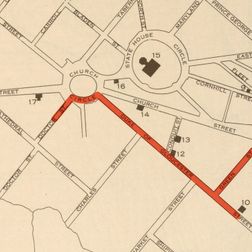
Everywhere you go in Annapolis is a piece of history, and all of that history is connected to the Black experience. Mecca and local historian Janice Hayse-Williams explore local Black history from the 1700s through today while tracing Charity Folks’ life and legacy through the streets of Annapolis. This is the last in a series of four episodes that explore the history and legacy of the Banneker-Douglass-Tubman Museum. The artwork for this episode features a detail from the Annapolis, Maryland, and Alexandria, Virginia, showing localities associated with George Washington map (page 45) from The George Washington Atlas, United States, George Washington Bicentennial Commission. Image courtesy David Rumsey Map Collection, David Rumsey Map Center, Stanford Libraries. Episode Webpage Show Website
14. The Banneker-Douglass-Tubman Museum: Charity Folks, Life and Legacy
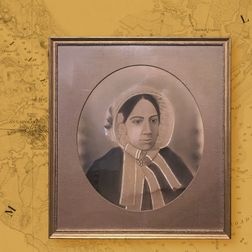
Charity Folks—born in Annapolis MD 1757, and enslaved until her manumission in 1797—went on to become one of the wealthiest free Black property owners in Annapolis. Upon her death she passed property on to her children that is now the site of the Banneker-Douglass-Tubman Museum. Tony visits with Belinda Moses, Folks’ seventh great-granddaughter to learn about her life and ongoing legacy. Note: The episode artwork features a portrait of Charity Folks Bishop, Charity Folks’ youngest daughter. This is the third in a series of four episodes that explore the history and legacy of the Banneker-Douglass-Tubman Museum. The artwork for this episode was created using images from multiple sources. Charity Folks Bishop portrait, image courtesy the Banneker-Douglass-Tubman Museum; The harbor of Annapolis (map), image courtesy Lionel Pincus and Princess Firyal Map Division, The New York Public Library. "The harbor of Annapolis" The New York Public Library Digital Collections. Transcript available on episode webpage. Episode Webpage Show Website
13. The Banneker-Douglass-Tubman Museum: She Speaks
Past, present, and future are intertwined at the Banneker-Douglass-Tubman Museum. The permanent exhibit, which is currently being reimagined, and their year-long art exhibits explore the Black experience in Maryland and beyond through both history and art. Mecca joins Leslie Rose, the museum’s exhibit manager for a look at one of Rose’s favorite sections from the permanent exhibit before exploring their current exhibition She Speaks: Black Women Artists and the Power of Historical Memory, which examines America’s 250 year history through the lens of Black Feminism. This is the second in a series of four episodes that explore the history and legacy of the Banneker-Douglass-Tubman Museum. The artwork for this episode features a detail from Martha Jackson Jarvis’ “Nightcrawlers Meets Daybreak I,” image courtesy of The Artist and Susan Inglett Gallery, NYC (via the Banneker-Douglass-Tubman Museum). Transcript available on episode webpage. Episode Webpage Show Website
12. The Banneker-Douglass-Tubman Museum: Love and Labor of Black Women
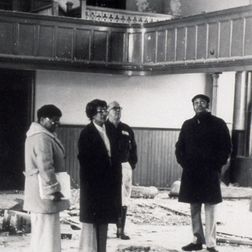
As the State of Maryland’s official museum of African American heritage, the Banneker-Douglass-Tubman museum comprises a wealth of both physical resources and documentation of African American life in Maryland. Tony visits with Chanel C. Johnson, executive director of the museum and Maryland Commission on African American History and Culture, to learn about the many lives that have had a hand in the shaping of the museum and its mission. This is the first in a series of four episodes that explore the history and legacy of the Banneker-Douglass-Tubman Museum. The artwork for this episode, photo of Maryland State Sentator Verda Freeman Welcome, Carroll Greene Jr., and planning team visiting Mt. Moriah A.M.E Church before renovations, ca. 1980. Photographer Unknown, was provided courtesy of the Banneker-Douglass-Tubman Museum. Transcript available on episode webpage. Episode Webpage Show Website
11. Anthony Cohen: 1996 Walk to Canada
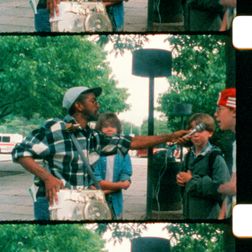
Pouring through the stacks and vertical files at the local historical society while doing research for his senior project at American University, Anthony Cohen “found” the Underground Railroad in Montgomery County. Runaway slave notices revealed escape routes, courthouse documents named accomplices, and slave narratives helped piece the stories together. His research led to the identification of over 30 points of interest in the county that related to the Underground Railroad, six routes of escape, and three safe houses—as well as an idea that would take him, on foot, from Sandy Spring, Md to Canada. This is the second in a series of two episodes that explore Cohen’s work, listen to Episode 10 | Button Farm: Hands-on History Experiment to learn more. Episode artwork courtesy The Menare Foundation. Transcript available on episode webpage. Episode Webpage Show Website

10. Button Farm: Hands-on History Experiment
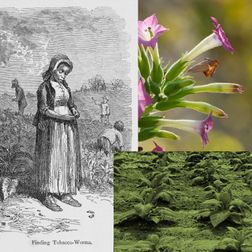
Off a wooded road in Germantown, Maryland sits Button Farm Living History Center. A project of The Menare Foundation, the 40 acre farm tucked inside of Seneca Creek State Park depicts 1850s plantation life and explores the legacy of slavery in Maryland. Mecca and Menare president, Anthony Cohen, explore the farm to learn more about what makes Button's programming so unique. This is the first in a series of two episodes that explore Cohen’s work, listen to: Episode 11 | Anthony Cohen: 1996 Walk to Canada to learn more. The artwork for this episode was created using images from multiple sources. Tobacco flowers, photograph courtesy Beech Works, Inc.; Woman finding tobacco-worms., image courtesy Schomburg Center for Research in Black Culture, Schomburg Center for Research in Black Culture, Jean Blackwell Hutson Research and Reference Division, The New York Public Library. Tobacco field, Marjory Collins, photographer., image courtesy Library of Congress Prints & Photographs Division, Library of Congress, LC-USF34-100365-D. Transcript available on episode webpage. Episode Webpage Show Website
9. The Harper Cabin: A Story of Continuity
Over the course of six weeks during the summer of 2025, the Rooted Wisdom team worked with a group of Montgomery County Public School students in the Summer RISE initiative. After listening to interviews about the Harper Cabin, the students visited the cabin with Tony to discuss the role of memory in our understanding of history. This is the fourth in a series of four episodes that explore the history of the Harper Cabin at Brookside Nature Center in Wheaton, MD. Transcript available on episode webpage. Episode Webpage Show Website
8. The Harper Cabin: The Harper Way
When Harper descendant, Faith Harper, steps through the threshold of the cabin that bears her family name—a structure that holds an important place in history—she sees “a home full of love.” Tony and Faith discuss what it means to be a Harper and the love that is the Harper Way. This is the third in a series of four episodes that explore the history of the Harper Cabin at Brookside Nature Center in Wheaton, Md. Transcript available on episode webpage. Episode Webpage Show Website
7. The Harper Cabin: Lineal Aspirations
In good practice historians rely on multiple sources of information to piece together the history of a building or place. Rebeccah Ballo, historian and preservationist, describes this standard as a three-legged bar stool; the physical, the paper trail, and the oral histories. Tony and Rebeccah investigate the historical context of preservation and how that last leg of the bar stool makes the documentation of the Harper Cabin so special. This is the second in a series of four episodes that explore the history of the Harper Cabin at Brookside Nature Center in Wheaton, MD. Transcript available on episode webpage. Episode Webpage Show Website
6. The Harper Cabin: Reenvisioning History
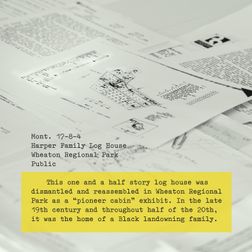
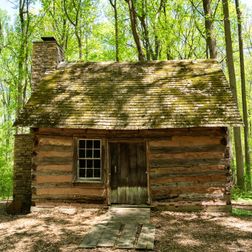
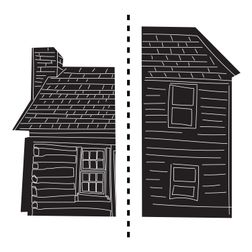
A one and a half story log cabin sits tucked in the woods at Brookside Nature Center in Wheaton, MD. Prior to 1976, this cabin was a two-story house built in the 1870s in the post-emancipation free Black community of Jonesville, MD. For decades, its true history went untold. Tony visits with museum supervisor, Shirl Spicer to discuss the cabin’s two lives and efforts made to present a more accurate history of the structure. This is the first in a series of four episodes that explore the history of the Harper Cabin at Brookside Nature Center in Wheaton, MD. Transcript available on episode webpage. Episode Webpage Show Website
1 of 2