
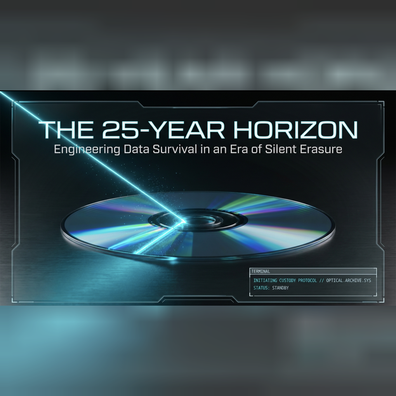
Episode notes
There is a kind of loss that does not announce itself. No fire. No headline. A tape deck stops tracking. A dye disc develops unreadable errors on its innermost tracks. A hard drive spins down in a drawer and never spins up. A photo service changes its terms, and the export path disappears. A cloud account sits dormant, invisible, until an automated policy—not a human decision—deletes it. A university lab migrates servers, and the graduate student's dataset is not on the list.
For most of my working life, I have been in the business of moving records out of that kind of custody. My career began where most preservation work actually begins: not in a vault, but wherever the last working reader still sat. Payphone rooms from the late 1970s onward, where I installed and maintained machines whose only record of a call was a paper tape, a coin box, or a line card that a later owner would throw out. Garage benches. Stacks of media that had already outlived the machine that wrote them. Later, the work moved to hard drives and digital accounts. The rooms changed. The failure did not.
The task was never to admire a format. It was to move a record onto something that could still be read before the window closed.
The digital age does not remember everything. It generates an enormous volume of data, retains a thin slice of it, and then fails, quietly, to keep even that slice. Two numbers have to be kept apart, because they are often collapsed into one slogan.
It is almost a certainty you are and will continue to lose your data: Images, videos, test and everything else, gone.
But there is something you can do..
Read more at: ReadMultiplex.com
Support this work by buying us a coffee: https://ko-fi.com/brianroemmele