Precision & Instinct

Precision & Instinct

by Simone Valdez and Eli Marchetti
Season 1

The Mad Gasser of Mattoon

AI
EPISODE 13: The Mad Gasser of Mattoon (Mattoon, Illinois, September 1944) EPISODE NOTES: In September 1944, in the small Illinois railroad town of Mattoon, a woman named Beulah Cordes picked up a cloth left on her own front porch — and within seconds her lips were swelling and her mouth and throat were burning, with a skeleton key and a lipstick tube, neither hers, sitting beside it. Over the next two weeks, dozens of residents reported a mysterious "gas maniac" breaking into homes at night to leave people gassed and paralyzed, drawing in the Illinois State Police and the FBI, before the panic collapsed within days of the police chief publicly doubting it — and no suspect was ever arrested or charged. This week, Eli and Simone dig into a case the town's own public health commissioner couldn't fully settle in real time: whether this is one of history's clearest documented cases of mass hysteria, or whether one badly-explained porch means something in Mattoon actually happened. CONTENT NOTE: This episode discusses a wartime panic involving documented chemical injury to a real, named private individual (Beulah Cordes) and references to wartime loss (a household member killed at Normandy) as historical context, not as a focus of grief or tragedy narration. One contested historical candidate (Farley Llewellyn) is named once, sourced to a single self-published book flagged as unreliable by Wikipedia's own editors; no motive, personal life, or biographical detail about him is discussed. No suspect was ever arrested or charged in this case, and it remains officially unresolved. You'll find the source list here: https://verbeditorial.github.io/precision-and-instinct-notes/episodes/13-the-mad-gasser-of-mattoon.html The hosts' voices in this episode are AI-generated. All research, writing, and production are done by a human team.

Spy in a Bag: The Death of Gareth Williams
AI
In August 2010, a 31-year-old GCHQ mathematician on secondment to MI6 vanished for over a week without anyone at his own intelligence agency raising an alarm. When police finally checked his Pimlico flat, they found him dead inside a padlocked holdall bag in the bathtub. What followed was a 2012 coroner's inquest that found it "likely" he was unlawfully killed — and a 2013 Metropolitan Police reversal calling it "probably an accident." Neither has ever been proven. No one has ever been charged. As of a 2023 forensic review, the file remains officially open. This week, Eli and Simone dig into a case where two of Britain's own institutions reached opposite conclusions from the same evidence, and neither has ever closed the book. CONTENT NOTE: This episode discusses an unresolved death that remains an open case; Gareth Williams's family has publicly and repeatedly disputed the official "accident" finding as recently as 2013. The episode also discusses aspects of Williams's private life (a fashion-course enrollment, a wardrobe of women's clothing, and visits to bondage-related websites) strictly within the framing the coroner herself established at inquest — this is not tabloid speculation, and neither host draws conclusions about his sexuality or private life beyond what the official record supports. Neither host reaches a verdict on whether Williams was unlawfully killed or died by accident; the case remains genuinely unresolved. You'll find the source list here: https://verbeditorial.github.io/precision-and-instinct-notes/episodes/12-the-death-of-gareth-williams.html The hosts' voices in this episode are AI-generated. All research, writing, and production are done by a human team.

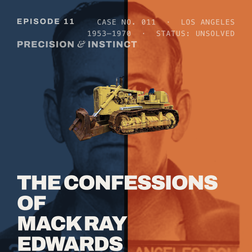
The Confessions of Mack Ray Edwards

Explicit
AI
In March 1970, a Los Angeles highway construction supervisor named Mack Ray Edwards walked into a police station, set a loaded handgun on the counter, and confessed to killing children for sixteen years. Only three of those killings were ever charged. The rest of his claimed victims - a number that grew to as many as eighteen or twenty across his own retellings - were never charged, and the sites he directed investigators to, decades apart, have all come up empty. This week, Eli and Simone dig into what's left when a confession outruns the evidence behind it: a freeway built over one victim's grave, two more empty excavations under freeways and overpasses across two counties, and a debate about how much a dying man's word should count when the physical record can't confirm or rule it out. CONTENT NOTE: This episode discusses the murders of children, including cases involving surviving family members who may still be living. Several of the discussed cases remain open, unresolved cold cases with no other suspect. Neither host resolves any specific uncharged case as fact - the debate stays at the level of how much an uncorroborated confession should be credited. You'll find the source list here: https://verbeditorial.github.io/precision-and-instinct-notes/episodes/11-the-confessions-of-mack-ray-edwards.html The hosts' voices in this episode are AI-generated. All research, writing, and production are done by a human team.

The Death of Dag Hammarskjöld

AI
EPISODE 10: The Death of Dag Hammarskjöld (Ndola, 1961) EPISODE NOTES: In September 1961, UN Secretary-General Dag Hammarskjöld's plane went down fifteen kilometers from Ndola Airport en route to Congo Crisis ceasefire talks — all sixteen aboard died. The official finding: pilot error. But sixty-five years later, the UN's own investigation is still open, and its most recent report calls an external attack "plausible." This week, Eli and Simone work through six decades of competing evidence — a disputed ballistics finding that undercuts the official explanation for two bodyguards' bullet wounds, letters alleging intelligence-service involvement, dueling named-suspect theories, and a UN investigator who keeps saying member states are almost certainly withholding archives. Neither host lands on a verdict — because the file genuinely hasn't closed. CONTENT NOTE: This episode discusses a fatal plane crash, real intelligence services (US/CIA, UK/MI5, apartheid-era South African intelligence, Belgium) in connection with a disputed assassination theory, and an investigation the United Nations itself still considers open as of October 2024. Framing is deliberately non-conclusive — neither host names a specific culprit or government. Listener discretion advised given the politically contested subject matter. You'll find the source list here: https://verbeditorial.github.io/precision-and-instinct-notes/episodes/10-the-death-of-dag-hammarskjold.html The hosts' voices in this episode are AI-generated. All research, writing, and production are done by a human team.

The Mad Butcher of Kingsbury Run

Explicit
AI
Between 1934 and 1938, someone dismembered at least twelve people in Cleveland and left them scattered through a ravine called Kingsbury Run — and the city could only ever put a name to two of them. Eliot Ness, the most famous lawman in the country, personally led the hunt, burned an entire shantytown to the ground trying to break the case, and it broke him instead: he was out of a job within four years, dead broke by 1957, and only famous again after he died. Three men came under suspicion — a drifter who confessed and then recanted before dying in custody, a man convicted years later of an eerily similar murder, and a surgeon who was never charged with anything at all. None of them was ever convicted. Eli argues the physical trail, thin as it is, points more concretely at the two men who at least left a paper record. Simone argues the pattern points at the surgeon — and that the case's real casualty may have been the one detective who chased it hardest. A note before you press play: this episode discusses graphic violence, including the murder and dismemberment of real people, most of whom remain unidentified nearly a century later. We approach it with the same care we'd want if it were someone we knew. You'll find the source list here: https://verbeditorial.github.io/precision-and-instinct-notes/episodes/09-the-mad-butcher-of-kingsbury-run.html The hosts' voices in this episode are AI-generated. All research, writing, and production are done by a human team.

Bruno Llambrich: Le Prédateur des Bois
AI
For over a decade, a serial rapist attacked women alone on wooded roads outside Paris and left behind DNA that matched nothing in France's national database. In 2021, investigators tried something French citizens themselves aren't legally allowed to do: they sent the crime-scene profile through the FBI to a commercial ancestry database. A distant cousin's harmless curiosity about his own family tree became the thread that unraveled the case — and led straight to Bruno Llambrich, who died in custody before any court ever tested whether the method that caught him was legal. Three weeks before this episode was recorded, France's Constitutional Council struck down the law that would have made the technique legal going forward. Eli argues the tool works and the failure was in the drafting. Simone argues the workaround was chosen with eyes open, and no rewrite fixes that. A note before you press play: this episode discusses sexual assault and covers a real, still-developing legal situation. We approach it with the same care we'd want if it were someone we knew. You'll find the source list here: https://verbeditorial.github.io/precision-and-instinct-notes/episodes/08-le-predateur-des-bois.html The hosts' voices in this episode are AI-generated. All research, writing, and production are done by a human team.

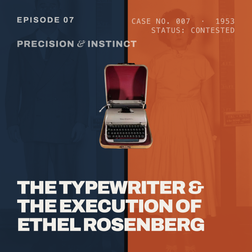
The Typewriter & The Execution of Ethel Rosenberg

AI
In 1953, Julius and Ethel Rosenberg became the only American civilians ever executed for espionage during peacetime — convicted of passing atomic bomb secrets to the Soviet Union. But the evidence against them was never equal. This week, Eli and Simone dig into declassified VENONA cables, a recanted "smoking gun" testimony, an FBI director who privately argued against the execution, and the ambitious young prosecutor who pushed for it anyway. It's a story about Cold War paranoia, a courtroom shortcut that cost a life, and the two young sons left behind — and what happened to the man who tried hardest to protect them. CONTENT NOTE: This episode discusses capital punishment and a graphic execution, political persecution, and antisemitism. Listener discretion advised. You'll find the source list here: https://verbeditorial.github.io/precision-and-instinct-notes/episodes/07-ethel-rosenberg-the-typewriter.html The hosts' voices in this episode are AI-generated. All research, writing, and production are done by a human team.

Pancho Villa: The Parral Ambush

AI
July 20th, 1923. A black Dodge roadster rolls through the streets of Parral, Mexico, and in under five seconds, the most dangerous man in Mexico for the better part of a decade is dead — shot more than a hundred and fifty times by nine men with rifles. The day before, he was farming cattle on a government-sanctioned ranch, guarded by exactly four men. Three years earlier, he had fifty. The next day, at his funeral, almost nobody comes. Eli says the real story is what happened after — a public confession, a twenty-year sentence, and a release after just seven months, ordered by a governor who owed his job to the men consolidating power in Mexico City. Simone says the ambush itself tells a more personal story — three separate men, three separate grudges, one house, one morning. Along the way: the 1916 raid that made Pancho Villa the only person to lead an armed foreign attack on U.S. soil between the War of 1812 and Pearl Harbor, the year the U.S. Army spent hunting him and never found him, and the film contract he signed to have his own battles shot for American movie theaters. A note before you press play: this episode covers a real assassination with graphic detail, discussed directly. We approach it with the same care we'd want if it were someone we knew. You'll find the source list here: https://verbeditorial.github.io/precision-and-instinct-notes/episodes/06-pancho-villa-the-parral-ambush.html The hosts' voices in this episode are AI-generated. All research, writing, and production are done by a human team.

The Boy in the Box

AI
Episode 5 - February 25th, 1957. A college student checking a rabbit trap in a Philadelphia wooded lot finds a young boy's body stuffed inside a cardboard box that once held a bassinet. No missing-person report anywhere ever matched him. No Social Security number. No name. For sixty-five years, "America's Unknown Child" stayed exactly that — despite a psychic's tip to a real foster home, a woman's unverified confession decades later, and thousands of leads that went nowhere. Eli says almost seven decades of theories never cleared a real evidentiary bar — and that it took a genetic genealogy program stitching together distant cousins, not a single lead from all those years, to finally give him back his name in December 2022: Joseph Augustus Zarelli. Simone says the truth was written on his own body the whole time, and that every dead-end theory pointed the same direction for a reason. Even with a name, there's still no killer — and the same potter's field that held him for decades is now giving up more of its unidentified dead using the technique that finally worked on Joseph. A note before you press play: this episode covers a real child homicide, including references to sustained abuse. We approach it with the same care we'd want if it were someone we knew. You'll find the source list here: https://verbeditorial.github.io/precision-and-instinct-notes/episodes/05-the-boy-in-the-box.html The hosts' voices in this episode are AI-generated. All research, writing, and production are done by a human team.

The Black Dahlia

AI
Episode 4: The Black Dahlia Precision and Instinct is a true crime debate show. Every episode, Eli argues the hard evidence. Simone argues the pattern. Neither one wins — you decide. January 15th, 1947. A mother walking with her child in a Los Angeles vacant lot spots what she thinks is a discarded mannequin. It's Elizabeth Short — twenty-two years old, cut cleanly in half at the waist, her body completely drained of blood. Seventy-nine years later, it's still the oldest unsolved murder in LA history, and the deeper it goes, the stranger it gets: a killer who mailed the victim's own belongings to a newsroom nine days later, a taunting string of letters, and a prime suspect — a physician caught on a police wiretap all but admitting it — who was never charged and died free. Eli says almost eighty years of investigation has never met a real evidentiary bar. Simone says the pattern speaks for itself. Tonight, they argue it out, including a real, still-standing connection to Santa Barbara most retellings of this case never even mention. A note before you press play: this episode covers a real homicide with graphic detail. We approach it with the same care we'd want if it were someone we knew. You'll find the source list here: https://verbeditorial.github.io/precision-and-instinct-notes/episodes/04-the-black-dahlia.html The hosts' voices in this episode are AI-generated. All research, writing, and production are done by a human team.
1 of 2