Pod Mag

Pod Mag

by Christoph Ericsson
Season 1

Issue No. 13 — We've Been Here Before

AI
This week: the Democratic Republic of Congo's 17th Ebola outbreak since 1976 — and, for once, real signs it's slowing. Typhoon Dujuan shuts down Japan's bullet trains. Seventy-seven delegations walk out on Netanyahu at the UN, in a ritual nobody was surprised by. Stanford finds your brain is actually two ancient nervous systems stapled together. And a guy scouting a Quebec campsite accidentally discovers a 390-million-year-old impact crater. The cover story asks the question of the week: if we already know how this ends, why do we always start over? Financial crashes, wildfire policy, locust plagues, and a dismantled pandemic office all say the same thing. Plus: Society Pages roasts a pension fund, the Review covers Fire Weather, and — five issues late — THE WHEEL finally spins for real.

Issue No. 12 — Who Checks the Checker

AI
When two sides both swear they're right, who actually gets to check? This week: a Gaza City building collapse with dueling accounts of what struck it, a Los Angeles news helicopter crash, a disputed drone over Mecca, and a black hole blasting out winds 100 times stronger than we thought. The buried lede: the Pentagon just handed its own UFO whistleblowers a legal waiver to finally talk. The cover story spans three centuries of verification — Newton grading his own homework, a 1919 eclipse that settled Einstein fair and square, and the fastest debunking in modern science. Plus: the 41-year hoax hiding in a British gravel pit, a CEO's very bad math, and a podcast recommendation that reads the transcripts so you don't have to.

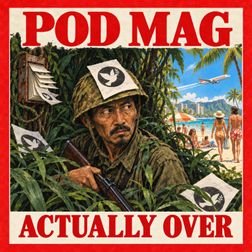
Issue No. 11 — Actually Over

AI
This week the world declared three different things over, and none of them were. The US-Iran war hit day 195 with its biggest naval escalation yet — tankers sunk, ships struck, a ceasefire that's been pronounced dead more times than we can count. Hurricane Lowell never made landfall in Hawaii and still tore the islands apart. OpenAI says its AI solved a 90-year-old math problem; the one institute with the authority to say so isn't talking. Plus: the Devil's Arrows finally get their real origin story after 4,000 years, a Cabinet secretary's own lawyers contradict his sworn testimony, and the true story of a soldier who fought a war 29 years after everyone else agreed it had ended. No ads, no sponsors — just the news, straight, with the bark on.

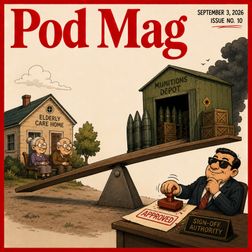
Issue No. 10 — Too Close

AI
Double digits, folks — Issue Ten. This week: the Nepal-Tibet flood toll climbs past eleven hundred, and a Kyiv ammunition depot kills thirty-seven people, thirty-four of them residents of the care home next door. Two disasters, one question: how close is too close, and who actually signs off on the distance? The cover story digs through three ammonium-nitrate catastrophes — Texas City, Beirut, and small-town Texas — that all share the same shape. The feature tells you about the Halifax dispatcher who spent his last eighteen minutes trying to warn strangers he'd never met. Plus: a US-Venezuela oil deal, right-curling snake embryos, a 4,000-year-old sealed love letter finally read, and a podcast pick about a bridge that was "screaming" it would fail.

Issue No. 7 — Off-Label

AI
Who decides what a thing is for — the person who built it, or the person holding it? This week: the Colombia earthquake and the count nobody agrees on; Ebola's grim milestone in the Congo; the off-ramp closes between Washington and Tehran; and NASA buys Voyager 2 a year of life with two heaters and a tape recorder from 1977. Plus: Kyoto University drafts 1,200 Starlink satellites into science without asking, a weapons system that became the world's clock, a phone antenna that found the beginning of the universe, the fifth-grade dropout who invented your microwave, and a superyacht that forgot the one job every ship has. Reporting up front, opinion in the back, and the tuba has moved.

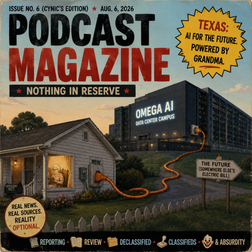
Issue No. 6 — Nothing In Reserve

AI
A country runs out of interceptors. A hospital runs out of beds. A grid runs out of margin. This week Podcast Magazine asks the least glamorous question in the world: what are you keeping in reserve, and who decided you didn't need it? On the front page — seventeen dead in Kyiv and not one missile stopped; the Congo outbreak becomes the second largest ever recorded; six thousand cubic kilometres of magma hiding under Tuscany; immune cells that kill by exploding; and a buried lede about Texas, four hundred and seventy-four gigawatts, and a grid being auctioned off to a chatbot. Plus: the letter that saved Britain by refusing to help, a two-thousand-year-old Chinese grain policy that ended up in American federal law, and a podcast recommendation about a seawall that wasn't tall enough. Reporting up front, opinion in the back, corrections in the open.

Issue No. 5 — The Off-Ramp

AI
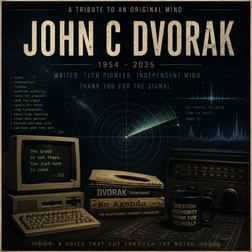
How do you stop a thing once it's started? This week: the DRC Ebola outbreak passes 1,400 dead even as Uganda declares itself Ebola-free, a fragile US–Iran strike pause holds for two days, 300,000 people flee wildfires across France and Spain and nearly all make it out, and Pogačar wins a fifth Tour de France on a course the fires cut short. Plus a Bronze Age "town that stopped" in Northern Ireland, and The Number: 42. Our cover story visits three times humanity actually pulled off the stop — the Cuban Missile Crisis, smallpox, and the ozone layer — the feature is the Kuwaiti oil fires and the tank with jet engines bolted on, and the review is Norman Maclean's Young Men and Fire. We close with a heartfelt goodbye to John C. Dvorak. Reporting up front, opinion in the back, and the commerce is fake.

Issue No. 4 — The Thing Hiding in Plain Sight
AI
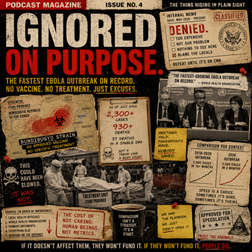
How do you find the thing that's hiding in plain sight? This week: the fastest-growing Ebola outbreak on record in the DRC, the sharp escalation between Russia and Ukraine, and — looking up — a giant planet the Webb telescope found without ever seeing it, detected purely by its chemical fingerprint. Our cover story traces the art of detecting the invisible, from finding Neptune with a pencil to Pauli's ghost particle to dark matter. The feature is Ignaz Semmelweis, the doctor who spotted an unseen killer and was destroyed for being early. Plus a new Corrections desk, a new celebrity desk skewering the World Cup's halftime spectacle, and a Podcast Feature on 99% Invisible's "Structural Integrity." Reporting up front, opinion in the back, and the commerce is fake.

Issue No. 3 — The Archaeology of a Bad Day

AI
Almost everything we know about the past survived by accident, and most of the accidents were catastrophes. This issue asks: what do we only learn when something breaks? The cover story reads history as a stain — Pompeii, the Burgess Shale, a bog man with stubble still on his chin — and the feature dives to the wreck that hid a two-thousand-year-old Greek computer nobody believed could exist. Up front, covered straight: the Bangkok bar fire and the nine hundred heat deaths the Netherlands counted in a spreadsheet. Plus a magnificent dinosaur cold case, Argentina breaking England's heart on schedule, and a Deep Cut about a Roman dinner service at the bottom of a Swiss lake. New this release: a closing theme, a tuba, and one quiet thank-you to the people who invented this medium. In the morning. Worth pausing on one editorial call from the run, because it was the right one: the number 33 genuinely appeared this week — as the Bangkok death toll — and the host deliberately withheld the numerology bit rather than attach it to a tragedy. The guardrails held under their first real test.

Issue No. 2 — Who's Flying the Plane?
AI
In 1914, Lawrence Sperry flew past the judges in Paris with his hands off the controls — and his mechanic standing on the wing. A hundred and twelve years later, we're still asking the same question: who's flying the plane? In this issue: the empty cockpit, from dead man's switches to the Soviet "Dead Hand" to Stanislav Petrov, the one guy who caught it. Plus the week's front page — Iran, a newborn magnetar caught "chirping," the first AI ransomware that runs itself, World Cup officiating drama — and a Deep Cut nobody's covering: a 1952 flying-saucer briefing film headed to Congress. New voice, by the way. Same guy, new larynx. We featured Tim Harford's Cautionary Tales in our first Podcast Feature — nobody paid, they don't know we exist. That's how you know it's real.
1 of 2