Playful Beginnings

Playful Beginnings

Video Podcast
by Maggie Parker and Kristie Opiola

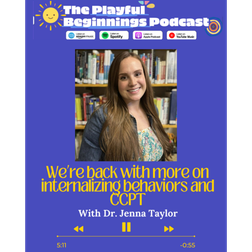
Child Centered Play Therapy and Internalizing Behaviors: With Dr. Jenna Taylor

Listen in to hear more from Dr. Jenna Taylor on children who experience internalizing behaviors. Dr. Taylor engaged in a large meta-analysis to better understand the effect of CCPT on children who experience anxiety, depression, social withdrawal, among others. Listen in to learn more about how to speak with parents and teachers about childhood depression and anxiety, how internalizing behaviors can present in the school setting and at home, and how CCPT can benefit!
Season 1

Play Therapy Week!

Bonus
In this episode, Kristie and Maggie share their activities for Play Therapy Week, as well as some "aha" moments from the playroom!

What is play therapy anyways?

Maggie and Kristie share how they explain play therapy, how it aligns with child development, and the importance of the relationship. Listeners will gain a greater understanding of what play therapy is, how it aligns to adult therapy, and some of the differences between being a play therapist and someone who works with children.

How we got to play therapy

Kristie and Maggie explore what initially spiked their interest in play therapy. They share their experiences in school, how it facilitated their perspective of children, and meaningful experiences in play therapy. Maggie and Kristie share stories of their first play sessions as well as the ones that really showed the power of play for children. This episode will help listeners understand what play therapy is, why it is important, and how it assists children in their healing journey. Whether you want to be a play therapist or you are wondering if your child should go to play therapy, this episode will share the magic of play therapy.

Beyond toys, let's talk the room

In this episode, Kristie and Maggie discuss their ideal playroom, what the room would look like, and do a deep dive into their thought processes and rationale for including and excluding items such as tents, puppet theaters, and rugs. We also discuss how to adapt rooms to meet the child's needs- and how you can adapt any space into a play therapy space- because we've done it all! From janitors closets to making our own kitchens out of refrigerator boxes, we explore ways to provide space and materials for children to express themselves fully.

Play therapy toys: What like they matter?
In this episode, Maggie and Kristie explore the categories of toys in a Child Centered Play room and their reasonings for being included. They discuss ways to set up the toys and the purpose behind each category and type of toy. This episode can assist play therapists and professionals interested in setting up their own playroom or those who want to adapt theirs to Child Centered. This episode can also help parents better understand what Play therapy is and how their kids play in the space.

What we do in the playroom

Within this episode, Kristie and Maggie explain what play therapists due in the room and how that helps children heal and grow. Examining the different skills used, the ways in which children bring in what they are struggling with, and the theory behind their approach, Kristie and Maggie will help parents, teachers, and future play therapists gain a better understanding of how and why play therapy works.

Limit Setting and Boundaries in the Playroom: It's not a free for all
Within this episode, Maggie and Kristie tackle a common misconception about play therapy. Even though Maggie and Kristie are permissive and trust the child in the play therapy space, there are limits as to what can be done in the playroom. Maggie and Kristie explain when and how to set limits on children's behavior and give examples from their own experiences in play therapy and parenting. Limits can really help adults engage meaningfully with children, connecting to the child's inner experience, and allowing the child to bring themselves under control.

Child Development and How it Impacts the Way We Show Up
In this episode, Kristie and Maggie explore common struggles of play therapists, students, and supervisees as to how to engage with children in a wide range of ages using Child Centered theory. Many people believe they must change out of child centered theory to engage with older children. Kristie and Maggie explore how they adapt their use of Child Centered to meet the needs of different developmental levels and how they assess when to adapt. This episode can be helpful for play therapists who are working with older children and are not sure how to engage, as well as for parents and teachers who may not be aware of different developmental needs of children across developmental levels.

Trust the Process: What to do when you feel stuck

Listener Sarah H. asked us to explore how Kristie and I remain true to CCPT, even when we feel stuck. Many times, play therapists want to "add in" activities and directives when they feel stuck. Kristie and Maggie examine how they handle these situations and provide guidance as to how others can adapt/engage when feeling stuck!
2 of 11