
Episode notes
When does being understanding quietly become giving in?
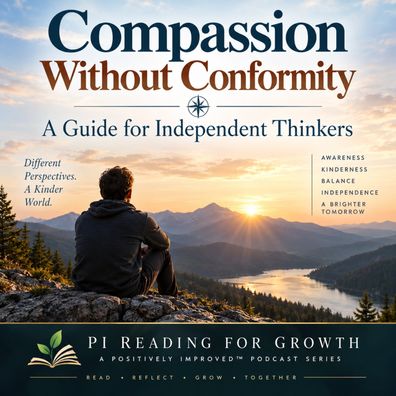
In this episode of Compassion Without Conformity: A Guide for Independent Thinkers, we explore the subtle social and emotional pressures that can cause compassion to become confused with agreement.
Conformity rarely arrives as a direct demand. More often, it appears through small signals: the warmth that follows agreement, the tension created by a different perspective, the desire to keep the peace, or the fear that speaking honestly might threaten belonging. Over time, these experiences can teach us to silence ourselves before anyone explicitly asks us to.
This episode examines the emotional cost of that pattern. Repeated accommodation can create exhaustion, resentment, self-doubt, and a growing distance between what we genuinely think and what we are willing to express.
We also explore an important distinction: choosing not to express every disagreement is not the same as self-silencing. Sometimes restraint is thoughtful and intentional. The question is whether silence comes from genuine choice or from fear of what honesty might cost.
Through the Recognize movement of the Positively Improved™ 5R Methodology, we begin noticing these patterns without immediately judging or trying to change them.
Awareness allows us to ask better questions.
Is my agreement genuine or performed?
Is my silence intentional or driven by fear?
Am I reconsidering my perspective because I have learned something new, or abandoning it because disagreement feels uncomfortable?
And does the peace I am maintaining include peace within myself?
Compassion without conformity does not require becoming argumentative, rigid, or unwilling to change. It allows us to listen, reconsider, disagree, establish boundaries, and even change our minds while remaining connected to our own discernment.
Because understanding another person does not require surrendering yourself.
In this episode, you’ll explore:
- How social pressure can quietly turn compassion into conformity
- The difference between thoughtful restraint and self-silencing
- Why repeated accommodation can create resentment and emotional exhaustion
- How conformity can gradually weaken trust in your own judgment
- Why understanding another person does not require endorsing their perspective
- How the Recognize movement of the 5R Methodology helps reveal hidden patterns
- Why healthy compassion must include consideration for your own well-being
- How disagreement and genuine connection can coexist
Series: Compassion Without Conformity: A Guide for Independent Thinkers
PI Reading for Growth is a Positively Improved™ podcast series exploring self-awareness, emotional resilience, relationships, healing, and intentional personal growth.
Tags: Compassion Without Conformity, Independent Thinking, Compassion, Conformity, People Pleasing, Self-Silencing, Self-Awareness, Emotional Resilience, Healthy Boundaries, Self-Trust, Relationships, Personal Growth, 5R Methodology, Positively Improved, PI Reading for Growth