
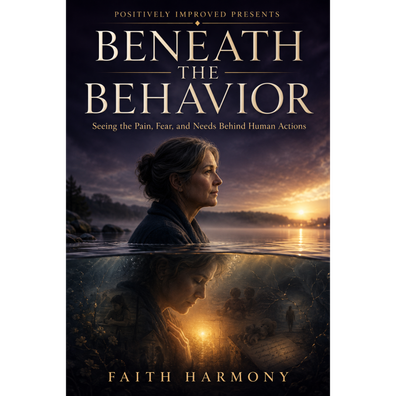
Episode notes
Can compassion help us see a painful situation more clearly?
In this episode of Beneath the Behavior, we examine how hurt can create an emotional fog that causes us to take another person’s actions as a verdict on our worth. Compassion helps widen our perspective, while clarity helps us decide what the situation requires.
Compassion does not ask us to ignore harmful behavior, abandon our needs, or accept unhealthy patterns. It helps us consider what may be happening beneath another person’s reaction so we can respond thoughtfully rather than being controlled by raw emotion.
We also explore the radical importance of self-compassion. When we judge ourselves relentlessly, that judgment eventually affects how we relate to the people around us. Self-compassion allows us to examine our mistakes honestly, take responsibility, repair what we can, and grow without turning one harmful choice into a permanent identity.
In this episode, we explore:
- How hurt can distort the way we interpret another person’s behavior
- Why compassion can restore rather than weaken our clarity
- The partnership between compassion and healthy boundaries
- How understanding context creates more thoughtful options
- Why another person’s behavior is not a verdict on our worth
- How resentment keeps us emotionally connected to painful moments
- The difference between self-compassion and self-indulgence
- Why harsh self-judgment can make honest accountability more difficult
- How the inner critic may have developed as a form of protection
- Why self-punishment and genuine repair are not the same
- How compassion and accountability work together to support growth
- What it means to care without carrying or abandoning ourselves
Questions for reflection:
- What conclusions about your worth do you draw from other people’s behavior?
- How might compassion help you see a difficult situation more clearly?
- Where do you need both understanding and a stronger boundary?
- How do you speak to yourself after making a mistake?
- Would you use the same language with someone you deeply care about?
- What emotion might self-criticism be helping you avoid?
- How could you accept responsibility without turning the mistake into your identity?
- What might change if you stopped treating self-criticism as the price of personal growth?
Compassion gives us the wider context.
Clarity helps us decide what comes next.
Self-compassion reminds us that we can acknowledge harm, make repairs, and learn without dehumanizing ourselves in the process.
PI Reading for Growth is presented by Positively Improved™ and created to support greater self-awareness, emotional healing, and intentional personal growth.
Namaste.