Ontario & Alberta May Be Paving The Way For A Modernized National Energy Grid
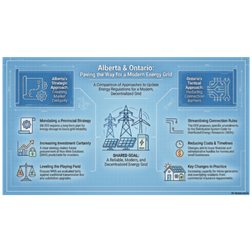
Two regulatory shifts, 3,000 kilometers apart, look like standard provincial energy moves. But when you connect the dots, these two seemingly separate strategies are secretly building the foundation for a national battery grid designed to trade the most expensive commodity: peak demand energy. Welcome to the deep dive, where we investigate how policy is leading the market toward a coordinated national energy future based on stored energy. We unpack two distinct policy stacks: Alberta’s private member’s Bill 203, and granular proposals from the Ontario Energy Board (OEB). In the West, Alberta is focusing on large-scale supply certainty. Bill 203, the Energy Storage Planning for Investment Act, legally mandates a long-term strategy for deploying energy storage, making it a regulated system-level priority over traditional “wire infrastructure”. To attract the necessary multi-billion dollar capital, the bill dramatically de-risks investment by utilizing two key mechanisms: the Regulated Asset Base (RAB), which guarantees a stable, regulated return by classifying storage as essential utility infrastructure, removing speculation risk; and Non-Wire Services contracts, which guarantee revenue streams for providing capacity and ancillary services, not just selling electrons. Meanwhile, in the East, Ontario is perfecting its grid as an efficient receiving dock for decentralized energy. The OEB proposals aim to dismantle small regulatory barriers to get more Distributed Energy Resources (DERs), like solar and battery storage, onto the grid quickly. Key changes include raising the micro-embedded generation limit from 10 kW to 12 kW to accommodate modern residential systems combining solar, batteries, and Vehicle-to-Grid (V2G) systems; and removing the million-dollar commercial general liability insurance requirement for residential customers. Additionally, the OEB is standardizing processes, broadening technical standards, and providing certainty for Connection Impact Assessment timelines. The synchronization of these policies suggests a shared vision: Alberta is building the massive, stable supply of stored energy, and Ontario is making its distribution system the most receptive environment in the country. This coordination is laying the groundwork for future high-capacity interconnections to efficiently trade this high-value, peak-responsive capacity, shifting the focus of national energy trade from inflexible base load power to strategic, stored electrification.